
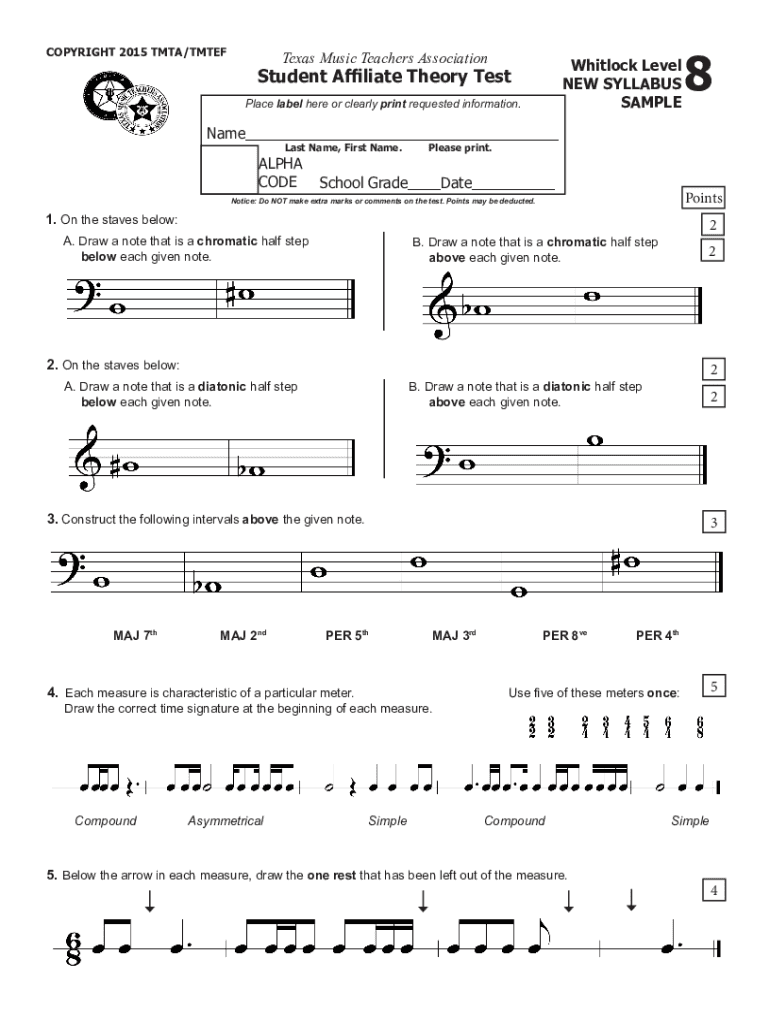







Definition & Meaning
The Texas Music Theory Test is an evaluative form administered by the Texas Music Teachers Association to assess a student's understanding of music theory. Primarily designed for students who are members of the TMTA Student Affiliate program, the test evaluates proficiency in various elements of music theory, providing a benchmark for both educators and learners to understand strengths and areas for improvement.
Purpose and Importance
- Educational Benchmark: It serves as a critical tool for measuring the theoretical understanding of music students.
- Progress Tracking: The test allows educators and students to track progress over time, setting goals for further learning.
- Certification: Successful completion and high scores can often serve as a certification of proficiency in music theory for students.
How to Use the Texas Music Theory Test
The Texas Music Theory Test is meant to be an evaluative instrument, generally used as part of a structured music education program.
Application in Learning
- Preparation Material: Students should prepare using recommended music theory syllabi and resources from the TMTA.
- Test Environment: It is often administered in a formal setting, ensuring that the conditions are conducive to accurate assessment.
Result Utilization
- Feedback: Educators can use the results to give personalized feedback to students.
- Curriculum Adjustment: Educators may modify the teaching approach depending on the outcomes, focusing on weaker areas.
How to Obtain the Texas Music Theory Test
The Texas Music Theory Test is provided through the Texas Music Teachers Association and can typically be accessed through local music teachers or educational institutions associated with the TMTA.
Access Process
- Registration: Students must register with a TMTA-affiliated teacher.
- Enrollment in the Program: Participation in the Student Affiliate program is necessary.
- Request through Teacher: Tests are generally obtained and administered by registered music teachers.
Steps to Complete the Texas Music Theory Test
Completing the Texas Music Theory Test requires careful preparation and understanding of the process.
Preparation Steps
- Study Materials: Utilize TMTA-provided resources and similar educational materials.
- Practice Tests: Engage in practice exams to familiarize with the test format.
During the Test
- Time Management: Ensure awareness of time limits to complete sections efficiently.
- Answer Strategies: Use a balanced approach between speed and accuracy to enhance performance.
Important Terms Related to Texas Music Theory Test
Understanding key terms is essential for effectively navigating the Texas Music Theory Test.
Common Terms
- Tonic: The first scale degree of a diatonic scale and the tonal center or final resolution tone.
- Cadence: Sequence of chords that brings an end to a phrase, either in the middle or the end of a composition.
- Interval: The difference in pitch between two sounds.
Technical Terminology
- Modulation: The process of changing from one key to another.
- Chords: Basic constituents of harmonic structure in a piece, consisting of multiple notes played simultaneously.
Key Elements of the Texas Music Theory Test
The Texas Music Theory Test encompasses various core elements essential for thorough assessment.
Core Sections
- Notation and Symbols: Understanding of musical notations and score reading.
- Scales and Modes: Knowledge of various scale types and modes, both major and minor.
Advanced Topics
- Harmony and Chord Progressions: Explores relationships between chords and their progression in music.
- Rhythmic Patterns: Involves identifying and replicating rhythmic patterns.
State-Specific Rules for the Texas Music Theory Test
While the TMTA governs the Texas Music Theory Test, there are specialized rules and guidelines specific to the state.
Compliance Requirements
- Statewide Standards: Abides by educational standards set for music education in Texas.
- Local Guidance: Utilizes input from local educators to ensure that the test remains relevant and effective.
Adaptations
- Evolution: The test evolves in response to changes in local educational requirements and feedback from educators.
Examples of Using the Texas Music Theory Test
Real-world applications of the Texas Music Theory Test can highlight its utility and impact.
Practical Scenarios
- Educational Advancement: Used by music programs to assess progress and qualify students for advanced classes.
- Competitions and Scholarships: Serves as a qualifying tool for students aspiring to win music competitions or scholarships.
Case Studies
- Music Schools: Many music schools employ the test to enhance educational outcomes and tailor curricula to student needs.
- Student Success Stories: Documented improvements in students' theoretical knowledge and practical skills following consistent use of the test.




