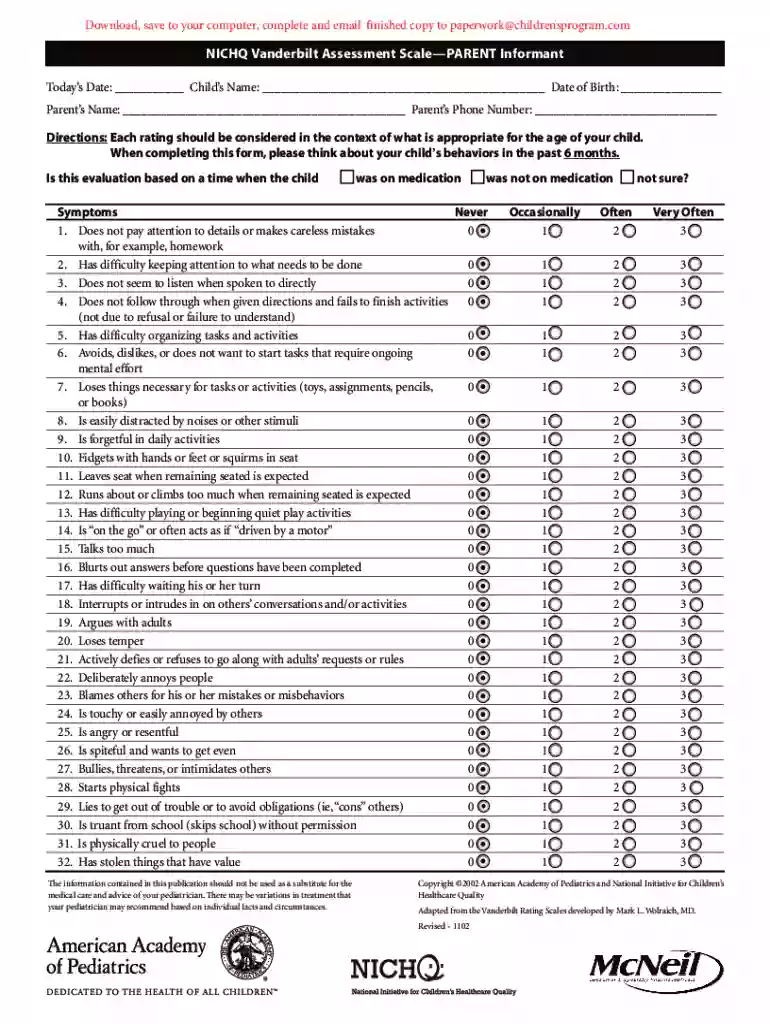
NICHQ Vanderbilt Assessment Scale Parent Informant 2026

Get Form
NICHQ Vanderbilt Assessment Scale Parent Informant Preview on Page 1

Here's how it works

01. Edit your form online
Type text, add images, blackout confidential details, add comments, highlights and more.

02. Sign it in a few clicks
Draw your signature, type it, upload its image, or use your mobile device as a signature pad.

03. Share your form with others
Send it via email, link, or fax. You can also download it, export it or print it out.

Definition & Purpose of the NICHQ Vanderbilt Assessment Scale Parent Informant

The NICHQ Vanderbilt Assessment Scale Parent Informant is a standardized tool used primarily to assess behavioral and emotional conditions in children, often in relation to Attention Deficit Hyperactivity Disorder (ADHD). This scale serves both as a diagnostic aid and a way to track behavioral progress or symptom changes over time. Developed by the National Institute for Children’s Health Quality (NICHQ), it’s designed to gather comprehensive input from parents, providing a well-rounded perspective on the child's behavior at home and in daily life. This tool is critical for healthcare providers making informed decisions regarding a child's mental health care plan.

How to Use the NICHQ Vanderbilt Assessment Scale Parent Informant

  1. Initial Setup: Begin by obtaining a copy of the scale from a healthcare provider or trusted source. Make sure the form is the most recent version.
  2. Completing the Scale: Answer each question based on your child's behavior over the past six months. Typical questions may address academic performance, interpersonal relationships, and specific behavioral symptoms.
  3. Observation & Recording: Detailed observations of the child’s behavior should be noted. It's important to be as honest and thorough as possible to ensure the accuracy of the scale’s results.
  4. Professional Review: Once completed, submit the assessment to your child's healthcare provider who will interpret the results in the context of a broader diagnostic evaluation.

Steps to Complete the NICHQ Vanderbilt Assessment Scale Parent Informant

  1. Preparation: Gather any past reports or notes about your child's behavior that might assist in completing the scale.
  2. Identify Additional Observers: If applicable, consider input from others who interact closely with the child, such as teachers or therapists, to provide a more robust view of their behavior.
  3. Review Each Question: Carefully read each item on the form, considering examples from real-life situations to guide your responses.
  4. Score the Responses: Use the scoring instructions provided to evaluate each section, which may involve rating symptoms on a numerical scale or selecting frequency bands.
  5. Consult a Professional: Discuss your filled form with a healthcare provider to receive an expert analysis and next-step recommendations, including potential interventions or therapies.

Key Elements of the NICHQ Vanderbilt Assessment Scale Parent Informant

  • Behavioral Symptoms: Covers domains such as hyperactivity, inattentiveness, impulsiveness, and mood dysregulation.
  • Performance Ratings: Includes assessments of academic and social performance, such as interactions with peers and adaptation to classroom settings.
  • Parental Observations: Gathers subjective data from parents regarding typical challenges faced and symptomatic behaviors observed.
  • Scoring Instructions: Provides a clear guideline for calculating scores, enabling consistent evaluation across different users and settings.

Why Use the NICHQ Vanderbilt Assessment Scale Parent Informant

Utilizing this scale helps in the identification and management of potential ADHD or similar behavioral disorders in children. The tool is valuable for its ability to:

  • Accurate Diagnosis: Aid in forming a reliable diagnosis by compiling data regarding both home and social behaviors.
  • Treatment Planning: Inform treatment plans tailored to the child's specific needs, based on documented behavioral trends.
  • Progress Monitoring: Track symptom evolution over time, helping to assess the effectiveness of implemented interventions.

Important Terms Related to NICHQ Vanderbilt Assessment Scale Parent Informant

  • Hyperactivity: Excessive movement and restlessness.
  • Inattentiveness: Lack of focus and difficulty maintaining attention.
  • Impulsiveness: Rash actions and decisions without considering consequences.
  • Emotional Dysregulation: Difficulty in managing emotional responses appropriately.

Who Typically Uses the NICHQ Vanderbilt Assessment Scale Parent Informant

The scale is most frequently utilized by:

  • Pediatricians: To monitor and diagnose potential behavioral disorders.
  • Psychologists and Psychiatrists: For comprehensive mental health assessments.
  • Parents and Caregivers: To provide essential input on the child’s behavior from close observations.
  • Educators: To collaborate with medical professionals by identifying behavior patterns that might not be apparent in a clinical setting.
decoration image ratings of Dochub

Examples of Using the NICHQ Vanderbilt Assessment Scale Parent Informant

For example, a parent noticing their child’s difficulty in completing homework might use the scale to quantify these observations. Similarly, a teacher could supplement a child's assessment with insights into classroom behavior, allowing for a holistic view of the child’s behavioral challenges that aid targeted intervention.

Legal Use of the NICHQ Vanderbilt Assessment Scale Parent Informant

The scale is intended for use with the guidance of qualified healthcare professionals. It ensures compliance with legal requirements for confidentiality and privacy regarding the child’s mental health records, adhering to standards like the Health Insurance Portability and Accountability Act (HIPAA). Proper use within medical and educational contexts supports ethical practices and contributes to better outcomes in child mental health care.

be ready to get more

Complete this form in 5 minutes or less

Get form

Security and compliance

At DocHub, your data security is our priority. We follow HIPAA, SOC2, GDPR, and other standards, so you can work on your documents with confidence.

Learn more
ccpa2
pci-dss
gdpr-compliance
hipaa
soc-compliance