
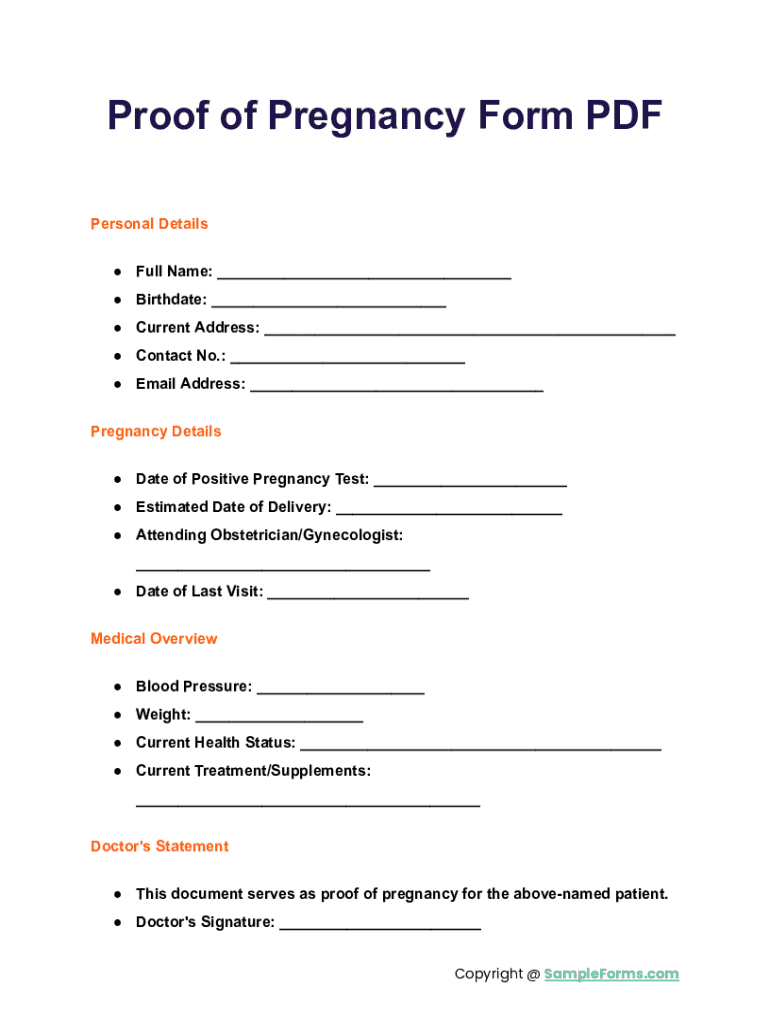







Definition and Meaning of the Proof of Pregnancy Form
The Proof of Pregnancy Form is a document used to verify a pregnancy medically, typically required for various bureaucratic processes. This form serves as official confirmation from a healthcare provider about an individual's pregnancy status. Although the purpose and content may slightly vary depending on specific institutional requirements, the core objective remains the same: to authenticate a pregnancy claim for legal or welfare purposes.
Importance of the Proof of Pregnancy Form
- Healthcare Services: An essential step in accessing prenatal care services and planning procedures.
- Employment Accommodations: Necessary for requesting maternity leave or workplace accommodations under the Family and Medical Leave Act (FMLA).
- Insurance Claims: Required to confirm pregnancy to access specific health insurance benefits.
- Welfare Programs: Used to access government assistance programs designed for expecting mothers, like the Women, Infants, and Children (WIC) program.
How to Obtain the Proof of Pregnancy Form
Obtaining this form typically involves visiting a licensed healthcare provider who can verify and document the pregnancy.
- Schedule an Appointment: Arrange for a consultation with a licensed healthcare provider.
- Medical Examination: Undergo a pregnancy test if not already confirmed, often involving a blood or urine test.
- Form Issuance: Upon confirmation, the healthcare provider will issue the form, often incorporating details such as expected due date and verification of pregnancy.
Location Options
- Hospitals and Clinics: Most accredited medical facilities can provide this service.
- Planned Parenthood Centers: These and similar organizations often offer free or reduced-cost testing and verification services.
Steps to Complete the Proof of Pregnancy Form
Completing this form efficiently requires following a set process to ensure all required information is correctly documented.
- Fill in Personal Details: Enter basic contact information, such as full name, birth date, and current address.
- Complete Medical Information: Input specific pregnancy details, like the date of the positive test and estimated due date, as provided by your healthcare provider.
- Sign and Date: Both the patient and the healthcare provider must sign and date the document to make it official.
Verification Process
- Healthcare Professional’s Signature: A licensed practitioner must sign the form to authenticate your pregnancy officially.
- Clinic or Facility Stamp: Some institutions may require an official stamp from the medical facility for added legitimacy.
Key Elements of the Proof of Pregnancy Form
Understanding what information must be included in the form is crucial to ensure it meets the validation requirements.
- Patient Information: Full name, birthdate, and contact details.
- Healthcare Provider’s Information: Name, contact information, and medical credentials.
- Pregnancy Confirmation: Date of positive test, estimated due date, and hospital visit information.
- Authorized Signatures: Legally binding signatures from both the patient and provider.
Additional Elements
- Office/Facility Contact: Ensures verifiability by including the healthcare provider's location and contact.
- Medical Records Number: Unique identifier linking the form to other medical documentation.
Legal Use of the Proof of Pregnancy Form
This form not only confirms medical status but also integrates into various legal frameworks to support gender-specific accommodations and benefits.
Applications
- Employment: Used to enforce maternal rights in workplaces, such as leave and accommodation requests.
- Legal Proceedings: Serves as evidence in legal cases concerning parental rights or health-related disputes.
- Government Benefits: Essential for applications to federal and state welfare programs.
Compliance
- FMLA: Ensures compliance with U.S. labor laws regarding maternal leave.
- State Regulations: Compliance varies by state; always check local requirements for legal standing.
State-Specific Rules for Proof of Pregnancy Form
The rules governing the use and acceptance of the Proof of Pregnancy Form can vary significantly across different states, affecting how the form is issued, completed, and accepted.
Variations by State
- Form Acceptance: Some states may require additional documentation or specific form versions.
- Submission Channels: States may have differing procedures for how forms must be submitted or verified, particularly when integrating with state-specific healthcare or welfare systems.
Regional Examples
- California: May involve more comprehensive patient information due to integrated healthcare systems.
- New York: Could require a registered practitioner signature for enhanced verification.
Digital vs. Paper Version of the Form
The transition from traditional paper forms to digital formats presents both advantages and challenges, impacting how the form is handled and submitted.
Advantages of Digital Forms
- Ease of Access: Can be shared and signed electronically, streamlining the submission process.
- Security Features: Encrypted data and verification protocols enhance privacy and data protection.
Paper Forms
- Traditional Recognition: Paper forms are universally accepted and easy to locate and complete.
Hybrid Solutions
- DocHub Integration: Platforms like DocHub allow for digital editing and signing of forms, offering a hybrid model that can satisfy both digital and traditional needs.
Examples of Using the Proof of Pregnancy Form
The form finds diverse applications in real-world scenarios, illustrating its utility across various contexts:
- Maternity Leave Application: Employers require proof of pregnancy documentation when applying for extended leave.
- Healthcare Coverage: Insurance companies may mandate a formal pregnancy confirmation to adjust coverage and benefits.
- State Assistance Programs: Verification of pregnancy needed to access nutritional and financial support tailored for expecting mothers.
Practical Scenarios
- School Accommodations: Used in educational settings to secure advantages such as deferred deadlines or excused absences.
- Family Legal Matters: Important for child custody or parental rights cases, granting peace of mind and formal recognition.
Each block maximizes detailed, practical guidance, ensuring comprehensive coverage of the Proof of Pregnancy Form's relevance and applications.




