
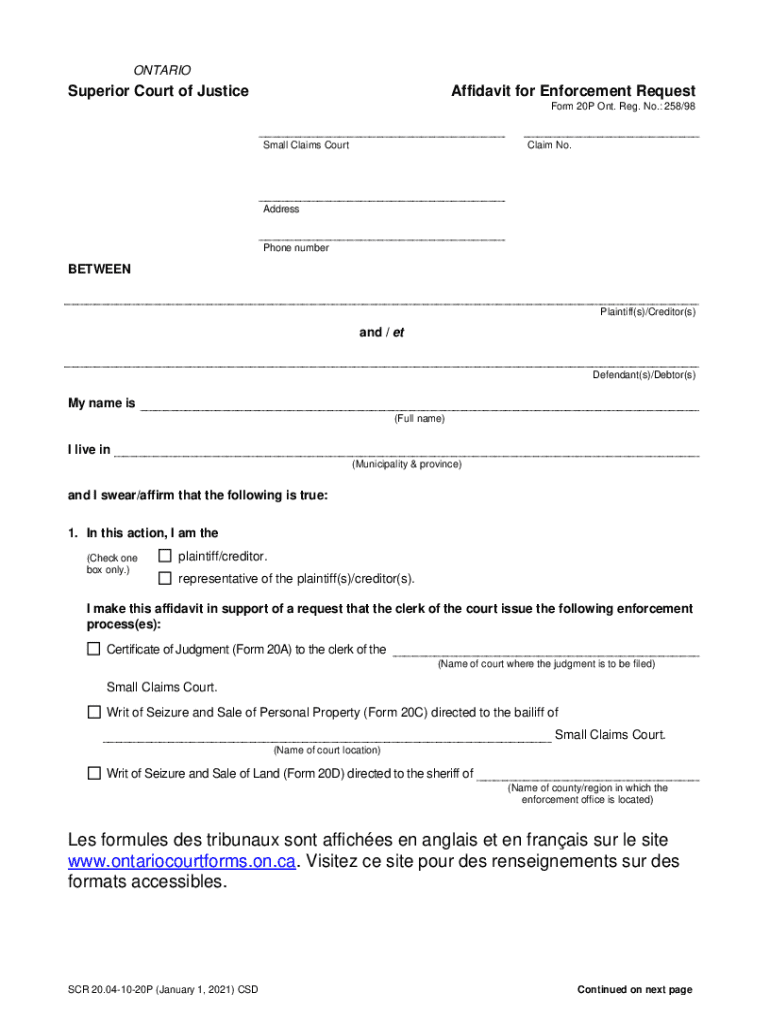







Definition and Purpose of the Ontario Superior Court Affidavit for Enforcement Request
An Ontario Superior Court Affidavit for Enforcement Request is a legal form used to request the enforcement of a judgment or court order issued by the Ontario Superior Court of Justice. This document outlines the necessary details and justifications needed for the court to consider enforcing a previous ruling. The form ensures that all parties involved are informed of the enforcement action and provides a formal basis for the request, making it an essential tool for both plaintiffs and creditors looking to ensure compliance with established legal decisions.
Key Elements of the Form
-
Claim and Court Details:
- Includes the claim number and the relevant details about the Ontario Superior Court to ensure proper identification and processing of the enforcement request.
-
Plaintiff and Defendant Information:
- Detailed identification of all parties involved in the case, including plaintiff(s) or creditor(s) and defendant(s) or debtor(s).
-
Description of the Order:
- A comprehensive overview of the court order or judgment being enforced, specifying the type of enforcement action requested.
-
Reason for Enforcement:
- An explanation detailing why enforcement is necessary, including any instances of non-compliance or breach by the defendant.
Steps to Complete the Ontario Superior Court Affidavit for Enforcement Request
Completing the affidavit involves several crucial steps to ensure accuracy and compliance with legal standards.
-
Gather Necessary Documents:
- Collect all relevant documents related to the original court order, including any court decisions or judgments.
-
Fill Out Plaintiff and Defendant Information:
- Enter full names, addresses, and any other pertinent details about the involved parties.
-
Detail the Enforcement Request:
- Clearly describe the order needing enforcement and the type of enforcement action requested.
-
Outline Reasons for Enforcement:
- Provide a concise narrative explaining the reasons for the enforcement request, supporting the need with applicable evidence or instances of non-compliance.
-
Sign and Submit the Affidavit:
- Ensure the affidavit is signed by the appropriate authority or representative before submission to the relevant court.
Obtaining the Ontario Superior Court Affidavit for Enforcement Request Form
The form can typically be obtained through several avenues:
- Court Website: The Ontario Superior Court of Justice's official website often provides downloadable forms, including the Affidavit for Enforcement Request.
- Court Clerk’s Office: Visit the local court clerk’s office to request a physical copy of the form.
- Legal Professionals: Engage with a lawyer or legal advisor who can provide you with the form and assist in the completion process.
Importance of the Ontario Superior Court Affidavit for Enforcement Request
This form is crucial for several reasons:
- Legal Compliance: Ensures that judgments and orders are enforced according to legal standards.
- Protection of Rights: Helps protect the legal rights of plaintiffs/creditors by enabling them to enforce compliance.
- Streamlined Legal Processes: Facilitates clear communication and procedural efficiency in enforcement actions.
Who Typically Uses the Ontario Superior Court Affidavit for Enforcement Request
Typically, the affidavit is used by:
- Plaintiffs/Creditors: Seeking enforcement of court judgments or orders when defendants have not complied.
- Legal Representatives: Assisting their clients in navigating the enforcement process effectively.
- Judicial Officers: Reviewing enforcement applications to ensure compliance with legal requirements.


Legal Use and Considerations for the Form
The form is legally binding and must be completed accurately to avoid complications:
- Accuracy and Detail: Ensure all information is precise and well-documented.
- Legal Regulations: Comply with specific legal guidelines governing enforcement requests in Ontario.
- Timely Submission: Submit within required timelines to avoid delays in enforcement.
Examples of Using the Ontario Superior Court Affidavit for Enforcement Request
Practical scenarios include:
- Non-Payment Cases: Request enforcement when a defendant has failed to comply with a financial judgment.
- Breach of Order: Applicable when a party violates court-mandated obligations, necessitating enforcement.
- Continued Non-Compliance: Useful for plaintiffs seeking timely judicial assistance to ensure compliance with ongoing orders.
Each example emphasizes the form's utility in enforcing legal resolutions, securing compliance, and supporting the integrity of the judicial process.




