



01. Edit your form online
Type text, add images, blackout confidential details, add comments, highlights and more.

Type text, add images, blackout confidential details, add comments, highlights and more.

Draw your signature, type it, upload its image, or use your mobile device as a signature pad.

Send it via email, link, or fax. You can also download it, export it or print it out.
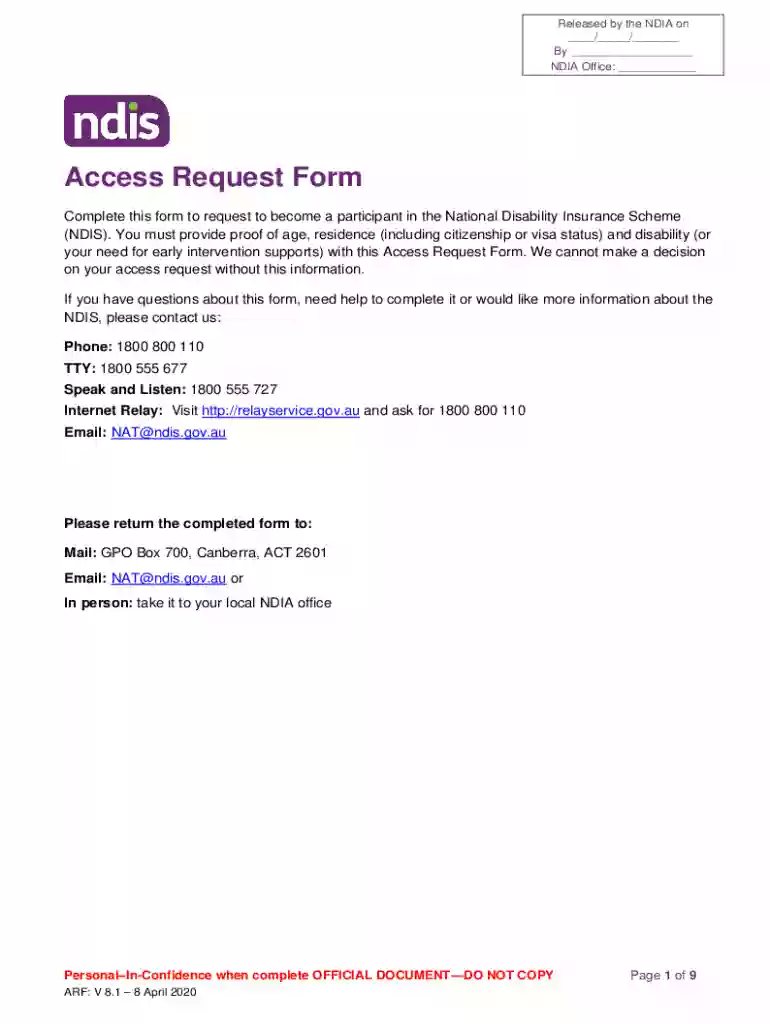
The National Disability Insurance Scheme Access Request Form, commonly referred to as the NDIS Access Request, is an official document used to apply for support under the National Disability Insurance Scheme (NDIS). This form is essential for individuals seeking to become participants in the NDIS, which provides funding for people with disabilities in Australia to access necessary services and supports. The form collects detailed information about the applicant, their disability, and their support needs to determine eligibility for the scheme. Understanding the importance and purpose of this form is crucial for successful application and access to the benefits offered by the NDIS.
Obtaining the NDIS Access Request Form can be done through several channels:
Online Download: The form can be easily downloaded from the official NDIS website. This method requires access to a computer or device with internet connectivity.
Request by Phone: Applicants can call the NDIS hotline to request a copy of the form be sent to them via mail.
In-Person: Visit a local NDIS office or disability support organization, where staff can provide assistance and a physical copy of the form.
Each obtaining method ensures that individuals can receive the form in a manner best suited to their circumstances, allowing for broad accessibility.
Completing the NDIS Access Request Form involves several detailed steps:
Personal Information: Fill in your personal details, including name, date of birth, and contact information. Ensure accuracy to avoid processing delays.
Disability Details: Provide comprehensive information about your disability, including the type, duration, and impact on daily life. Supporting documentation from a healthcare professional may be required.
Support Needs: Clearly outline the types of support and services you are seeking from the NDIS. Be specific and concise in your descriptions.
Consent and Declaration: Read the consent section carefully and provide your signature to confirm you understand the terms and conditions of applying.
Submission: Review your answers for accuracy before submitting. Submit the completed form according to the preferred method outlined by the NDIS.
These steps ensure your application is complete and enhances the chances of a successful outcome.
When submitting the NDIS Access Request Form, having the necessary documentation ready is vital:
Maintaining organized and up-to-date documentation helps facilitate a smoother review process and ensures all necessary information is available for eligibility determination.
Eligibility for the NDIS through the Access Request Form involves meeting certain criteria:
Understanding and meeting these criteria is intrinsic to the successful processing of an access request.

The legal use of the NDIS Access Request Form involves adhering to guidelines set by the National Disability Insurance Agency (NDIA):
Compliance with legal requirements is essential to maintain eligibility and integrity within the program.
The key components of the form include:
Each section of the form serves a distinct purpose in the assessment and eligibility process, collectively covering all necessary aspects of the application.
The form can be submitted through:
Selecting the most convenient submission method ensures timely processing of your application, accommodating different preferences and resources.
At DocHub, your data security is our priority. We follow HIPAA, SOC2, GDPR, and other standards, so you can work on your documents with confidence.
by T Shelby-James 2023 Cited by 4 The EPD form is the only disability-specific access form currently available to assist individuals in applying to the NDIS. To support the use of the EPD formRead more
Oct 5, 2018 Sec. 1. Short title; table of contents. DIVISION ASPORTS MEDICINE LICENSURE. Sec. 11. Short title. Sec. 12. Protections for covered sportsRead more
To date, 81.4% of people with psychosocial disability who requested access were accepted into the Scheme compared to over 97% for people with cerebral palsy,


