
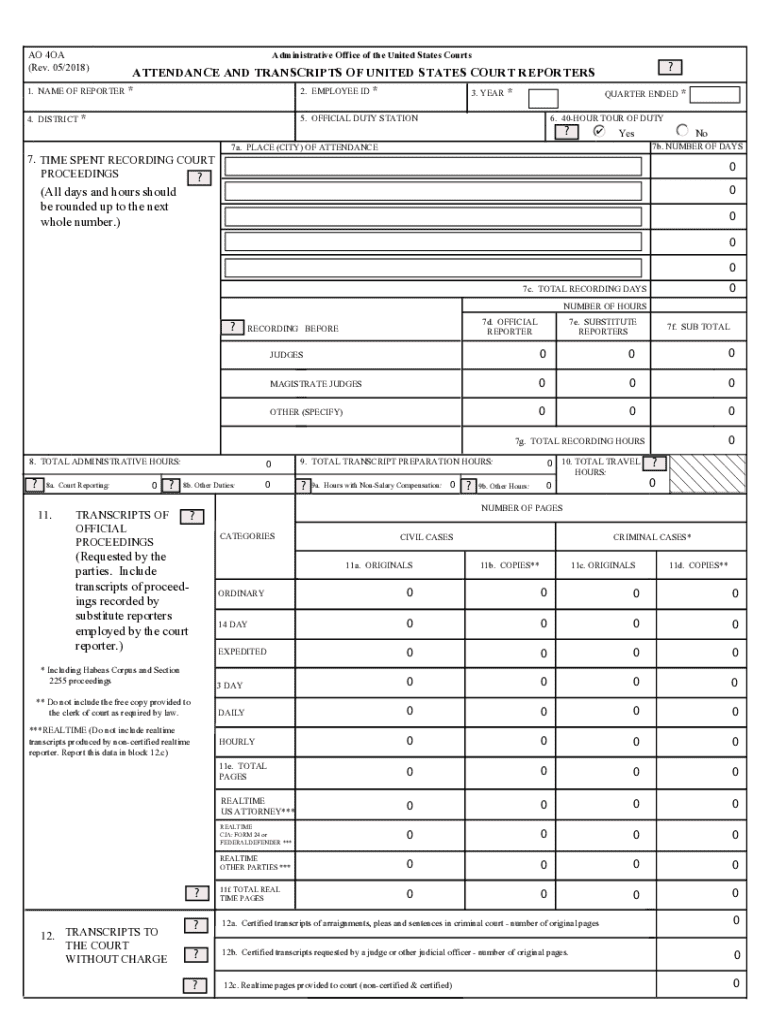







Definition and Purpose of the US Court Reporters Attendance and Transcripts Form
The US Court Reporters Attendance and Transcripts Form is an official document utilized by court reporters within the United States judiciary system to record their attendance and the transcription services they provide. This form primarily serves to document the services rendered by court reporters, including the details of the courtroom sessions they cover, the number of transcript pages produced, and the time taken for such services. The form acts as a crucial component in maintaining accurate records and ensures that court reporters are appropriately compensated for their work. Understanding this form's definition and purpose can assist court reporters, legal professionals, and administrative personnel in effectively managing and auditing the use of transcription services.
Practical Example
Consider a scenario where a court session requires detailed transcription services. The assigned court reporter attends the session and takes comprehensive notes that later result in a verbatim transcript. At the end of the working period, the reporter fills out the US Court Reporters Attendance and Transcripts Form, providing data on the time spent in court, the exact number of pages transcribed, and any additional services rendered. This completed form will then be submitted to authorized personnel for review and processing.
Steps to Complete the US Court Reporters Attendance and Transcripts Form
Filling out the US Court Reporters Attendance and Transcripts Form involves several key steps. These steps ensure that all relevant information is accurately recorded and that the submission complies with reporting standards.
1. Identify Court Reporter Details
- Fill in personal data, including the name of the reporter, employee ID, and district assignment.
- Attach relevant identification if required, such as a court-issued ID card or badge number.
2. Record Attendance Information
- Document the dates of attendance with times for each court session covered.
- Specify the court location and the type of proceeding (e.g., civil, criminal, appeals).
3. Transcription Services Details
- Note the start and end times of transcription work associated with specific court sessions.
- List the number of pages transcribed and any revisions or corrections made.
4. Verification and Submission
- Review all entries for accuracy and completeness.
- Sign the form to affirm the authenticity of the recorded information.
- Submit the form according to the designated protocol, which may include online submission or physical delivery.
How to Obtain the US Court Reporters Attendance and Transcripts Form
Obtaining the US Court Reporters Attendance and Transcripts Form is a straightforward process, often facilitated through judiciary administration offices.
Methods of Access
-
Judicial Administrative Offices: Most court reporting staff can request this form via their administrative department, which provides either physical copies or links to electronic versions.
-
Official Judiciary Websites: Some jurisdictions may offer downloadable versions from their websites, often accessible through a specific section dedicated to court reporter resources.
-
Direct Supervisor or Manager: Court reporters may acquire forms directly through their supervisors, who manage workflow and document distribution.
Legal Use of the US Court Reporters Attendance and Transcripts Form
The US Court Reporters Attendance and Transcripts Form must adhere to legal standards concerning documentation and reporting of court transcription services. Legal use of this form ensures the proper allocation of funds for services rendered and supports transparency within legal proceedings.
Compliance with Legal Standards
-
Adherence to Privacy Laws: All sensitive information recorded in the form must comply with applicable privacy regulations to safeguard confidential data related to court cases.
-
Official Record Keeping: Ensure proper archiving of completed forms as dictated by judicial rules, allowing for future reference in audits or inquiries.
Real-World Application
In practice, accurate completion and retention of this form can prevent disputes regarding service fulfillment and compensation. Any discrepancies noted either during internal audits or raised by external audits can be swiftly addressed through precise documentation on the form.
Key Elements of the US Court Reporters Attendance and Transcripts Form
Understanding the essential components of the form can enhance accuracy and efficiency in its completion. The form comprises several crucial elements that align with the specific roles and responsibilities of court reporters.
Essential Form Components
- Reporter Identification: Fields requiring specific identification information, such as a unique employee ID.
- Session Details: Sections dedicated to the dates, times, and nature of court proceedings covered by the reporter.
- Service Provision: Detailed accounts of transcription services, including page counts and corrections.
- Verification: Final approval fields for signatures and dates, substantiating the validity of the entries.
Examples of Using the US Court Reporters Attendance and Transcripts Form
The practical use of the US Court Reporters Attendance and Transcripts Form can be highlighted through various court reporter scenarios.
Case Example 1: Routine Documentation
A court reporter consistently assigned to a busy metropolitan district completes the form weekly, systematically documenting every session covered. Their form includes details of lengthier trials alongside shorter preliminary hearings, assisting in systematically recording a balanced workload.
Case Example 2: Special Circumstance Transcription
During a significant trial with heightened public interest, a court reporter accurately uses the form to account for additional hours and pages transcribed beyond standard expectations. Their attention to detail in recording this helps justify the additional compensation and resources allocated by the court administration.
State-Specific Rules and Regulations
While the US Court Reporters Attendance and Transcripts Form provides a standardized approach to reporting, variations may exist depending on specific state regulations governing court documentation practices.
Differences by State
-
Type of Proceedings Documented: State laws might dictate the kind of cases requiring detailed transcription, affecting how the form is filled.
-
Submission Protocols: Some states enforce particular submission guidelines, potentially demanding additional sign-off by legal officers or offering alternative digital filing methods.
Understanding these state-specific requirements is essential for court reporters working across different jurisdictions.
Digital vs. Paper Versions of the Form
The availability and acceptance of digital versus paper versions of the US Court Reporters Attendance and Transcripts Form can vary depending on the court system's level of technological integration.
Advantages of Digital Forms
- Efficiency: Digital versions allow instant edits, ease in storage, and swift transmission to relevant personnel.
- Environmental Impact: Reducing paper usage aligns with broader efforts to promote sustainability within public institutions.
Paper Form Utility
Despite digital advancements, paper forms may still be preferable in situations where technology infrastructure is limited, ensuring all court reporters can fulfill their documentation obligations without technological barriers.
These comprehensive insights into the US Court Reporters Attendance and Transcripts Form provide a thorough understanding of its significance, proper completion process, and legal implications, supporting court reporters and related legal professionals in their documentation needs.




