
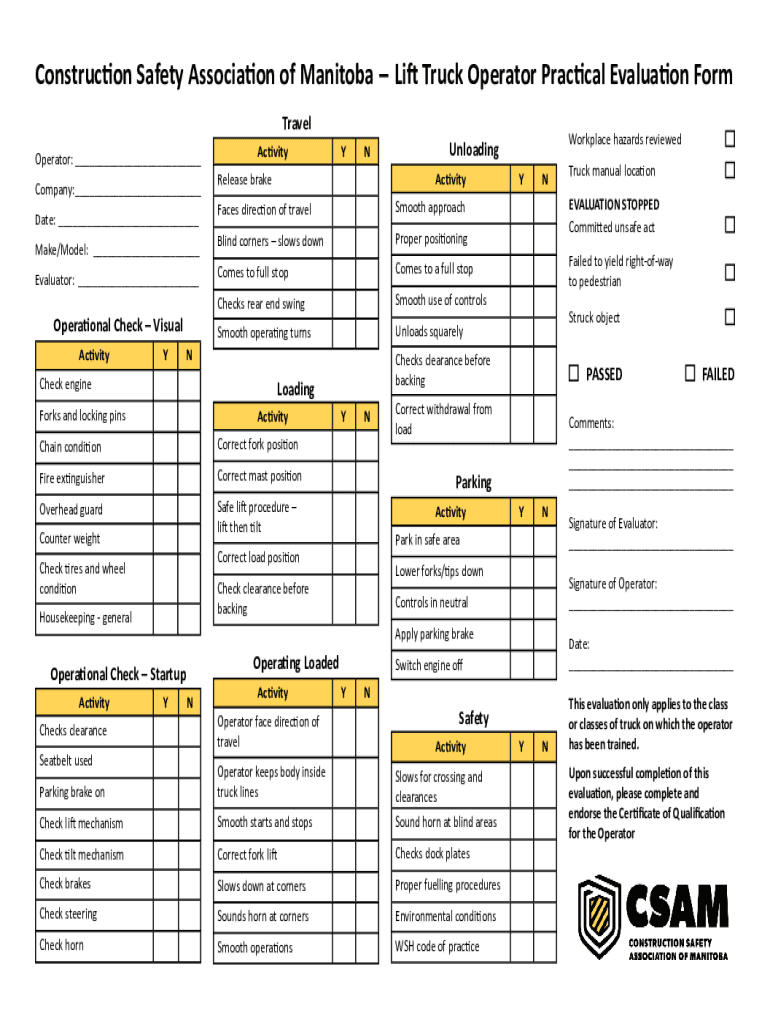







Definition and Purpose of the Lift Truck Operator Practical Evaluation Form
The Lift Truck Operator Practical Evaluation Form is a specialized tool used to assess the proficiency and safety practices of individuals operating lift trucks. This form helps evaluate the skills and safety knowledge of operators, ensuring compliance with workplace safety standards. Designed primarily for use in industries where material handling is prevalent, such as warehousing and manufacturing, it is a critical component of occupational safety protocols. The form provides a structured method for instructors and safety officers to record and assess an operator’s performance through practical tasks.
Key Elements of the Evaluation Form
- Operator Identification: Captures basic details like operator's name, employee ID, and company affiliation to ensure accurate record-keeping.
- Equipment Specifications: Includes details about the lift truck model, make, and serial number, facilitating the assessment of operator familiarity with specific machinery.
- Evaluator Information: Requires details of the evaluator to authenticate the legitimacy of the evaluation process.
Steps to Complete the Lift Truck Operator Practical Evaluation Form
-
Initial Operator Information:
- Record operator's full name, employee ID, and training date.
- Fill in the operator’s department and job title if applicable.
-
Equipment and Environment Check:
- Note the lift truck model, make, and any unique identifiers.
- Verify that the operating environment meets safety and operational standards.
-
Performance Assessment:
- Evaluate the operator's ability to perform specific functions, such as load lifting, maneuvering, and compliance with safety protocols.
- Use checkboxes or scoring systems to mark proficiency levels for each task.
-
Feedback and Recommendations:
- Provide detailed feedback on performance.
- Offer recommendations for further training or areas needing improvement.
Practical Examples and Scenarios
The evaluation process often includes diverse practical scenarios such as navigating through tight spaces, handling variable load weights, and responding to emergency situations. Evaluators may create specific tasks that mimic real-world challenges to accurately assess an operator’s competence.
Importance of Using the Evaluation Form
This form serves multiple critical purposes in workplace safety and compliance, including ensuring that operators are adequately trained and identify areas where further instruction is necessary. It helps mitigate risks associated with improper equipment handling, thus reducing workplace accidents and enhancing operational efficiency.
Who Typically Uses the Lift Truck Operator Practical Evaluation Form
The Evaluation Form is mainly used by safety officers, training coordinators, and supervisors in environments where lift trucks are utilized. Organizations engaged in logistics, warehousing, manufacturing, and construction prominently rely on this form for maintaining high safety standards and ensuring employees' operational competence.


Legal Use and Compliance
Operating a lift truck without proper evaluation can lead to severe legal liabilities in case of accidents. US-based federal regulations, such as those from OSHA (Occupational Safety and Health Administration), provide guidelines that necessitate the evaluation of lift truck operators to promote safe working conditions. Non-compliance can result in penalties and increased scrutiny from safety inspectors.
State-Specific Regulations
Although federal guidelines exist, states may impose additional regulations that organizations must comply with. It is essential for companies to ensure that their evaluation forms align with both federal and state regulations, adapting the form content as necessary to meet state-specific requirements.
Variants or Alternatives to the Lift Truck Operator Practical Evaluation Form
While this form is comprehensive, some organizations might adapt or create alternative formats to better suit specific operational requirements or regulatory changes. Alternative forms might integrate digital platforms for ease of use and data management, promoting efficiency and accessibility.
Digital vs Paper Version
Organizations increasingly lean towards digital versions of the form for benefits such as easier document management, improved data tracking, and ready accessibility. Digital platforms, like DocHub, allow for seamless integration and streamlined workflows, ensuring efficient form handling and processing.
Obtaining the Lift Truck Operator Practical Evaluation Form
Forms can typically be acquired through industry associations, regulatory bodies, or developed in-house by organizations to adhere to specific safety and operational standards. Often, these forms are part of a broader safety and compliance toolkit designed to maintain high operational safety levels.




