






Definition & Meaning
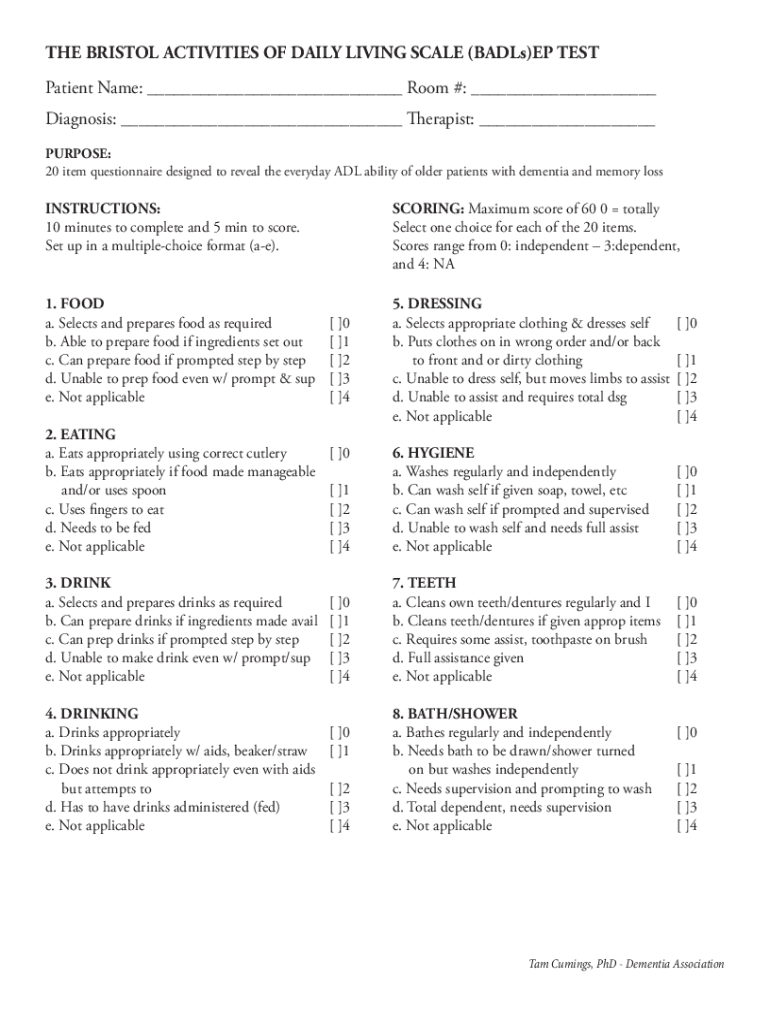
The Bristol Activities of Daily Living Scale (BADLs) Test is a structured, 20-item questionnaire designed to evaluate the everyday ability of individuals, primarily focusing on older patients with dementia and memory loss. This test aims to assess how these individuals manage their daily activities, which are critical for independent living. The BADLs test concentrates on core activities, such as personal hygiene, meal preparation, and mobility, each scored based on the level of assistance required from others.
Key Components of BADLs
- Personal Hygiene: Evaluates tasks like grooming, bathing, and dressing.
- Feeding: Assesses the ability to prepare and consume meals independently.
- Mobility: Examines walking and transferring skills, such as getting in and out of a chair or bed.
- Communication: Involves understanding and expressing information effectively.
- Household Management: Covers tasks like handling personal finances and managing medications.
How to Use the Bristol Activities of Daily Living Scale (BADLs) Test
The Bristol Activities of Daily Living Scale is used by healthcare professionals to gauge the extent of functional impairment in individuals with cognitive challenges. This tool aids in crafting personalized care plans by identifying specific areas where the patient may need support.
Steps to Administer the Test
- Preparation: Gather information about the individual's usual daily routine and any existing physical or cognitive limitations.
- Conducting the Questionnaire: Go through each of the 20 items with the patient and, if necessary, their caregivers to ascertain the level of independence in each activity.
- Scoring: Assign scores based on the required assistance for each task, where lower scores signify greater independence.
- Interpretation: Analyze results to identify areas of high dependency and tailor interventions accordingly.
Who Typically Uses the Bristol Activities of Daily Living Scale (BADLs) Test
The BADLs test is typically utilized by healthcare professionals such as geriatricians, occupational therapists, and nurses. It is particularly valuable in settings like hospitals, long-term care facilities, and community health centers, where elder care and dementia management are priorities.


Use Cases
- Hospitals: For assessing patient readiness for discharge.
- Care Facilities: To create individualized care plans.
- Home Care Services: To evaluate the necessity and extent of in-home support services.
- Research: In clinical studies focusing on aging and dementia.
Key Elements of the Bristol Activities of Daily Living Scale (BADLs) Test
Several critical elements contribute to the effectiveness of the BADLs test, addressing multiple dimensions of daily life:
- Task-specific Assessment: Evaluates a broad range of activities crucial for daily living.
- Objective Scoring System: Provides a quantitative measure of functional ability.
- Patient-centered Approach: Focuses on the individual's specific needs and abilities.
Practical Considerations
- Environmental Factors: Assess how environmental changes might impact task performance.
- Cultural Sensitivity: Understand cultural influences on daily living activities and adapt the assessment accordingly.
Why Should You Use the Bristol Activities of Daily Living Scale (BADLs) Test
The Bristol Activities of Daily Living Scale is an essential tool for evaluating the functionality and care needs of older adults. It helps in pinpointing specific areas that need intervention, ensuring that caregivers can provide targeted support that enhances the individual's independence and quality of life.
Benefits
- Comprehensive Evaluation: Covers all key areas affecting daily functionality.
- Guided Care Planning: Facilitates personalized care strategies.
- Monitoring Progress: Tracks changes over time, enabling adjustments to care approaches.
Steps to Complete the Bristol Activities of Daily Living Scale (BADLs) Test
Completing the BADLs test involves a structured process that ensures accuracy and consistency in evaluation. It is essential to ensure the environment is conducive to accurate responses and foster open communication throughout the assessment.
Detailed Steps
- Engage the Participant and Caregivers: Start by explaining the purpose of the test to the participant and their caregivers, ensuring clarity and cooperation.
- Read Each Question Aloud: Proceed through the questionnaire, reading each item clearly and allowing the participant or caregiver to respond without pressure.
- Record Responses Accurately: Mark down the level of assistance required for each activity, noting specific challenges and observations.
- Review and Finalize Scores: Conclude by reviewing responses to ensure completeness and coherence before calculating the total score.
Important Terms Related to the Bristol Activities of Daily Living Scale (BADLs) Test
Understanding certain key terms is crucial for maximizing the BADLs test efficiency. Awareness of these terms will enhance comprehension and facilitate more accurate evaluations.
Essential Terminology
- Independence: The capability of performing tasks without assistance.
- Assistance Levels: Differentiates between partial and total assistance required for tasks.
- Cognitive Impairment: Refers to difficulties with memory, language, thinking, or judgment impacting daily task performance.
Examples of Using the Bristol Activities of Daily Living Scale (BADLs) Test
Real-world examples underscore the practical application of the BADLs test, providing insight into its utility across different scenarios and settings.
Case Studies
- Case Study: Mrs. Johnson: An 80-year-old woman with early-stage dementia. The BADLs test was utilized to determine her ability to live independently with some in-home support for meal preparation.
- Case Study: Mr. Lee: A stroke recovery patient. The BADLs test helped in planning a rehabilitation program focusing on improving his mobility and self-care skills.
- Research Setting Example: Used in a study to compare functional decline rates among different age groups, highlighting areas of rapid change and intervention effectiveness.
These sections provide comprehensive coverage of the Bristol Activities of Daily Living Scale, offering a thorough understanding for individuals seeking to utilize or comprehend the test in various professional settings.