01. Edit your form online
Type text, add images, blackout confidential details, add comments, highlights and more.

Type text, add images, blackout confidential details, add comments, highlights and more.

Draw your signature, type it, upload its image, or use your mobile device as a signature pad.

Send it via email, link, or fax. You can also download it, export it or print it out.
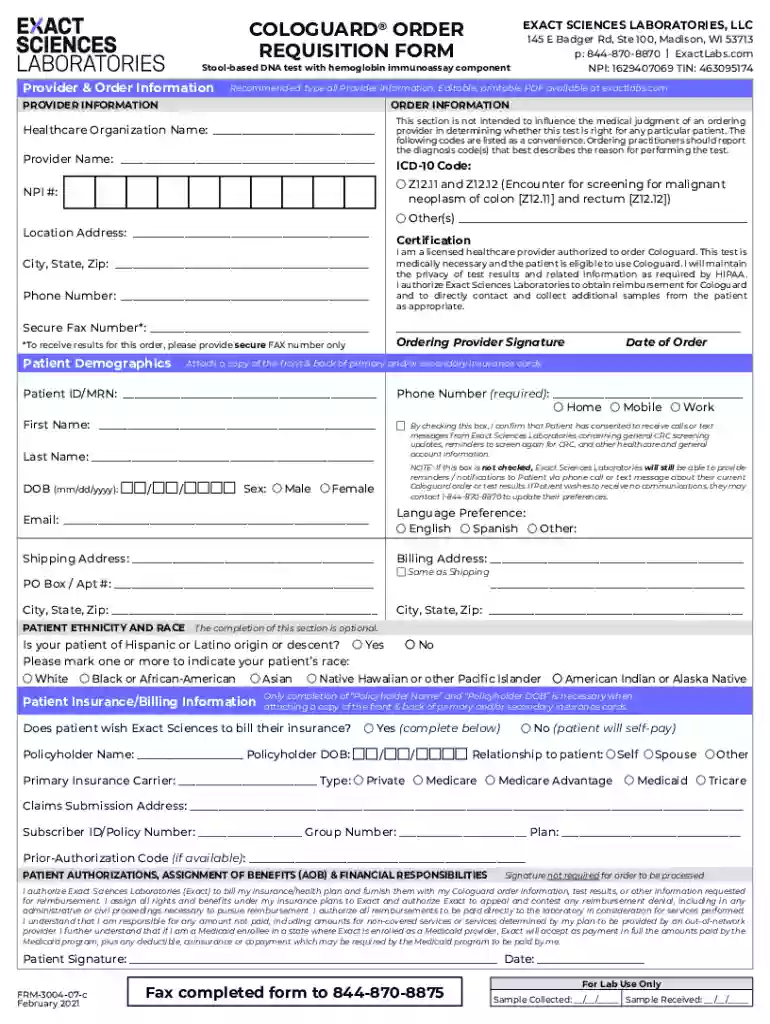
The Cologuard Order Requisition Form is a document used by healthcare providers to order Cologuard tests for their patients. Cologuard is a non-invasive, at-home screening test that detects colon cancer and precancerous conditions. This form plays a crucial role in facilitating the testing process by ensuring that healthcare providers can efficiently request and authorize screening tests, enabling timely detection and patient care.
Using the Cologuard Order Requisition Form involves several steps to ensure its proper completion and submission:
Patient Information: Begin by entering the patient's full name, date of birth, and contact details. Ensure that all information is current and accurate to avoid delays.
Healthcare Provider Details: Include the name, contact information, and National Provider Identifier (NPI) number of the healthcare provider ordering the test.
Insurance Information: Fill out the patient’s insurance details, including the insurance provider’s name and policy number, to facilitate billing.
Test Details: Indicate any specific instructions related to the test, including the urgency and special conditions, if applicable.
Signature: The healthcare provider must sign and date the form to authorize the test order.
Submission: Submit the completed form as per the instructions—typically via fax or electronic submission according to the provider's protocol.
To obtain the Cologuard Order Requisition Form, healthcare providers can typically access it through the following avenues:
Completing the Cologuard Order Requisition Form involves a detailed process to capture all necessary information:
The Cologuard Order Requisition Form is typically utilized by:
When completing the form, it is critical to include:
The use of the Cologuard Order Requisition Form must comply with regulatory standards and privacy laws:
These content blocks cover multiple aspects of the Cologuard Order Requisition Form, providing medical practitioners detailed guidance to facilitate its use.
At DocHub, your data security is our priority. We follow HIPAA, SOC2, GDPR, and other standards, so you can work on your documents with confidence.