01. Edit your form online
Type text, add images, blackout confidential details, add comments, highlights and more.

Type text, add images, blackout confidential details, add comments, highlights and more.

Draw your signature, type it, upload its image, or use your mobile device as a signature pad.

Send it via email, link, or fax. You can also download it, export it or print it out.
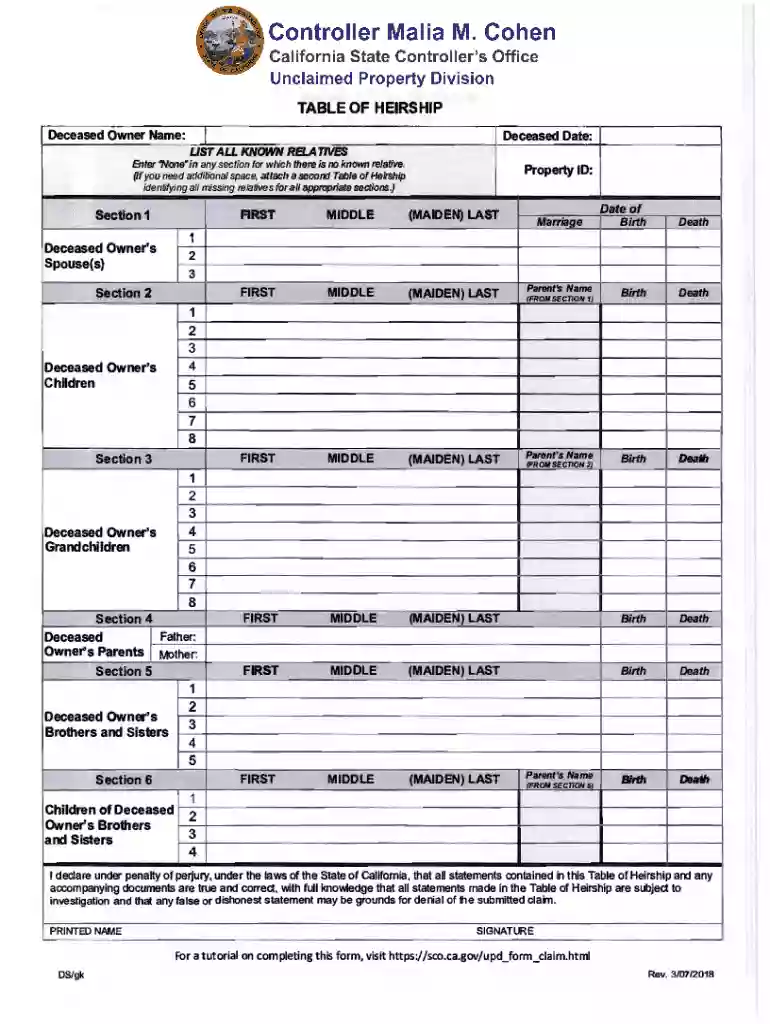
The CA Table of Heirship is a legal document used to determine the heirs of a deceased individual in California. This template is particularly relevant for probate proceedings, where it serves as a formal declaration of the decedent's relatives. Understanding the familial lineage and relationships of the deceased is essential for the equitable distribution of the estate. The table lists all known heirs and their relationship to the deceased, ensuring that the probate process is conducted transparently and in alignment with legal standards.
Examples include situations where there may be multiple heirs, unknown family dynamics, or contested wills. A clear understanding of its definition aids in appreciating its importance in estate management and legal settlements.
Using the CA Table of Heirship template involves several steps:
Gather Relevant Information: Collect all pertinent details about the deceased, including their full name, date of death, and known relatives.
Complete the Form: Enter the collected data into the template. Include names, relationships, and any additional notes pertinent to each heir. For example, specify if an heir is a child, spouse, or sibling.
Attach Additional Sheets if Needed: For cases with extensive familial networks, additional sheets can be attached to the original form to ensure all individuals are accounted for.
Review for Accuracy: Cross-check all entries for accuracy and completeness. Mistakes or omissions can delay the probate process.
Most effectively used in collaboration with legal professionals, evaluating nuanced family dynamics ensures that all required documentation is accurately captured.
Completing the CA Table of Heirship requires methodical attention to detail:
List the Deceased’s Details: Start by filling out the demised individual's name and date of death. This anchors the document's context.
Enumerate Known Relatives:
Utilize the Full Template: If any categories have no known relatives, explicitly notate as "None."
Legality and Formality: This document should be notarized or witnessed to enhance its legal validity in court proceedings.
By systematically completing these steps, signee errors and legal challenges can be minimized.
The CA Table of Heirship is primarily utilized in probate court to:
Legal professionals oversee the table’s completion and notarization, ensuring alignment with the statutes governing inheritance. When properly submitted, this document aids in the seamless transition of assets to rightful heirs.
Significant components of this form include:
These elements collectively provide a holistic view of familial relationships, ensuring an informed settlement of the estate.
To access the template:
Online Platforms: Available as a free download on various legal and document management websites like DocHub.
Legal Resources: Attorneys specializing in estate planning or probate law often provide this form to clients.
County Probate Office: Physical copies can often be procured from local probate court offices.
By knowing multiple sources, users can easily obtain a current and applicable template version.
California-specific regulations influence this document’s use, such as:
These rules ensure California’s probate proceedings follow structured legal processes designed to ascertain fair adjudication.
Case study examples include:
Examining these examples underpins the practical application’s effectiveness in different legal scenarios and family contexts.
At DocHub, your data security is our priority. We follow HIPAA, SOC2, GDPR, and other standards, so you can work on your documents with confidence.