01. Edit your funeral excuse letter for work online
Type text, add images, blackout confidential details, add comments, highlights and more.

Type text, add images, blackout confidential details, add comments, highlights and more.

Draw your signature, type it, upload its image, or use your mobile device as a signature pad.

Send funeral excuse letter for work pdf via email, link, or fax. You can also download it, export it or print it out.
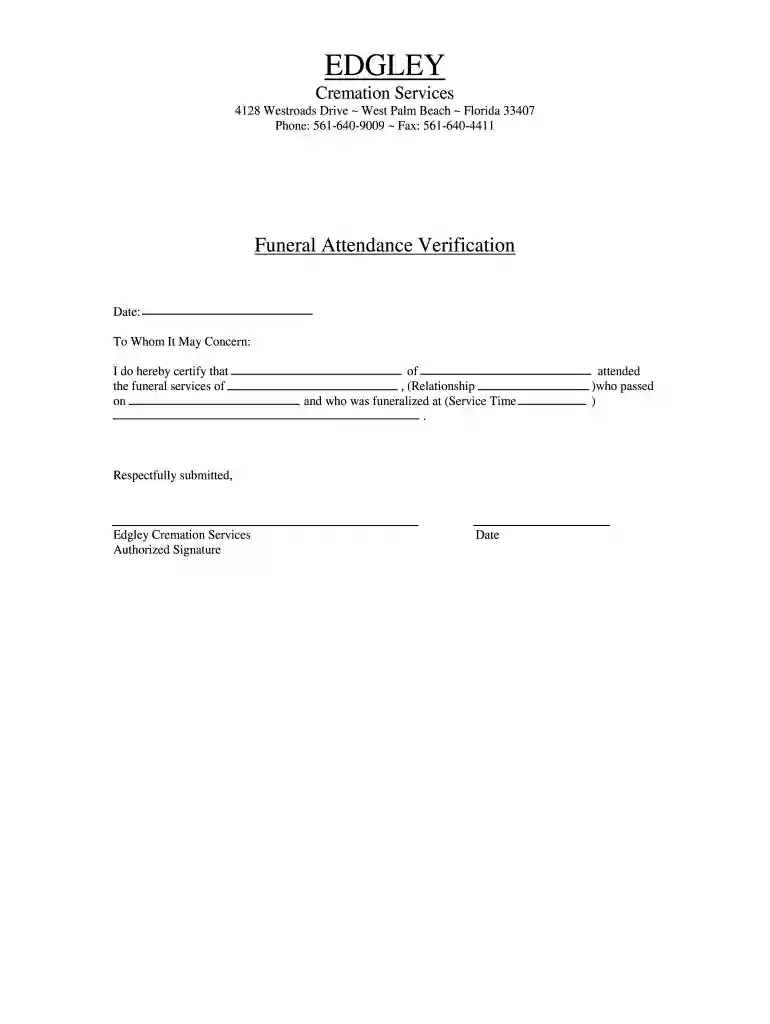
The terms "Phone:" and "Fax:" refer to specific communication channels commonly used in business to facilitate contact and the exchange of documents. The phone number is a unique identifier that enables voice communication, allowing for real-time conversation, while the fax number serves as a conduit for sending printed documents electronically. Both serve as essential tools in the business environment, ensuring that stakeholders can communicate efficiently and effectively.
Businesses often assign distinct numbers for various functions, with phone numbers typically used for general inquiries and customer service, while fax numbers are designated for formal communications. This separation supports organized communication strategies, allowing businesses to streamline their workflow and maintain a professional image.
Using the phone number involves dialing the number directly from any phone device. This allows users to connect with customer service representatives, technical support teams, or administrative staff. The process is straightforward:
When utilizing the fax number, the following steps apply to send documents securely:
Maintaining clarity during communication is key to resolving inquiries promptly.
The presence of a dedicated phone line, like, significantly enhances customer satisfaction by providing direct access to representatives who can resolve issues or answer questions quickly. This immediacy fosters trust and builds long-lasting relationships between the business and its clients. Additionally, phone calls allow for nuanced conversations that fax communication alone cannot facilitate.
Conversely, the fax number serves a critical role in document submission and formal communication. The ability to send and receive faxes remains relevant for:
This dual-channel communication strategy encompassing both voice and document transmission significantly enhances operational efficiency.
Essential elements associated with effective communication through these channels include:
When utilizing these communication lines, businesses must ensure they have trained personnel available to answer calls promptly and manage incoming faxes efficiently. This enhances the overall communication flow and improves service delivery.
To optimize usage of the phone and fax numbers, regular checks and updates to contact information are necessary. Consider implementing the following steps:
By attending to these practices, businesses can significantly enhance their communication strategies while ensuring a supportive environment for their clients.
According to eSignature laws, forms signed digitally have the same validity as traditionally approved ones. You can eSign almost any business and private paperwork. Four types of documents still call for handwritten signatures only - wills and testamentary trusts, court orders and other court forms, state statutes governing divorce, adoption, or other family law, and notice of cancellation of utility services. If you adhere to the guidelines and use a safe and compliant software solution, like DocHub, you can eSign your funeral letter for work without printing it.
If you edit your funeral excuse letter for work sample with DocHub, you simply will not need to look for other software or solutions to eSign it. An electronic signature is part of DocHub’s extensive editing toolset, which enables you to apply changes in your form without jumping between platforms. Just complete your form, double-check the correctness of your information and place your electronic signature at the end to make it submission-ready in minutes.
At DocHub, your data security is our priority. We follow HIPAA, SOC2, GDPR, and other standards, so you can work on your documents with confidence.