
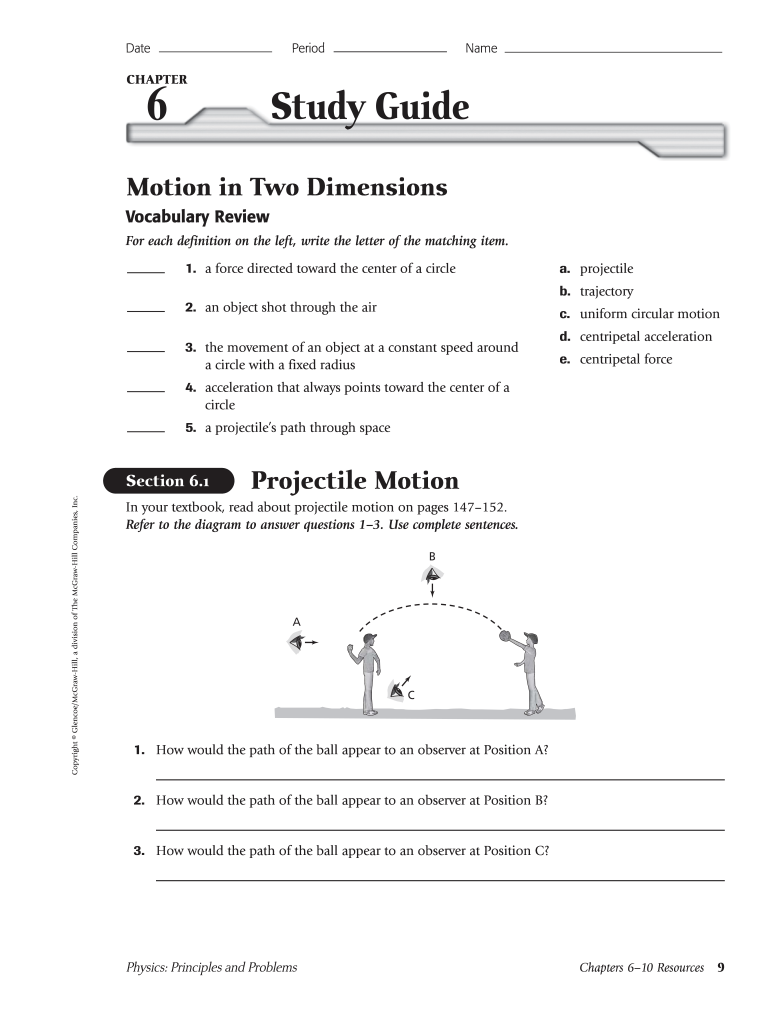







Definition and Meaning
"Chapter 6-10 Resources Physics Principles and Problems" refers to materials and content found within the chapters between six and ten of a physics textbook titled "Physics: Principles and Problems." These chapters typically cover critical physics concepts, practical problems, evaluation tools, instructional guides, and various resources for teachers and students to enhance understanding and application of physics principles in real-world contexts. Users need to delve into these resources to grasp foundational and advanced physics topics and solve related problems effectively.
How to Use the Chapter 6-10 Resources
To effectively utilize the Chapter 6-10 resources, follow a structured approach:
-
Accessing Content: Start by identifying the specific chapters or concepts you wish to explore. The content might be available in physical books, educational platforms, or digital formats like PDFs.
-
Conceptual Understanding: Carefully read through explanations and examples provided in each chapter. Take notes on key principles, equations, and problem-solving strategies.
-
Practical Application: Engage with practice problems and case studies at the end of each chapter. Try solving them using the methodologies outlined to reinforce your understanding.
-
Review and Revise: Regularly review summaries and key points to retain information. Revising helps cement concepts and prepare for assessments.
-
Utilize Additional Resources: Leverage supplementary materials such as videos, interactive simulations, and study groups for a comprehensive learning experience.
How to Obtain the Chapter 6-10 Resources
To access the "Chapter 6-10 Resources Physics Principles and Problems," consider the following methods:
-
Purchase or Borrow Textbooks: Look for the "Physics: Principles and Problems" textbook in bookstores, libraries, or online platforms. Libraries often offer digital versions that can be borrowed.
-
Educational Institutions: If you're a student, inquire whether your school or university provides access to these materials as part of your course curriculum.
-
Online Resource Hubs: Certain educational websites and platforms might host or sell digital versions or study aids related to these chapters.
-
Peer Resources: Connect with peers or educators who have previously or are currently using these resources; they may share valuable insights or lend materials.
Steps to Complete the Chapter 6-10 Resources
Completing the resources effectively involves several steps:
-
Set Learning Goals: Identify what you aim to achieve by engaging with these resources, such as mastering specific physics principles or preparing for exams.
-
Dedicated Study Schedule: Allocate regular study sessions dedicated to exploring and understanding these chapters.
-
Interactive Engagement: Work through interactive elements such as experiments or simulations where possible, to apply theoretical knowledge practically.
-
Problem Solving: Consistently attempt to solve provided problems without immediately relying on solution guides. This enhances problem-solving skills.
-
Seek Clarification: Where challenges arise, seek help from educators, online forums, or peer study groups to clear up confusion.
Important Terms Related to Chapter 6-10 Resources Physics Principles and Problems
Understanding key terminology is crucial for comprehending Chapter 6-10:
-
Centripetal Force: A force directed toward the center of a circle, crucial for understanding planetary motion and rotational dynamics.
-
Vector Quantities: Entities characterized by both magnitude and direction, pivotal in describing forces and motion.
-
Newton's Laws of Motion: Fundamental principles describing the relationship between a body and the forces acting upon it, forming the foundation of classical mechanics.
-
Energy Conservation: A critical concept explaining that energy cannot be created or destroyed, only transformed, fundamental to understanding systems in equilibrium.
-
Kinetic and Potential Energy: Forms of energy related to motion and position, essential for solving energy-related physics problems.
Key Elements of the Chapter 6-10 Resources
Key elements of these resources include:
-
Explanatory Diagrams: Visual aids clarifying complex concepts like motion diagrams and force vectors.
-
Examples and Case Studies: Real-world applications illustrating the principles taught, facilitating practical understanding.
-
Practice Exercises: Problems with varying difficulty levels to challenge and assess comprehension.
-
Conceptual Summaries: Concise overviews of critical points and principles following each chapter.
-
Instructor Annotations: Teacher's notes providing additional guidance or clarification on tricky sections.
Examples of Using the Chapter 6-10 Resources
Examples showcasing the application of these resources include:
-
Lab Experiments: Using the outlined procedures to conduct experiments demonstrating principles like centripetal force or energy conservation.
-
Exam Preparation: Leveraging practice problems and chapter reviews to prepare effectively for physics exams.
-
Project Work: Applying concepts from these resources in physics projects or research assignments to demonstrate comprehensive understanding.
-
Tutoring Sessions: Using these chapters as a basis for tutoring others, explaining concepts with examples and exercises.
Digital vs. Paper Version
The choice between digital and paper formats for these resources depends on personal preference and usability:
-
Digital Version: Offers portability and easy access across devices, ideal for dynamic learning environments or for those who travel frequently. Features like search functions can enhance the ease of navigation and quick referencing.
-
Paper Version: Suited for individuals who prefer a tangible format for note-taking or highlighting. Beneficial in environments where digital access is limited or where screen reading causes fatigue.




