






Definition and Meaning of Percent
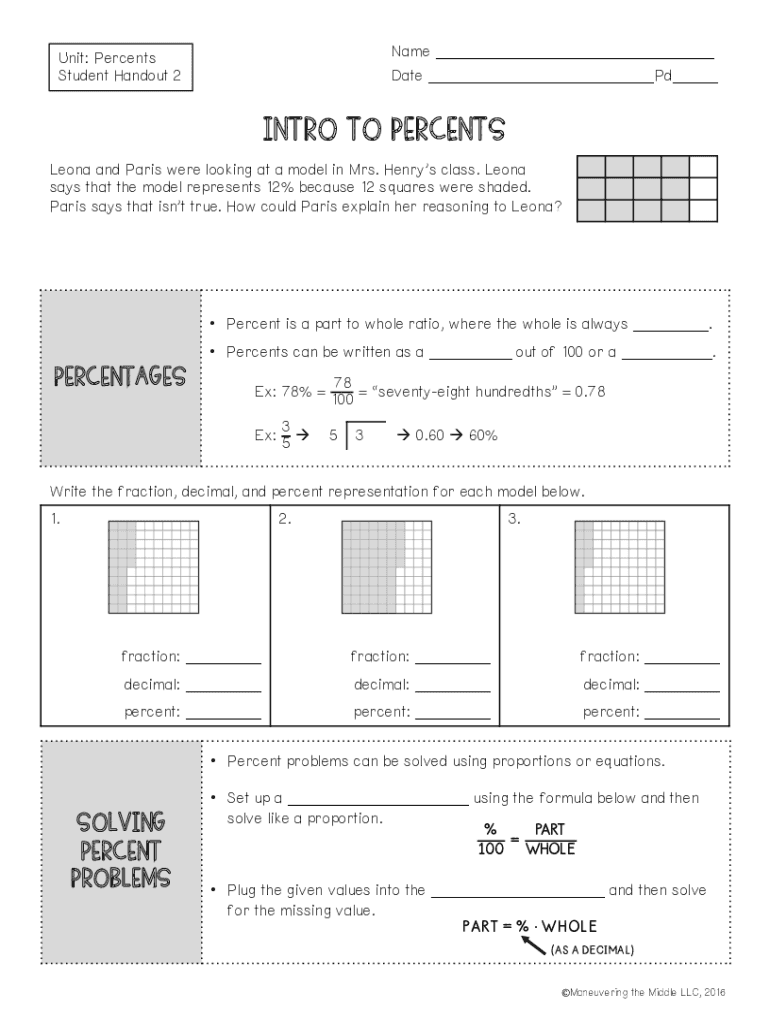
In the context of the "INTRO TO PERCENTS Leona and Paris were looking at a" form, understanding the definition and meaning of percent is crucial. Percent, a term derived from the Latin "per centum" meaning "by the hundred," represents a ratio that indicates a part per hundred. For example, 50% is equivalent to 50 parts out of 100 or half of the whole. This concept is vital in various real-life applications such as calculating discounts, analyzing data, and understanding statistical information. It sets the foundational knowledge required for effectively engaging with the form, ensuring users can apply percent calculations to their specific needs.
Steps to Complete the INTRO TO PERCENTS Form
To complete the form effectively, follow these structured steps. First, gather all relevant data that requires percentage calculation. This includes identifying key values that need to be converted into percentage form. Next, follow systematic calculations, employing the formula: Percentage = (Part/Total) x 100. Make sure to apply proper rounding rules where necessary for accuracy. Finally, review all filled sections for correctness before submission to avoid errors that may lead to misinterpretation of the information provided.
Detailed Calculation Example
- Identify the part and the total.
- Use the formula: Percentage = (Part/Total) x 100.
- Round the result appropriately.
For instance, if 30 out of 150 students passed an exam, the percentage of students who passed is calculated as (30/150) x 100 = 20%.
How to Use the INTRO TO PERCENTS Form
Utilizing this form efficiently requires understanding its purpose and where it applies. This form is typically used in educational settings to reinforce students' comprehension of percentage calculations. It guides students through various exercises designed to solidify their understanding of percent-related concepts. Users should approach the form by first reviewing all instructions thoroughly, ensuring all sections are understood before attempting to fill them out. This structured approach enhances learning outcomes by promoting systematic engagement with percent exercises.
Key Elements of the INTRO TO PERCENTS Form
The form is composed of several key elements designed to support the learning of percent concepts. These elements include:
- Instructional Guidelines: Provides clear steps on how to tackle percentage problems.
- Practice Exercises: Offers a range of problems for practical application of percent calculations.
- Explanatory Sections: Delivers explainer notes on how to interpret and solve percent-related questions.
- Feedback Areas: Allows for reflection or instructor comments to help guide further learning.
Real-Life Applications of Percentages
Percentages play a vital role in various real-life scenarios beyond the classroom. For instance, they are used in financial sectors for calculating interest rates, in retail for determining discounts and sales tax, and in statistical analysis for interpreting data trends. This practical understanding is essential for students, helping them relate theoretical percentage knowledge to everyday situations and decisions.
Examples
- Retail Discounts: A $100 item with a 25% discount means a $25 reduction, making the final cost $75.
- Interest Rates: An interest rate of 5% on $1,000 in a savings account equals $50 earned over a year.
Who Typically Uses the INTRO TO PERCENTS Form
This educational form is mostly utilized by students, educators, and tutors in academic settings. It serves as a tool for teachers to evaluate student comprehension of percentage concepts and for students to practice and validate their learning. Additionally, tutors may use it to supplement learning sessions, offering additional practice to reinforce educational material covered in class.


Important Terms Related to Percent Concepts
Several terms are frequently used in the context of percentages, each contributing to a deeper understanding of the subject:
- Base: The whole or total amount from which percentages are derived.
- Rate: The specific percent value being applied to the base.
- Part: The portion of the base that the percent represents.
Understanding these terms is crucial for correctly interpreting and solving percent problems encountered in the form.
Examples of Using Percentages in Educational Settings
Educational scenarios often use percentages to illustrate concepts such as student performance metrics, resource allocation, and attendance rates.
- Student Grades: Calculating grades as percentages of total possible points helps standardize evaluation across different types of assessments.
- Attendance Tracking: Schools might use percentages to monitor attendance, with a student's presence recorded as a percentage of total school days.
This section provides context to assist users of the form in visualizing how percentages are applied in educational settings.
State-Specific Rules for Percent Calculations
While percentages themselves do not change by location, specific educational standards for how percentage topics are taught may vary by state. Educators should ensure that percentage lessons align with local curricular guidelines, reflecting any unique requirements or emphases found within their state's educational standards. This ensures that students receive consistent and accurate instruction in alignment with institutional expectations.
Software Compatibility for Educational Forms
For instructors and students utilizing digital tools, compatibility with various educational software platforms is important. Software such as Google Workspace allows seamless interaction with forms for completing and submitting work digitally, enabling ease of collaboration and feedback. These platforms often include features conducive to educational tasks, such as real-time editing and shared document access, making them ideal for use alongside the "INTRO TO PERCENTS" form in a contemporary learning environment.