






Definition & Meaning
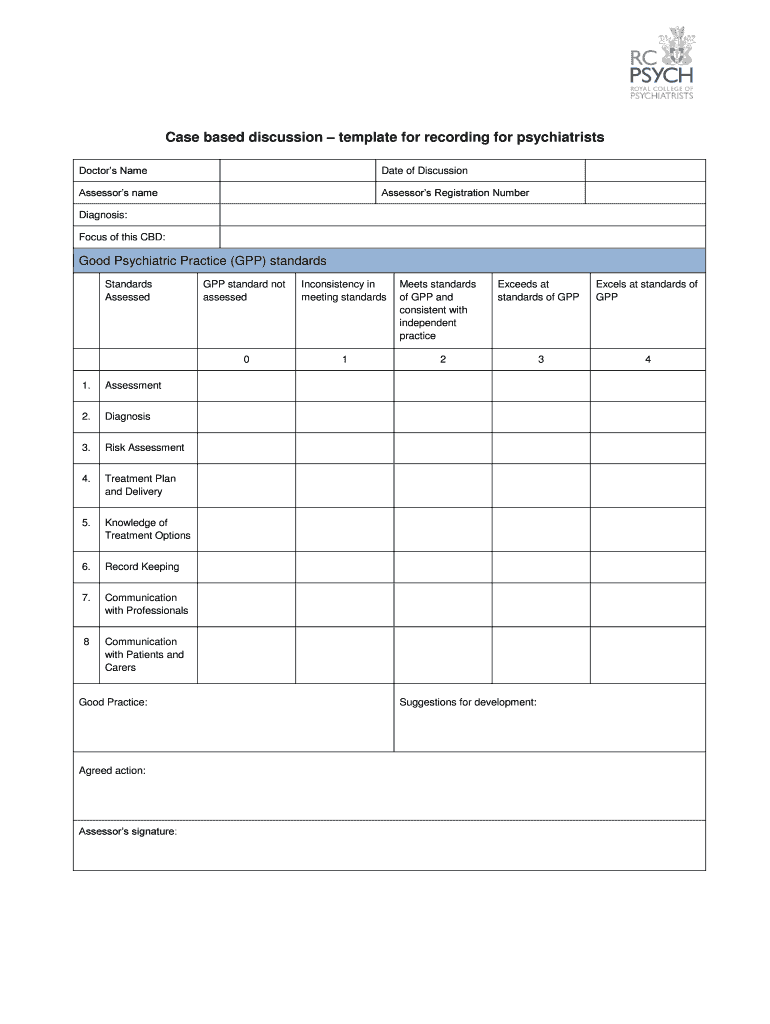
The "Case Based Discussion Template for Recording for Psychiatrists" is an essential tool designed to facilitate structured assessments of Good Psychiatric Practice (GPP). This template serves as a standard framework for psychiatrists to record and evaluate important aspects of patient cases. By providing sections for details such as the psychiatrist's name, date, diagnosis, and specific assessment areas, it ensures a comprehensive approach to documenting case-based discussions (CBDs). This practice is vital for professional development and adherence to established psychiatric standards.
How to Use the Case Based Discussion Template
Using the Case Based Discussion Template involves several key steps that ensure effective data recording and evaluation. Psychiatrists begin by selecting a relevant patient case that aligns with the goals of the discussion. A detailed examination of the case, including diagnosis and therapeutic approach, is then documented in the provided sections. The template allows for chronological recording of discussion points, feedback, and reflection, which promotes a thorough assessment of professional practice and patient outcomes.
- Select a Case: Choose a patient case that highlights specific aspects of psychiatric practice.
- Document Details: Fill in sections with the psychiatrist's name, case date, and patient diagnosis.
- Record Discussion: Note key discussion points, focusing on clinical decision-making and problem-solving.
- Feedback & Reflection: Include constructive feedback received and personal reflections to enhance future practice.
Key Elements of the Template
The template is comprised of several key elements that facilitate detailed analysis and discussion. These elements ensure that each area of psychiatric evaluation is thoroughly covered and documented:
- Personal and Case Details: Record the psychiatrist's name, discussion date, and patient diagnosis.
- Assessment Areas: Focus on specific areas like clinical decision-making, risk assessment, and treatment planning.
- Feedback Section: Space for assessors to provide constructive feedback on the psychiatrist's performance.
- Reflective Notes: Area for psychiatrists to reflect on discussions and feedback, aiding in professional growth.
Steps to Complete the Template
Completing the Case Based Discussion Template efficiently involves understanding its structure and requirements. Follow these detailed steps to ensure comprehensive documentation:
- Initial Preparation: Review the patient's history and treatment plan to choose a suitable case.
- Detail Entry: Accurately complete personal and case details in the template's initial sections.
- Discussion Recording: Document each aspect of the discussion systematically, focusing on key assessment criteria.
- Incorporate Feedback: Carefully note any feedback provided by the assessor for professional insight.
- Add Reflections: Reflect on the discussion outcome to recognize areas of strength and aspects needing improvement.
Who Typically Uses the Template
The template is predominantly used by psychiatrists at various stages of their career, from residents to experienced practitioners seeking continued professional development. It is also utilized by supervisors and assessors who evaluate and provide feedback during case-based discussions. The tool aids in fulfilling educational requirements and is pivotal in the continuous enhancement of clinical skills and judgment.
- Psychiatric Residents & Trainees: Utilize the template for documenting assessment and feedback during training.
- Experienced Psychiatrists: Use it to evaluate complex patient cases and support peer discussions.
- Supervisors & Assessors: Provide structured feedback and evaluate psychiatrist performance using the template.


Why Use the Template
Utilizing this template offers multiple benefits in the psychiatric field. It not only structures the evaluation process but also ensures consistency across case discussions. Through this methodical approach, psychiatrists can identify strengths and areas for development, while assessors can objectively measure and guide their progress.
- Structured Analysis: Provides a clear framework for documenting and analyzing case discussions.
- Consistent Evaluation: Ensures uniformity in evaluation standards and criteria.
- Professional Growth: Facilitates constructive feedback and reflection for continuous improvement.
- Educational Requirement: Fulfills mandatory CBDs needed for professional accreditation and development.
Important Terms Related to the Template
Understanding the terminology within the Case Based Discussion Template can enhance comprehension and application. Some key terms often associated with the template in the psychiatric context include:
- Good Psychiatric Practice (GPP): Standards to which psychiatric practice is held, ensuring quality care.
- Clinical Decision-Making: The process of evaluating patient information to make informed healthcare decisions.
- Risk Assessment: Evaluation of potential risks posed to or by the patient, forming a crucial part of psychiatric assessment.
- Reflective Practice: A method of self-examination and evaluation to improve clinical practice and outcomes.
Examples of Using the Template
The practical application of this template can be illustrated through various real-world scenarios. Consider a case where a psychiatrist assesses a patient with depression and anxiety. Using the template, the psychiatrist records the diagnosis, therapeutic strategies, and outcomes of the discussion with peers or supervisors. Feedback might emphasize effective risk assessment practices or suggest alternative therapeutic approaches. Over time, these documented discussions contribute significantly to the psychiatrist's professional development and refinement of clinical skills.