REASONABLE ACCOMMODATIONS UNDER THE ADA 2026

Get Form
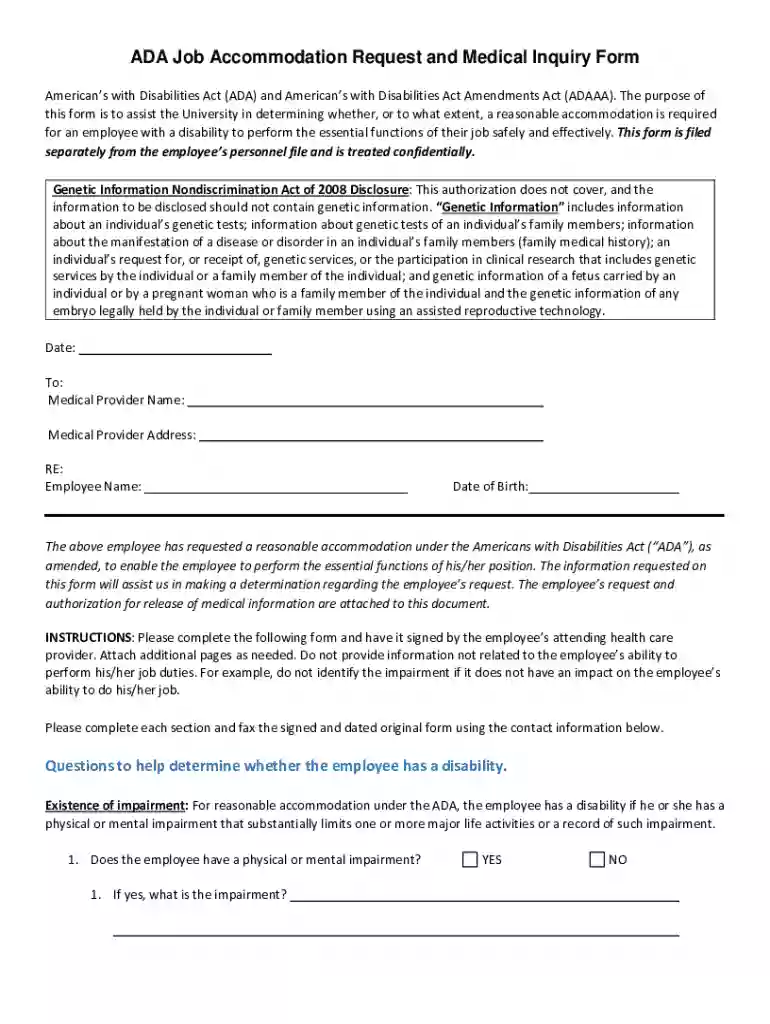
REASONABLE ACCOMMODATIONS UNDER THE ADA Preview on Page 1

Here's how it works

01. Edit your form online
Type text, add images, blackout confidential details, add comments, highlights and more.

02. Sign it in a few clicks
Draw your signature, type it, upload its image, or use your mobile device as a signature pad.

03. Share your form with others
Send it via email, link, or fax. You can also download it, export it or print it out.

Definition and Meaning of Reasonable Accommodations Under the ADA

Reasonable accommodations under the Americans with Disabilities Act (ADA) refer to modifications or adjustments to a job or work environment that enable qualified individuals with disabilities to perform the essential functions of a job. These accommodations are designed to provide equal employment opportunities without imposing undue hardship on the employer. Examples include accessible workspaces, modified work schedules, and assistive technologies.

Key Elements of Reasonable Accommodations

Understanding the critical components of reasonable accommodations is essential for both employers and employees. The key elements include:

  • Essential Job Functions: Identifying job duties that are fundamental and cannot be changed. Accommodations address how these tasks are performed rather than altering the essential duties themselves.
  • Qualified Individual: The employee must meet the requirements for the job, with or without accommodations.
  • Interactive Process: Involves open communication between the employer and employee to explore potential accommodations.

Steps to Complete the ADA Accommodation Request Form

Filling out the ADA accommodation request form involves several key steps:

  1. Employee Information: Provide basic personal and contact information.
  2. Job Description: Outline essential duties and responsibilities.
  3. Disability Description: Detail the nature of the disability, any limitations, and how they affect job performance.
  4. Proposed Accommodations: List suggested modifications or tools needed to perform job tasks effectively.
  5. Medical Documentation: Include any relevant medical records or a physician's statement supporting the request.

Who Typically Uses the Form

This form is typically used by:

  • Employees with Disabilities: Seeking adjustments to perform their jobs effectively.
  • Human Resources Professionals: Facilitating the accommodation process.
  • Medical Professionals: Providing necessary documentation for employees' medical conditions.
  • Employers: Ensuring compliance with legal obligations under the ADA.
decoration image ratings of Dochub

Why Request Reasonable Accommodations

The primary purpose of requesting reasonable accommodations is to ensure that employees with disabilities have an equal opportunity to thrive in their workplace. Benefits include:

  • Increased Productivity: Employees can perform their jobs more effectively with the right accommodations.
  • Legal Compliance: Helps employers adhere to ADA requirements and avoid discrimination lawsuits.
  • Employee Retention: Creates an inclusive work environment that reduces turnover and fosters loyalty.

Legal Use of the Form

The ADA accommodation request form is a crucial tool for ensuring legal compliance with the ADA. Its use must be consistent with privacy laws and anti-discrimination regulations. Employers are required to:

  • Maintain Confidentiality: Safeguard any medical information obtained during the accommodation process.
  • Avoid Discrimination: Ensure that individuals with disabilities are not treated unfavorably because of their condition.

Important Terms Related to ADA Accommodations

Familiarity with specific terminology is crucial when dealing with ADA accommodations:

  • Undue Hardship: A significant difficulty or expense that may excuse an employer from providing certain accommodations.
  • Accessibility: The design of products, devices, and environments to be usable by people with disabilities.
  • Interactive Process: The ongoing dialogue between employer and employee to identify effective accommodations.

State-Specific Rules for Accommodations

While the ADA sets federal standards, individual states may have additional requirements:

  • State Laws: Some states have specific disability laws that provide broader protections than the ADA.
  • Local Regulations: Certain jurisdictions may have unique compliance criteria or additional resources for accommodating employees with disabilities.

Application Process and Approval Time

The accommodation request process involves several stages:

  1. Submission: Employees submit the completed form to their employer.
  2. Review: Employers assess the request, consult with medical professionals if necessary, and explore possible accommodations.
  3. Decision: Employers provide a timely response indicating the decision or needed adjustments.
  4. Implementation: Approved accommodations are put in place, and their efficacy is monitored over time.

Approval time can vary based on the complexity of the requested accommodation and the employer's resources. Employers are encouraged to process requests promptly to avoid delays that could hinder an employee's job performance.

Examples of Using the ADA Accommodation Form

Practical examples illustrate the varied use of accommodation forms:

  • Case Study 1: An employee with a mobility impairment requests a height-adjustable desk and ergonomic chair to enhance comfort and efficiency at work.
  • Case Study 2: A visually impaired employee needs screen reader software to access digital content on their computer.
  • Case Study 3: A person with a hearing disability requests sign language interpretation for team meetings and training sessions.

Each case requires an individualized assessment to determine appropriate accommodations that meet both the employees' needs and the employer's capabilities.

be ready to get more

Complete this form in 5 minutes or less

Get form

Security and compliance

At DocHub, your data security is our priority. We follow HIPAA, SOC2, GDPR, and other standards, so you can work on your documents with confidence.

Learn more
ccpa2
pci-dss
gdpr-compliance
hipaa
soc-compliance
be ready to get more

Complete this form in 5 minutes or less

Get form