
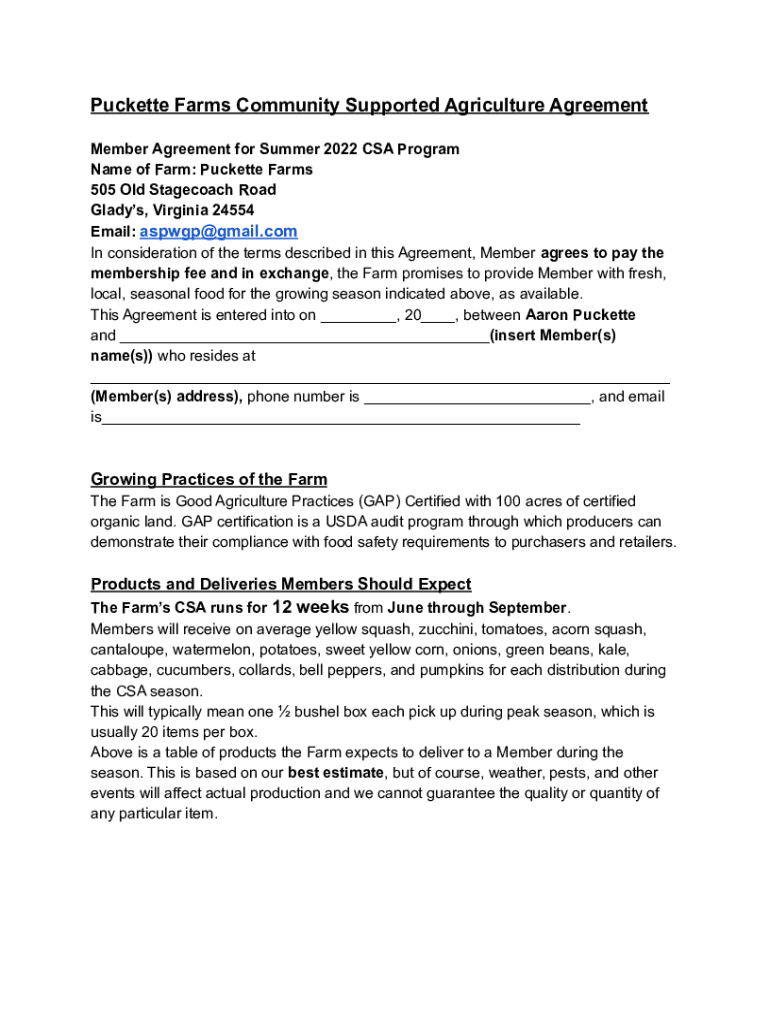







Key Elements of the Puckette Farms Community Supported Agriculture Agreement
The Puckette Farms Community Supported Agriculture (CSA) Agreement is a pivotal document for participants in the Summer 2022 CSA program. The agreement outlines the responsibilities and privileges of members who invest in a seasonal share of the farm's produce. Here are the primary elements covered in the agreement:
- Membership Fee: Participants are required to pay a fee upfront, which entitles them to receive a bi-weekly or weekly share of fresh, local produce throughout the 12-week season.
- Seasonal Produce: The farm provides a variety of GAP-certified vegetables and fruits, ensuring high-quality and safe-to-consume products.
- Risk and Reward Sharing: As part of the CSA model, members share in the risks and rewards of farming, including crop failures or surpluses.
- Pick-Up Responsibilities: Members are responsible for picking up their produce at designated times and locations, ensuring timely access to fresh goods.
- Communication Channels: The agreement specifies how participants should communicate with the farm, typically through email updates and a dedicated member portal.
Steps to Complete the Puckette Farms Community Supported Agriculture Agreement
Completing the CSA Agreement involves several essential steps, designed to ensure that both parties fully understand the terms and commitments. Below is a step-by-step guide:
- Read the Agreement: Carefully review the entire agreement to understand all conditions, including payment terms and responsibilities.
- Provide Personal Information: Enter your name, address, and contact information in the relevant fields.
- Select Share Type: Choose between the available share options, whether bi-weekly or weekly, based on your needs.
- Agree to Terms: Checkboxes are typically provided for members to acknowledge and agree to various terms, such as pick-up responsibilities and risk-sharing.
- Sign the Agreement: The agreement must be signed electronically through a secure platform, ensuring it is legally binding and compliant with the ESIGN Act.
- Submit the Agreement: Once completed, submit the agreement through the designated platform or email as instructed.
How to Obtain the Puckette Farms Community Supported Agriculture Agreement
Accessing the CSA Agreement is straightforward, ensuring ease of participation for interested individuals. Here are the methods through which you can obtain the document:
- Online Access: The agreement can be downloaded from the Puckette Farms website, providing a convenient option for prospective members.
- Email Request: Interested parties can request a copy of the agreement via email, offering direct interaction with the farm's customer service team.
- In-Person Visit: Visiting the farm directly allows potential members to obtain a physical copy and discuss any questions or concerns with staff members.
Important Terms Related to the CSA Agreement
Understanding the terms used in the CSA Agreement is crucial for clear communication and comprehension. Here are some key definitions:
- Community Supported Agriculture (CSA): A program where individuals purchase shares of a farm's harvest in advance, providing financial support to the farm.
- GAP Certified: A certification ensuring that the farm's produce adheres to Good Agricultural Practices, focusing on food safety.
- Risk Sharing: The concept that members accept shared responsibility for both successes and challenges, such as weather-related crop issues.
- Indemnification: Members agree to hold the farm harmless for events outside of its control, reflecting shared accountability.
Legal Use of the Puckette Farms Community Supported Agriculture Agreement
The CSA Agreement not only facilitates a mutual understanding between farmers and members but also serves as a legally binding document. Here are key legal considerations:
- Compliance with ESIGN Act: Electronic signatures on the agreement are recognized as legally valid, provided they meet the standards set forth by the act.
- Consumer Protection: Members are protected under consumer law, ensuring transparency and fair treatment under the agreed terms.
- Dispute Resolution: The agreement typically outlines methods for resolving disputes, whether through mediation or arbitration, to avoid litigation.
Examples of Using the CSA Agreement
Engaging with the CSA Agreement through practical scenarios can help illustrate its applicability. Consider these examples:
- Family Subscription: A family subscribes to a weekly share, collecting fresh produce regularly and exploring new recipes.
- Farmers Market Vendors: A small business owner participates to resell produce at local markets, relying on the CSA for consistent supplies.
- Health Enthusiasts: Individuals focused on healthy living might join the CSA to ensure access to organic and fresh produce regularly.
State-Specific Rules for the CSA Agreement
While the CSA model is broadly consistent, slight variations might occur based on state regulations. Here are potential differences:
- State Regulations: Local agricultural regulations may influence GAP certification requirements or food safety standards.
- Tax Incentives: Some states may offer tax benefits for participating in CSAs, encouraging local agricultural support.
- Consumer Rights Variances: States may have different laws concerning contract cancellation periods or refund policies.
Digital vs. Paper Version of the CSA Agreement
The choice between digital and paper versions of the CSA Agreement reflects preferences for convenience and physical documentation. Below are considerations:
- Digital Agreement: Ideal for ease of access, storage, and environmental impact reduction. It integrates seamlessly with electronic signature tools and online communications.
- Paper Copy: Preferred by those who value physical documentation for personal records, allowing handwritten annotations or notes.




