




01. Edit your form online
Type text, add images, blackout confidential details, add comments, highlights and more.

Type text, add images, blackout confidential details, add comments, highlights and more.

Draw your signature, type it, upload its image, or use your mobile device as a signature pad.

Send it via email, link, or fax. You can also download it, export it or print it out.
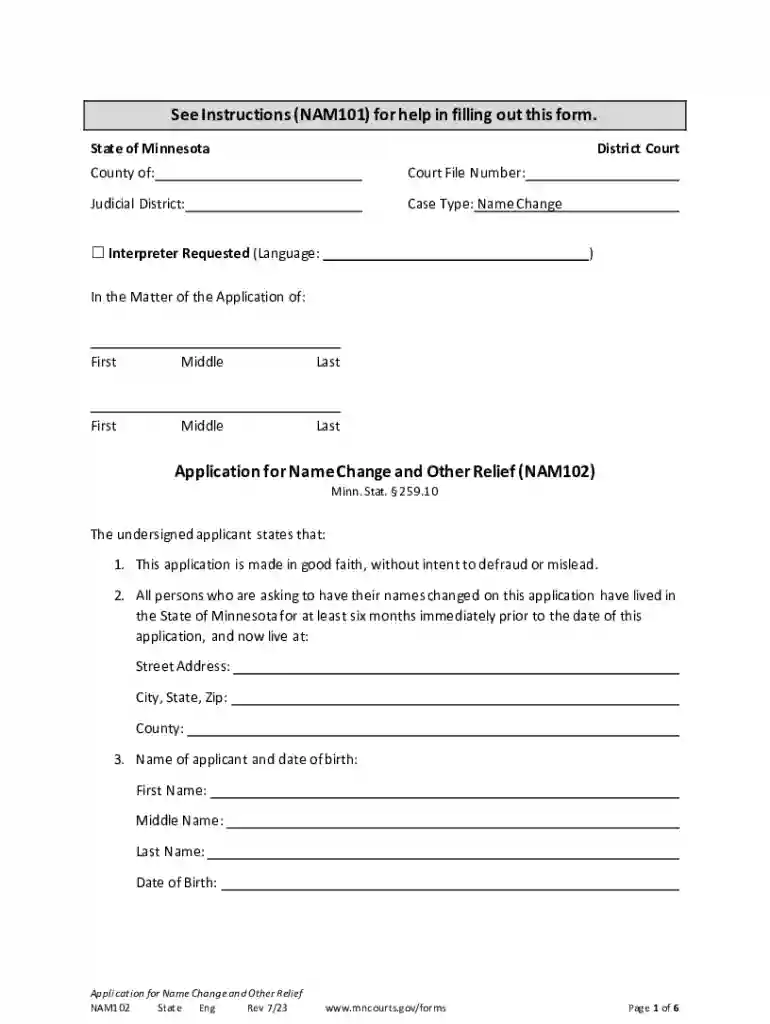
The "Application for Name Change and Other Relief (nam102)" is a legal document used primarily in the State of Minnesota to facilitate changes in an individual's legal name. This application is essential for individuals seeking to legally alter their name due to various personal reasons such as marriage, divorce, adoption, or personal preference. It also encompasses other reliefs that may accompany the name change request, ensuring a comprehensive approach to document modification within legal frameworks.
This form requires applicants to provide personal details and any relevant background information, ensuring that the name change process aligns with legal stipulations. Understanding its purpose is crucial for accurate and successful submissions.
To use the "Application for Name Change and Other Relief (nam102)," an individual must start by gathering all necessary personal and relevant information, such as current legal name, desired new name, and reasons for the change. This collected information guides the completion of the form accurately and ensures that no critical aspect is overlooked.
Here is a step-by-step guide on how to use the form:
Download or obtain the form: The form can be accessed online through legal document platforms or directly from Minnesota’s court system.
Fill in personal details: Provide detailed information about your current legal name, the desired new name, and the reason for the name change.
Provide criminal history details: Disclose any past criminal records, if applicable, as these may affect the name change process.
Include any additional reliefs: If seeking additional legal reliefs alongside the name change, ensure they are specified within the form.
Review and sign: Carefully review all provided information for accuracy and sign the form to authenticate the details.
Submit the form: Depending on state requirements, submit the form either online, by mail, or in person at the designated legal office.
Several essential elements are included in the "Application for Name Change and Other Relief (nam102)" to ensure its validity and acceptance. Understanding these components can streamline the completion process.
Each of these elements contributes to the comprehensive coverage necessary for a successful name change application.
Completing the "Application for Name Change and Other Relief (nam102)" involves a systematic approach to gather, verify, and submit accurate information. Here's a detailed guide to ensure successful completion:
Gather Required Information: Prepare all personal details, including legal documents like birth certificates or IDs.
Complete the Application Form:
Obtain Necessary Signatures: Sign the form under penalty of perjury, ensuring all information is accurate.
Attach Required Documents: Include photocopies of identification documents or any other required legal documents.
Pay Applicable Fees: Ensure payment of any fees associated with the application submission, which might vary based on jurisdiction.
Submit the Form: Deliver the completed form to the relevant legal authority through specified channels.
Following these steps meticulously can help avoid common errors and streamline the application process.
The application for a name change is governed by state-specific rules, particularly in Minnesota, where this form is predominately used. Legal use underscores the importance of adherence to state laws during the name change application process.
Minnesota-Specific Regulations: In Minnesota, applicants may need to appear before a judge to explain their reasons for the name change. This may involve a hearing where any objections to the name change can be addressed.
Age and Consent: Applicants over the age of eighteen can independently file for a name change, while minors require parental consent and involvement.
Criminal Conviction Impact: Individuals with a criminal record may face additional scrutiny and conditions before application approval. State laws dictate specific circumstances where a name change may be denied based on criminal history.
Understanding and adhering to these legal parameters ensures compliance and increases application success rates.
The eligibility to file the "Application for Name Change and Other Relief (nam102)" is subject to certain criteria and conditions that applicants must meet. Recognizing these prerequisites ensures a valid application process.
Residency: Applicants must be residents of Minnesota and typically need to prove residency with documents like utility bills or a lease agreement.
Age Requirements: Individuals must be of legal adult age or have parental consent if filing on behalf of a minor.
Legal Constraints: Applicants must not seek a name change for illegal reasons, such as evasion of debt or past criminal records. Courts scrutinize requests to ensure legitimacy.
Appropriate adherence to these criteria aids in streamlining the examiners' approval process.


To successfully process the name change application, several supporting documents may be required to validate the information. Including these documents can prevent unnecessary delays and facilitate smoother processing.
Ensuring all these attachments are accurate and current is essential for application approval.
The "Application for Name Change and Other Relief (nam102)" is utilized by a diverse range of individuals for various personal and legal reasons. Understanding use cases can provide deeper insight into the form's practical applications.
By examining these scenarios, applicants can better understand the form's relevance and complete it efficiently for similar circumstances.
At DocHub, your data security is our priority. We follow HIPAA, SOC2, GDPR, and other standards, so you can work on your documents with confidence.


