






Definition & Meaning
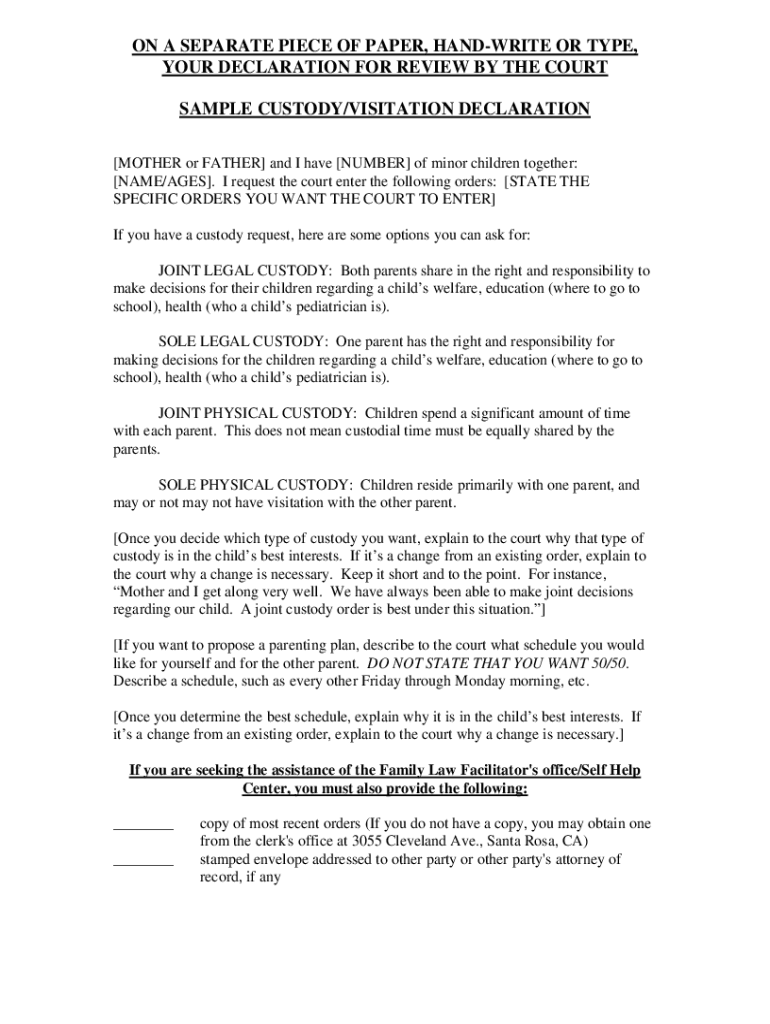
A Sample Declaration Letter to Judge for Child Custody is a formal written statement submitted to a family court by a parent or guardian involved in a child custody case. This declaration is intended to provide the judge with detailed information about the parent's terms for custody arrangements, outlining their requests for custody and explaining the reasons behind these requests. The primary aim is to persuade the court that the proposed custody plan aligns with the child's best interests. Key components typically include the number of children involved, specific custody requests (such as joint or sole custody), and arguments supporting these requests based on the child's well-being.
Key Components
- Parent's Information: Includes full name, address, and contact information.
- Child's Information: Details about the child or children, such as names and ages.
- Custody Requests: Explanation of the desired custody arrangements and visitation schedules.
- Supporting Arguments: Rationale for the proposed arrangements, demonstrating consideration of the child's needs.
- Conclusion: A brief summary and reiteration of the custody requests.
How to Use the Sample Declaration Letter to Judge for Child Custody
To effectively utilize the Sample Declaration Letter to Judge for Child Custody, individuals should tailor the template to their specific situation while adhering to legal standards. The letter should be honest and precise, providing concrete examples of why the suggested custody plan benefits the child.
Step-by-Step Writing Process
- Introduce Yourself and the Case: Begin with personal details and your relationship to the child.
- State Your Custody Request: Clearly articulate the type of custody you are seeking.
- Provide Supporting Details: Use specific incidents and evidence that support your custody request.
- Conclude with Your Proposed Plan: Offer a detailed parenting plan that includes visitation and custody schedules.
Practical Tips
- Be Concise: Keep sentences short and straightforward.
- Stay Objective: Focus on facts rather than emotions.
- Review Legal Guidelines: Ensure compliance with local family law regulations.
Steps to Complete the Sample Declaration Letter to Judge for Child Custody
Completing the Sample Declaration Letter involves a series of methodical steps to ensure all necessary details are included and the letter is persuasive to the judge reviewing the case.
- Research Local Requirements: Familiarize yourself with state-specific regulations regarding child custody declarations.
- Draft the Introduction: State your name, the child's name, and the purpose of the letter.
- Outline Custody Requests: Specify whether joint or sole custody is sought and provide justification.
- Develop Supporting Arguments: Include evidence that highlights your capability as a parent.
- Propose a Parenting Plan: Present a realistic and structured custody schedule.
- Revise and Edit: Review the letter for clarity, grammar, and compliance with legal standards.
Revision Checklist
- Are all essential details clearly outlined?
- Is the language straightforward and professional?
- Have local legal requisites been met?
Key Elements of the Sample Declaration Letter to Judge for Child Custody
The Sample Declaration Letter comprises several critical elements that ensure the court fully understands the parent's perspective and intentions.
Essential Sections
- Introduction: Establishes the author's relationship to the child and intention.
- Custody and Visitation Requests: Articulates the specific custody arrangement the parent is proposing.
- Justification: Provides thorough reasoning and evidence to support the custody proposal.
- Conclusion: Summarizes the request and underscores the child's best interest.
Supporting Documentation
- Character References: Letters from family members or friends affirming the parent's suitability.
- Evidence of Involvement: Documentation of active participation in the child's life.
- Professional Evaluations: Reports from child psychologists or social workers, if applicable.
Legal Use of the Sample Declaration Letter to Judge for Child Custody
The legal standing of a Sample Declaration Letter allows it to be a pivotal document in custody cases. It serves as formal evidence presented during hearings to sway judicial decisions.
Standard Legal Practices
- Compliance with Court Format: Adhering to prescribed formats and conventions increases the letter’s credibility.
- Submission Protocols: Timely submission in compliance with judicial deadlines is crucial.
- Inclusion of Verified Evidence: Affixing relevant documents enhances authenticity and supports claims.
Common Legal Outcomes
- Influencing the judge’s custody decision by presenting a compelling argument.
- Establishing the parent's commitment to the child's welfare.
- Clarifying any misconceptions about the parent's capacity to provide a stable environment.
State-Specific Rules for the Sample Declaration Letter to Judge for Child Custody
Different states within the U.S. may have nuanced requirements for what should be included in a Sample Declaration Letter for child custody.
Key Differences
- Documentation Needs: Some states might require additional documentation, such as proof of residence or employment.
- Formatting Requirements: Court-specific templates or structures may be mandated.
- Submission Processes: Varying guidelines for filing methods, whether online, via mail, or in person.
Examples of State Variations
- California: May emphasize the child’s relationship with each parent and the parenting environment.
- Texas: Could require a separate affidavit verifying the truth of statements made in the declaration.
Examples of Using the Sample Declaration Letter to Judge for Child Custody
Real-world applications of a Sample Declaration Letter illuminate its versatile role in legal proceedings.
Scenarios
- Parental Custody Requests: Parents pursuing changes to existing custody orders.
- Grandparent Visitation Rights: Grandparents seeking court-sanctioned visitation may use a similar template.
- Disputed Custody Cases: Offering a clear and well-documented argument to counter opposing claims.
Case Study
A single mother in Ohio successfully gained joint custody by detailing her daily involvement in the child’s schooling and extracurricular activities, presented through a meticulously crafted declaration letter.