Definition & Meaning
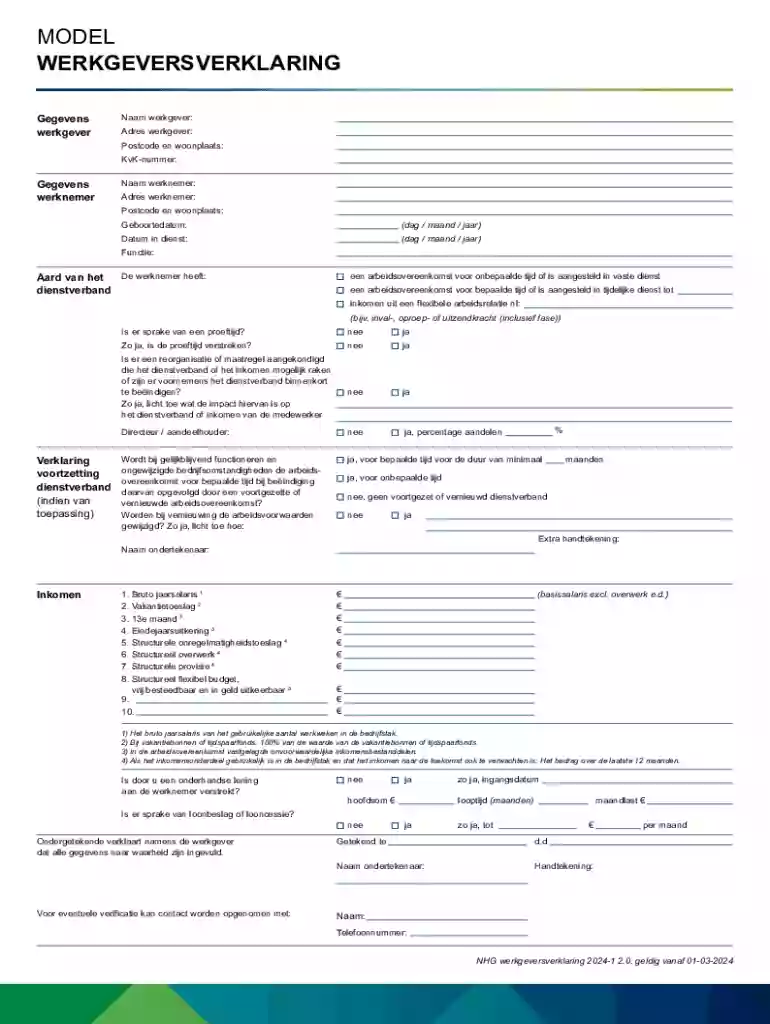
The MODEL WERKGEVERSVERKLARING, or Employer Declaration, is a document primarily used by employees to validate and confirm their employment status, job details, and compensation when undergoing various administrative processes. It serves as a testament to an individual's employment conditions, including salary components, employment type, and any conditions related to their contract. These details play a critical role when employees apply for loans, rentals, or other formal proceedings where proof of stable income and employment is crucial.
Key Elements
- Employee Information: Contains personal details such as full name, address, and social security number.
- Employment Details: Describes employment type (full-time, part-time), position, and employment duration.
- Salary Breakdown: Includes base salary, bonuses, commissions, and other compensations.
- Contract Conditions: Details about probation periods, contract length, and any specifics regarding employment termination.
- Employer Information: Provides the company's name, address, and official contact details.
How to Use the MODEL WERKGEVERSVERKLARING
The form is utilized during several financial and legal interactions requiring proof of employment. For instance, an employee might need to present this declaration when applying for a mortgage, where lenders require evidence of job security and salary confirmation. Similarly, landlords may request the form to ensure that prospective tenants have a reliable income source.
Steps for Utilization
- Fill Out Employee Details: Ensure accuracy in your personal and employment details.
- Submit to Employer: Present the form to your employer for verification and signature.
- Use as Needed: Provide the completed document as required by banks, landlords, or other institutions.
Steps to Complete the MODEL WERKGEVERSVERKLARING
Completing the MODEL WERKGEVERSVERKLARING requires meticulous attention to detail to ensure the information is correctly entered and validated by the employer.
- Personal Information: Begin with filling out your personal details such as name, address, and contact information.
- Employment Details: Include your job title, employment start date, and type (full-time or part-time).
- Salary Information: Break down your compensation package, listing all salary components.
- Contractual Information: Detail any probationary periods and employment contract stipulations.
- Employer Verification: Submit the form to your employer for signature and company seal.
Verification Process
- Employer Signature: The form must be signed by an authorized representative from your employer.
- Company Seal: Some institutions may require a company stamp or seal for additional verification.
Key Elements of the MODEL WERKGEVERSVERKLARING
This form is structured to capture comprehensive employment-related information. Each section is crucial in ensuring the document serves its purpose effectively.
- Personal & Contact Information: Key identifiers for the employee.
- Job Details: Includes position, department, and employment status.
- Compensation Package: A comprehensive view of the employee's remuneration.
- Employment Terms: Covers contract length, renewal options, and discrepancies.
- Employer Information & Authorized Signature: Validates the document's authenticity.
Examples
- Mortgage Application: Provides lenders with necessary employment verification.
- Rental Agreements: Assures landlords of reliable and steady income from the tenant.
- Visa Applications: Used as part of documentation for international travel to demonstrate employment status.
Legal Use of the MODEL WERKGEVERSVERKLARING
The document holds legal significance in various transactional and procedural environments. It is often essential in proceedings where proof of employment status affects eligibility or compliance.
Practical Applications
- Loan Approval Processes: Banks may require the document to determine borrower reliability.
- Immigration Requirements: Acts as evidence of ties to the workplace and continuity of employment.
- Legal Proceedings: Can be used to demonstrate employment stability in disputes or agreements.
Compliance Considerations
- Accuracy: Ensures all information must be current and precise to maintain legal validity.
- Employer Responsibility: Employers need to ensure the details are verified and accurately depict the employee's standing.
Who Typically Uses the MODEL WERKGEVERSVERKLARING
This form is primarily utilized by employees across different sectors who need to assert their employment credentials in various situations.

Typical Users
- Employees: Individuals seeking loans, renting property, or requiring job verification for a process.
- Financial Institutions: Utilize the document to validate loan or mortgage applications.
- Landlords: Assess prospective tenants' ability to maintain rent payments.
- Legal Authorities: Employ the form to verify employment claims during legal proceedings.
Required Documents for MODEL WERKGEVERSVERKLARING
To ensure completeness and validity of the form, certain documents accompany the submission to substantiate the claims within the declaration.
Supporting Documents
- Proof of Identity: Often a government-issued ID such as a driver’s license or passport.
- Current Pay Stubs: Validates salary information provided on the form.
- Employment Contracts: Clarifies the terms and conditions of the worker's engagement.
- Employer Letters: Formal letter from the employer validating the details and supplementing the declaration form.
Document Submission
All supporting documents should be submitted alongside the completed MODEL WERKGEVERSVERKLARING for verification. Failure to provide these documents may result in delays or rejection of the declaration.
Form Submission Methods (Online / Mail / In-Person)
Completing the form involves choosing the most suitable submission method based on the requirements of the receiving institution.
Submission Options
- Online: Upload digital copies through a secure portal if the receiving entity supports digital submissions.
- Mail: Send completed physical forms via postal services, ensuring all documents are securely packaged.
- In-Person: Deliver completed forms directly to the institution for immediate processing and confirmation.
- Digital Security: Ensure that all electronic submissions are through secure channels to prevent unauthorized access.
- Postal Confirmation: Choose tracking and confirmation services for mailed submissions to verify receipt.