







Definition & Meaning
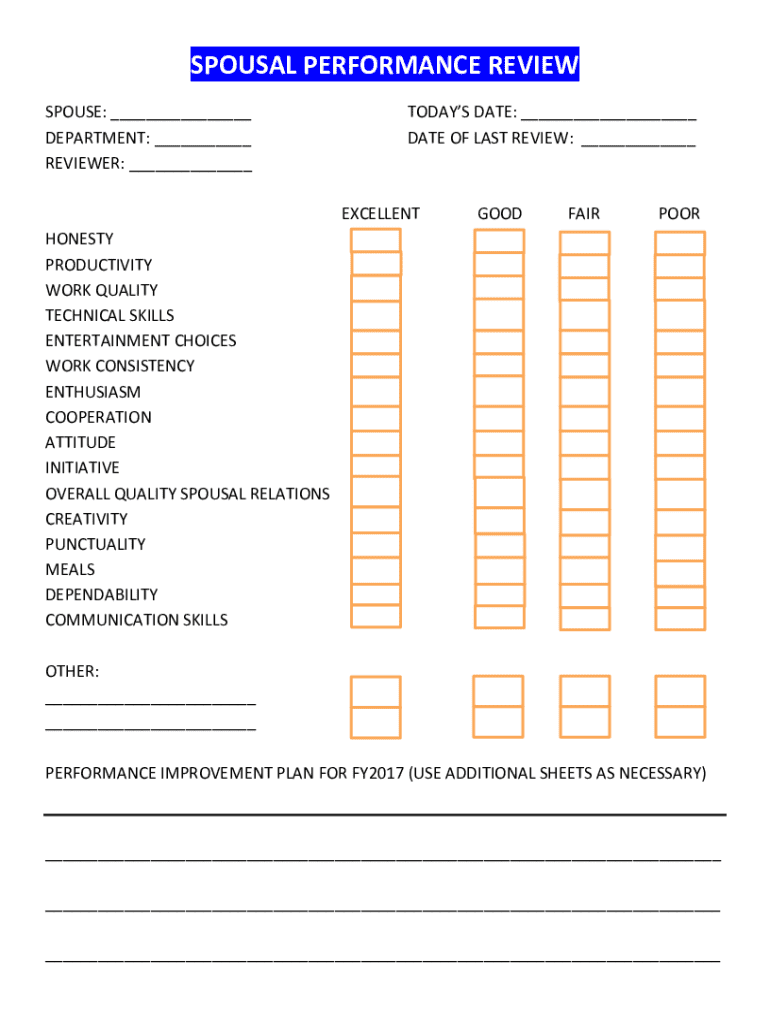
The Spousal Performance Review is a document used to assess various aspects of a spouse's performance in personal and domestic environments. Unlike traditional business performance evaluations, this form focuses on elements such as honesty, productivity, work quality, and communication skills within the context of marriage or partnership. It serves as a tool for couples to candidly evaluate their relationship dynamics and address areas needing improvement. Understanding its purpose and application can help couples use this evaluation constructively to strengthen their relationship.
- Performance Areas: The form evaluates specific areas including honesty, productivity, work quality, and communication skills.
- Purpose: Facilitates open communication between spouses about personal and shared responsibilities.
- Outcome: Aims to foster relationship growth through mutual understanding and feedback.
Steps to Complete the Spousal Performance Review
Completing the Spousal Performance Review involves several important steps that ensure the process is thorough and meaningful. Here is a structured guide to facilitate the completion of this form:
-
Preparation: Gather all relevant information about the areas to be evaluated. This may include notes on daily routines, shared responsibilities, and any relevant incidents that highlight specific performance attributes.
-
Ratings Section: Carefully assess each performance area using the provided ratings scale, which typically includes 'Excellent,' 'Good,' 'Fair,' and 'Poor.'
-
Comments Section: Provide detailed comments for each rated area. Use specific examples to justify the ratings, ensuring that the feedback is constructive rather than critical.
-
Performance Improvement Plan: Collaboratively develop a plan for improvement where necessary. This should include realistic goals and strategies for achieving them.
-
Review & Discussion: After completing the form, both parties should review the results together. Discuss the feedback openly and agree on action points.
- Tips: Use clear, non-confrontational language to foster a positive dialogue.
- Frequency: Consider doing this review annually or semi-annually to continuously improve marital dynamics.
Key Elements of the Spousal Performance Review
This form contains several essential components that contribute to a comprehensive evaluation:
- Ratings Section: Offers a structured way to evaluate performance across different categories.
- Comments Areas: Provides space for qualitative feedback that complements the numerical ratings.
- Improvement Plans: Encourages proactive steps towards personal and collective development.
Each element is designed to ensure that the feedback is both quantitative and qualitative, providing a well-rounded review process.
Who Typically Uses the Spousal Performance Review
This form is generally used by married couples or domestic partners who wish to evaluate and improve their relationship dynamics. It provides a formalized approach to discussing sensitive subjects and responsibilities.
- Use Cases: Ideal for couples experiencing recurring conflicts about household duties or communication gaps.
- Relationship Stages: Suitable for all relationship stages, from newlyweds to long-term marriages, as it facilitates ongoing improvement and adaptation.
Through its utilization, couples can enhance their understanding of each other's expectations and work together towards a more harmonious relationship.

How to Use the Spousal Performance Review
To use this form effectively, both parties should approach the process with an open mind and a commitment to constructive feedback:
Step-by-Step Usage
- Joint Agreement: Both spouses should agree on the objectives and value of the review process.
- Environment: Choose a comfortable setting free from distractions to complete and discuss the form.
- Honest Feedback: Provide honest, unbiased assessments in each section.
- Collaborative Analysis: Work together on interpreting the results and drafting action plans.
- Follow-Up: Schedule follow-up sessions to review progress and make necessary adjustments.
Using this structured approach ensures that the review process remains focused on improvement rather than criticism.
Legal Use of the Spousal Performance Review
This form does not hold legal weight in a court of law but can serve as an informal tool for agreement and understanding between spouses. Since it is primarily a personal document, it is not regulated by specific legal guidelines.
- Legal Implications: Not legally binding; intended for personal use.
- Confidentiality: Should be treated as a private document between the parties involved.
This perspective ensures that users understand the review's purpose and limitations, focusing on mutual benefit rather than legal enforceability.
Examples of Using the Spousal Performance Review
To illustrate the practical application of the Spousal Performance Review, here are a few scenarios where couples might find it beneficial:
- Scenario 1: A couple uses the review to address longstanding communication issues, ultimately developing a plan to improve daily interactions.
- Scenario 2: Partners living in different time zones utilize the review to evaluate roles and responsibilities, ensuring a balanced load despite geographical challenges.
- Scenario 3: Newlyweds use the form during their first year to establish expectations and adapt roles in their shared home.
These examples demonstrate how the form accommodates various relationship dynamics and can be customized to suit individual needs.
Important Terms Related to Spousal Performance Review
Understanding the terminology used in the Spousal Performance Review is crucial for accurately interpreting its sections and results:
- Performance Improvement Plan: A structured outline designed to address areas needing enhancement.
- Feedback: Constructive criticism or praise aimed at acknowledging strengths and identifying growth areas.
- Rating Scale: The measurement system (e.g., Excellent, Good, Fair, Poor) used to quantify performance in each area.
Being familiar with these terms ensures that users can effectively engage with the review process and interpret the outcomes.
By thoroughly exploring each block, this content provides a comprehensive guide to understanding and utilizing the Spousal Performance Review, offering valuable insights and practical guidance for couples seeking to improve their marital relationship.




