
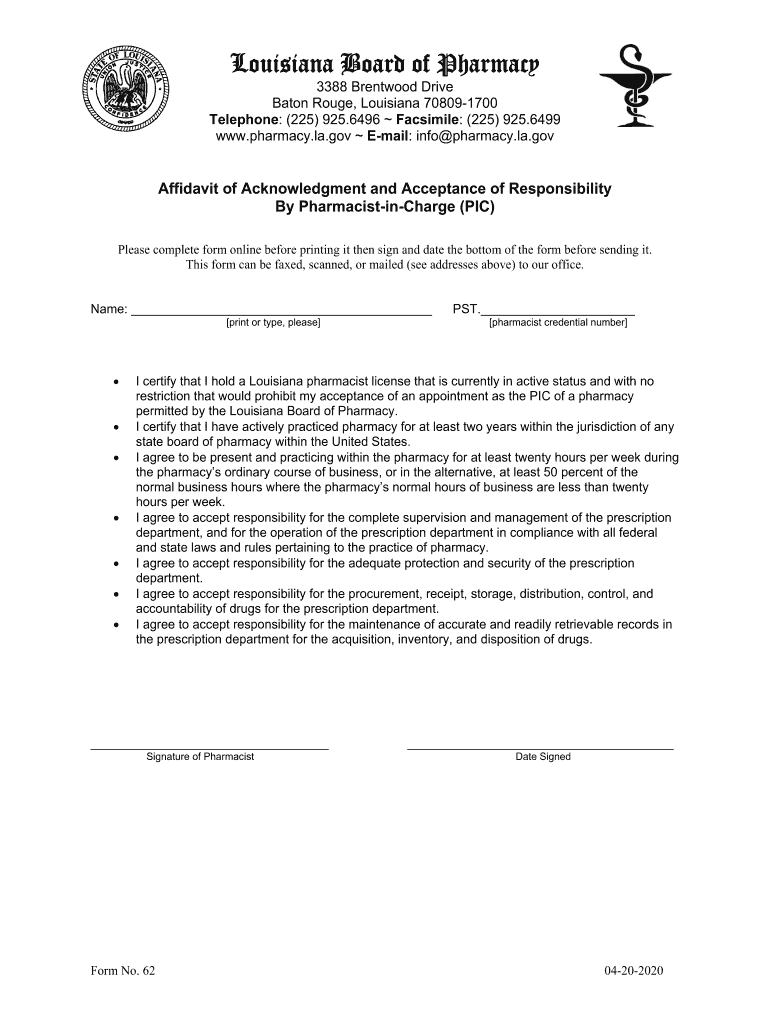







Definition and Meaning of the Affidavit of Acknowledgement and Acceptance of Responsibility
An Affidavit of Acknowledgement and Acceptance of Responsibility is a legal document primarily used to confirm an individual's acceptance of specific duties, responsibilities, and roles. It serves as a formal declaration under oath, where the signatory acknowledges their obligations and accountability in a particular context, such as a Pharmacist-in-Charge (PIC) in a pharmacy setting.
Purpose and Need
-
Legal Confirmation: This affidavit serves as a legal record, verifying that the person has willingly accepted the responsibilities outlined. It ensures transparency and accountability in professional or legal settings.
-
Professional Compliance: In professions such as pharmacy, it outlines the specific responsibilities related to the management, supervision, and compliance with applicable regulations.
-
Record Keeping: It acts as a crucial document for maintaining comprehensive records of accountability.
Key Elements of the Affidavit
The Affidavit of Acknowledgement and Acceptance of Responsibility contains several key elements, ensuring clarity and completeness.
Essential Components
-
Identification of the Signatory: Includes personal information like name and position.
-
Description of Responsibilities: Outlines detailed obligations the signatory must fulfill.
-
Acknowledgment Clause: A statement where the signatory acknowledges understanding and accepting the responsibilities.
-
Signature and Notarization: Typically requires the signatory's signature and notarization to validate authenticity.
Steps to Complete the Affidavit
Completing an Affidavit of Acknowledgement and Acceptance of Responsibility requires attention to detail to ensure accuracy.
-
Read and Understand Requirements: Thoroughly review the details and obligations before proceeding.
-
Gather Necessary Information: Collect personal and professional details required for the affidavit.
-
Complete the Document: Fill out the document with clear and accurate information, focusing on defined responsibilities.
-
Seek Notarization: Visit a notary public to have the affidavit signed and notarized to ensure its legal standing.
Importance of Using the Affidavit
The affidavit plays a significant role in both legal and professional contexts for various reasons.
Benefits of Compliance
-
Legal Protection: Provides legal defense if disputes arise regarding responsibilities.
-
Clarity in Roles: Offers clear delineation of duties to prevent overlap or misinterpretation of roles.
-
Ensures Accountability: Establishes a formal commitment to uphold defined duties.
Legal Use and Implications
The use of this affidavit varies by legal jurisdiction but generally ensures adherence to regulatory standards and professional guidelines.
Jurisdictional Considerations
-
State Regulations: Some states have specific requirements for this affidavit, particularly if related to licensing or professional standards.
-
Industry-Specific Rules: Certain industries, like healthcare, have stringent rules about acknowledging roles and responsibilities formally.
State-Specific Rules for Affidavit Use
In cases such as a Pharmacist-in-Charge, particular state requirements exist regarding documentation and acknowledgment.
Louisiana Example
- Pharmacist-in-Charge: For a PIC role in Louisiana, the affidavit confirms licensure, practice experience, and management responsibilities within a pharmacy.
Compliance and Variations
- State Regulations: Each state may have its own version or additional conditions attached to the affidavit.
Who Typically Uses the Affidavit
This affidavit is prevalent in professional settings where specific accountability is essential.


Common Users
-
Pharmacists: Often required for roles like PIC where regulation and oversight are crucial.
-
Legal Professionals: Utilize affidavits for various legal acknowledgments.
-
Business Executives: In corporate settings, similar documents might be used to delineate responsibilities among top management.

Examples of Affidavit Use Cases
Utilizing examples can provide clearer understanding and illustrate common scenarios where this affidavit is necessary.
Practical Applications
-
Pharmacy Settings: The affidavit is used to officially acknowledge pharmacy management roles and responsibilities in compliance with state law.
-
Legal Documentation: It is often used to document agreement to terms in legal contracts or settlements.
Variation Across Contexts
- Healthcare: Different healthcare sectors may require similar affidavits for compliance with regulatory standards.
By providing comprehensive insights and a structured approach to understanding this legal form, the content aims to equip individuals with the knowledge necessary for legally acknowledging responsibilities effectively.




