




01. Edit your wdep worksheet online
Type text, add images, blackout confidential details, add comments, highlights and more.

Type text, add images, blackout confidential details, add comments, highlights and more.

Draw your signature, type it, upload its image, or use your mobile device as a signature pad.

Send reality therapy wdep worksheet via email, link, or fax. You can also download it, export it or print it out.
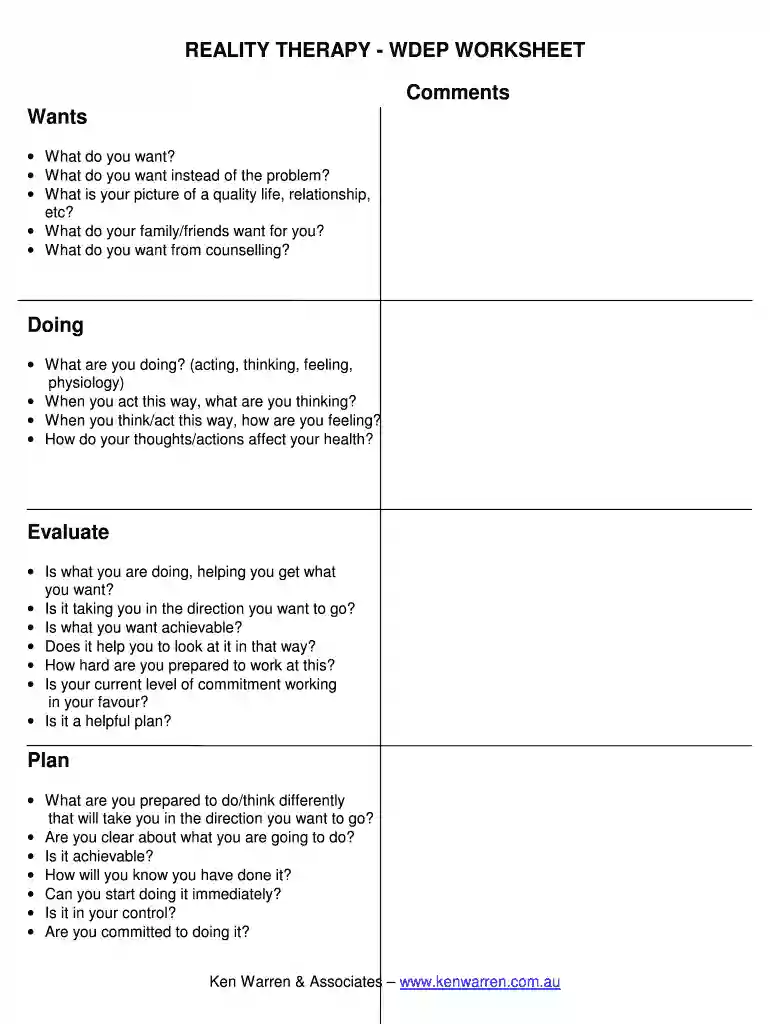
The WDEP worksheet, an integral component of Reality Therapy, is structured to facilitate self-reflection and personal development. It stands for Wants, Doing, Evaluate, and Plan, guiding individuals in a systematic way to articulate their goals, assess current actions, and develop strategies for change.
Wants: This section helps individuals clarify their personal desires and aspirations. It encourages users to reflect on what they genuinely want in various areas of life, such as relationships or career.
Doing: Here, individuals assess their current actions related to their goals. This may involve identifying specific behaviors and habits that contribute to or detract from achieving their wants.
Evaluate: In this critical step, users evaluate the effectiveness of their actions. They reflect on whether their current behaviors are aligned with their desires and how well they are progressing towards their goals.
Plan: The final section is focused on actionable steps. Individuals create specific plans detailing what they will do to bridge the gap between their current state and their desired outcomes.
Identify Your Wants: Begin by listing down what you truly desire in life. Use open-ended questions to explore your feelings and aspirations deeply.
Assess Current Actions: Document what you are currently doing in pursuit of these desires. Be honest about behaviors that may be holding you back.
Evaluate Your Effectiveness: Analyze the gap between your wants and your current actions. Ask yourself questions like, "Are my actions helping or hindering my progress?"
Develop a Concrete Plan: Create a list of actionable steps that will help you move forward. This plan should be specific, measurable, achievable, relevant, and time-bound.
Clarity of Goals: The structured approach helps individuals gain a clearer understanding of their objectives, making it easier to focus on what truly matters.
Enhanced Self-Awareness: By examining one's actions and their effectiveness, individuals can cultivate greater self-awareness and insight into their behaviors.
Motivation and Commitment: The worksheet acts as a commitment tool, enabling users to define their intentions and motivate themselves to take necessary steps toward change.
Therapeutic Settings: Mental health professionals often use the WDEP worksheet in therapy sessions to help clients articulate their needs and build self-empowerment.
Personal Development Workshops: Facilitators might incorporate the WDEP worksheet in workshops aimed at personal growth, allowing participants to work through their goals collaboratively.
Educational Environments: Educators could employ the WDEP model with students to promote self-directed learning and responsibility in setting their academic goals.
The structure of the WDEP worksheet promotes a comprehensive approach to self-discovery and goal achievement. By utilizing this tool, individuals can effectively map out their desires, assess their current trajectory, and develop actionable plans, all while fostering personal accountability and growth in their lives.
At DocHub, your data security is our priority. We follow HIPAA, SOC2, GDPR, and other standards, so you can work on your documents with confidence.
The wdep worksheet is a valuable tool used in reality therapy to help you and your therapist identify your goals, evaluate your progress, and develop a plan forRead more
by D Mabeus 2016 Cited by 10 The WDEP model is a tool that utilizes the principles of Reality Therapy This worksheet served as a visual for Rebecca to see her choices listedRead more


