







Definition & Meaning
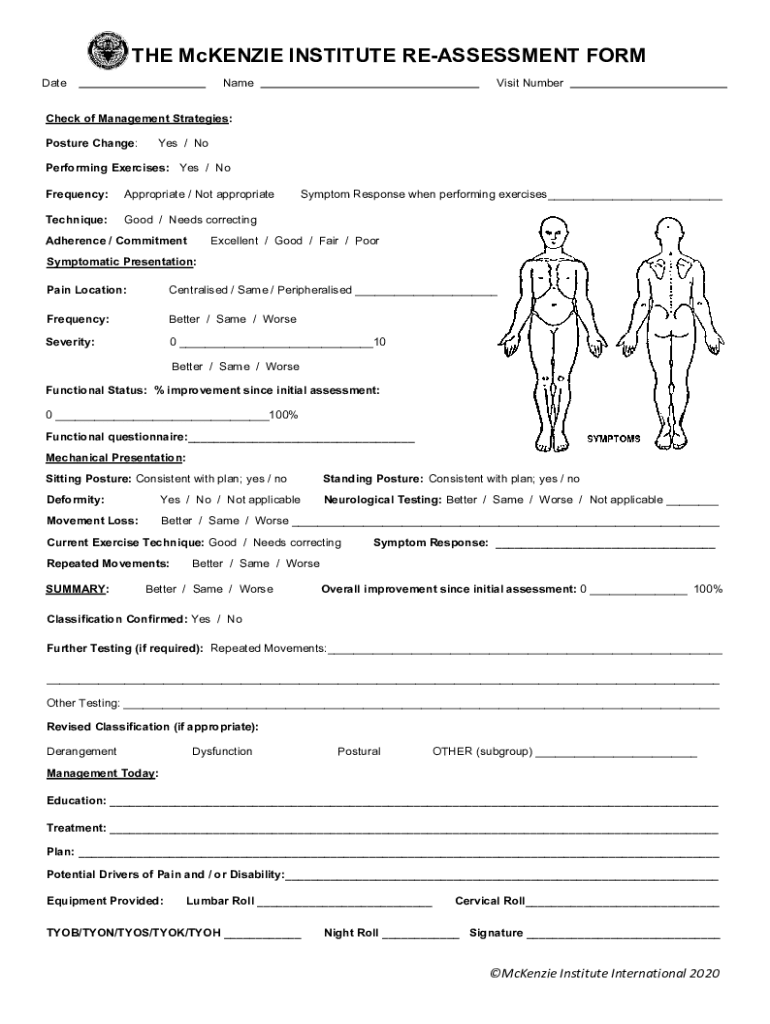
The McKenzie Institute Re-assessment Form is a comprehensive tool designed to evaluate a patient's ongoing progress concerning treatment plans related to posture, exercise adherence, symptom responses, and functional status. This form plays a pivotal role in the therapeutic process, allowing practitioners to assess areas such as pain location, severity, neurological testing, and overall improvement from the initial assessment. Its primary function is to guide healthcare providers in classifying conditions—derangement, dysfunction, postural syndromes—and developing subsequent management plans focused on education and personalized treatment.
How to Use the The McKenzie Institute Re-assessment Form
To effectively use The McKenzie Institute Re-assessment Form, healthcare professionals must approach it systematically. The process involves:
- Patient Information: Begin by gathering detailed patient history and current treatment goals. This helps in setting a baseline for comparison with the initial assessment.
- Symptom Analysis: Evaluate any changes in symptom location and intensity. Note if they have intensified, lessened, or shifted location, as this information is critical for the reassessment.
- Functional Evaluation: Record any functional improvements or declines, focusing on specific postures and movements.
- Neurological Testing: Conduct necessary tests to observe the presence or absence of reflex changes, weaknesses, or sensory loss.
- Condition Classification: Utilize observed data to classify the condition accurately, ensuring that the management plan aligns with the patient's current status.
- Plan Development: Create or adapt treatment strategies based on the collected data, ensuring patient-centric approaches focused on education and self-management.
Key Elements of The McKenzie Institute Re-assessment Form
The form comprises several essential components that provide a thorough overview of the patient's status:
-
Pain Location and Severity: This section inquires about the exact areas of discomfort and their respective intensities, allowing for targeted management.
-
Movement Loss Assessment: Notes on any restrictions or improvements in movement can help pinpoint specific dysfunctions or recovery.
-
Neurological Evaluation: Tests for reflex, sensory, or motor changes offer insights into potential neural involvement.
-
Overall Condition Classification: Categorizing the condition (e.g., derangement, dysfunction, postural syndrome) streamlines the management process, ensuring appropriate treatment plans.
Steps to Complete the The McKenzie Institute Re-assessment Form
Completing the form requires attention to the following elements to ensure thorough and accurate documentation:
- Gather Initial Assessment Results: Use previous assessment data for comparative purposes.
- Collect Comprehensive Patient Data: Update personal and clinical information, addressing any recent changes.
- Perform a Systematic Re-assessment: Conduct examinations focusing on posture, exercise adherence, and symptom response.
- Document Observations: Record any deviations in pain, movement range, and neurological states.
- Conclude with Condition Classification: Summarize findings to classify the condition and update the treatment plan accordingly.
Who Typically Uses the The McKenzie Institute Re-assessment Form
The form is primarily utilized by:
-
Physiotherapists and Physical Therapists: These professionals use it to track patient progress and adjust treatments accordingly.
-
Osteopaths and Chiropractors: Practitioners who specialize in musculoskeletal health rely on the form for systematic follow-ups.
-
Rehabilitation Specialists: They use the form to ensure that recovery is on track and adapt plans where necessary.


Legal Use of the The McKenzie Institute Re-assessment Form
When using The McKenzie Institute Re-assessment Form, healthcare professionals must adhere to:
-
Patient Confidentiality: Maintain strict patient privacy in accordance with HIPAA regulations.
-
Accurate Record-Keeping: Ensure that all patient interactions and observations are meticulously documented and stored securely.
Important Terms Related to The McKenzie Institute Re-assessment Form
Understanding key terms is essential:
-
Derangement: Refers to a mechanical issue within the joint.
-
Dysfunction: Indicates a condition where tissue flexibility is lost.
-
Postural Syndrome: Involves pain or discomfort resulting from prolonged poor posture.
-
Re-assessment: Evaluating current treatment efficacy and making necessary adjustments.
Software Compatibility
The McKenzie Institute Re-assessment Form can be integrated with digital healthcare record systems for streamlined data management:
-
Electronic Health Record (EHR) Systems: Facilitates easy documentation and accessibility.
-
PDF Editing Tools: Use platforms like DocHub to manage the form digitally and secure patient records through encryption.
-
Cloud Storage Services: Ensures that forms can be accessed and shared securely across different devices and locations.




