




01. Edit your form online
Type text, add images, blackout confidential details, add comments, highlights and more.

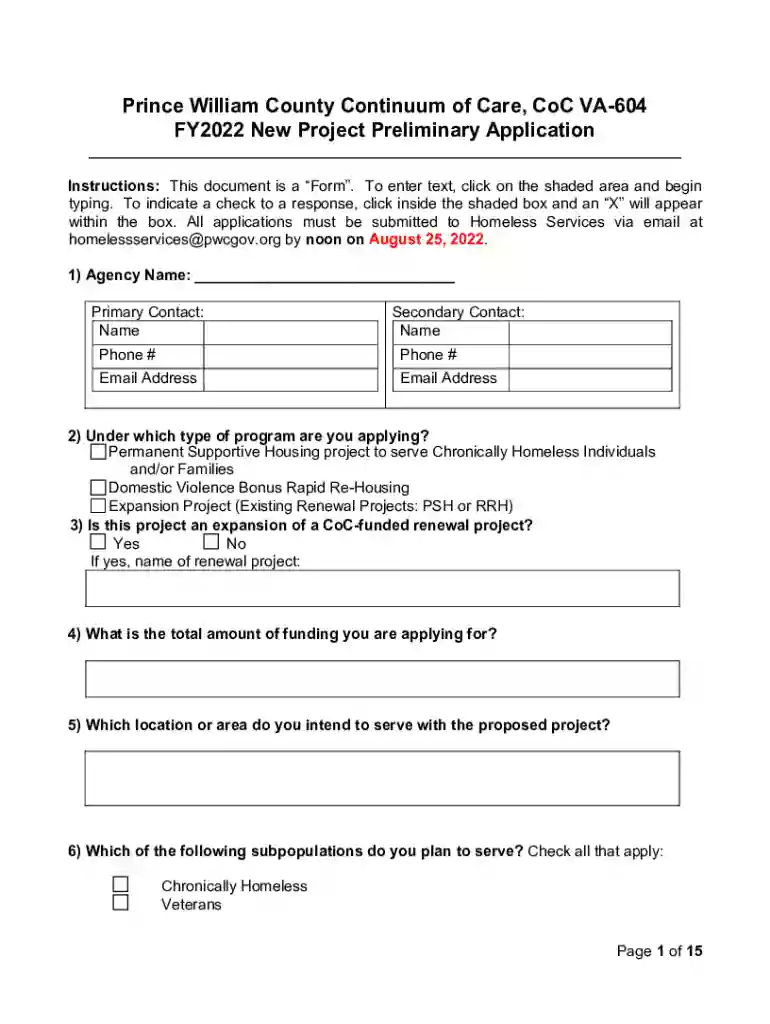
Type text, add images, blackout confidential details, add comments, highlights and more.

Draw your signature, type it, upload its image, or use your mobile device as a signature pad.

Send it via email, link, or fax. You can also download it, export it or print it out.
The "About Continuum of Care - Prince William County Government" refers to the framework established by Prince William County to coordinate housing and supportive services for people facing homelessness. This framework, known as the Continuum of Care (CoC VA-604), aims to provide comprehensive support through collaborative efforts with local agencies, ensuring a holistic approach to ending homelessness. The system strategically addresses issues from emergency shelters to permanent housing solutions, creating a seamless transition for homeless individuals and families.
The Prince William County Continuum of Care comprises several critical components to effectively manage and deliver services:
Completing the application form for new projects under the CoC requires attention to detail:
To apply for funding under the CoC, agencies must meet specific requirements, including:


The form serves as an application tool for agencies seeking to launch new housing initiatives or renew existing projects. Agencies must complete and submit the form as part of the funding application process to receive support from the Department of Housing and Urban Development (HUD).
Applicants can submit their forms through various channels:
Numerous projects have benefitted from successfully using the CoC form, including:
This form is legally mandated for agencies intending to apply for federal awards under the CoC program. Ensuring full compliance with the guidelines specified in the form is crucial for legality and subsequent funding approval. By adhering to federal and local regulations, agencies can facilitate transparency and accountability in their housing projects.
Successful implementation of CoC programs depends significantly on partnerships with community service providers, including:
These collaborations foster an all-encompassing support network, aiding individuals in achieving long-term stability and independence.
At DocHub, your data security is our priority. We follow HIPAA, SOC2, GDPR, and other standards, so you can work on your documents with confidence.




by J Meng 2024 As a result, the median monthly cost for assisted living services has steadily risen to about $4300 today, making it increasingly difficult for many to access
Prince William Area Continuum of Care (PWA CoC) promotes community-wide commitment to the goal of ending homelessness.
by M County The Civilian Conservation Corps activities in the National Capital Region of the National Park Service illustrate the important role of this program in.


