






Definition and Meaning
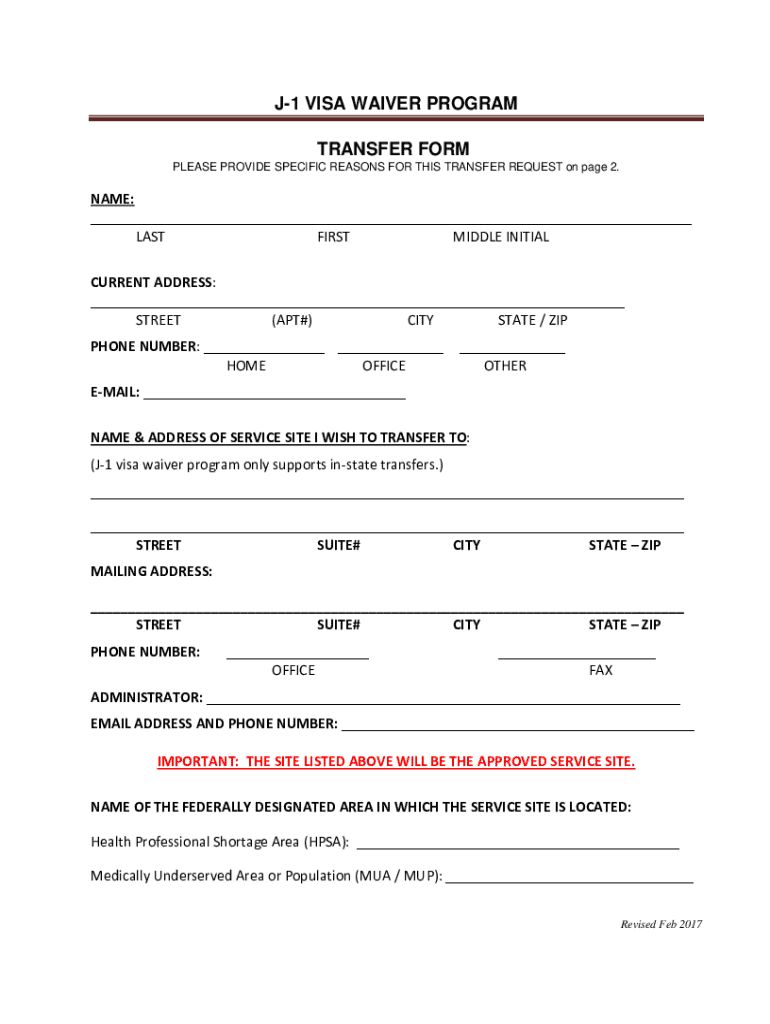
The J-1 Visa Waiver Program Transfer Form is an essential document for individuals participating in the J-1 Visa Waiver Program who need to request a transfer. This form allows the holder to shift their obligations or service location within the same state, ensuring that their transfer complies with the program's regulations. This document requires comprehensive details to articulate the reasons for the transfer, such as hardships, job availability, or other unique circumstances that justify the need for the change.
- Purpose: Designed to facilitate the transfer process within the confines of the program's guidelines, aligning with the individual's personal or professional situation.
- Scope: Applicable primarily to medical professionals under the J-1 Visa Waiver who must serve in medically underserved areas or specific employer requirements.
How to Obtain the J-1 Visa Waiver Program Transfer Form
Acquiring the J-1 Visa Waiver Program Transfer Form can be done through several methods to accommodate different preferences and accessibilities:
- Online Access: Most platforms, including government websites, offer downloadable versions of the form. Ensure you download from a verified source to avoid inaccuracies.
- Employer or Sponsoring Agency: Organizations involved in the J-1 Waiver process will often provide the necessary documents. This ensures that the form aligns with their specific requirements.
- Legal Advisors or Immigration Consultants: Professionals in immigration law often have the latest versions of such forms and can guide applicants through its completion.
Steps to Complete the J-1 Visa Waiver Program Transfer Form
Completing the J-1 Visa Waiver Program Transfer Form requires attention to detail and accuracy to ensure a successful request. Here is a step-by-step guide:
- Personal Information Section: Fill in all personal details accurately, including full name, J-1 visa number, and current contact information.
- Current and Desired Service Site: Document your existing service location and the proposed new service site, including complete addresses.
- Reason for Transfer: Provide detailed explanations for the transfer request. Common reasons include economic hardship or changes in employer needs.
- Supporting Documentation: Attach any necessary documents that corroborate your transfer rationale, such as letters from employers or proof of hardship.
- Review and Submit: Rigorously review the form for completeness and accuracy before submission to prevent delays or rejections.
Key Elements of the J-1 Visa Waiver Program Transfer Form
Understanding the critical elements of this form is vital for proper completion:
- Personal and Professional Information: Identifies the applicant and provides context for the transfer.
- Service Site Details: Specifies locations involved in the transfer, supporting compliance checks.
- Justification for Transfer: Contextualizes the request, often crucial for approval.
- Verification and Signatures: Ensures the authenticity and authority of the request with required signatories.
State-Specific Rules for the J-1 Visa Waiver Program Transfer Form
Different states may have unique requirements or supplementary documentation supporting a transfer request:
- Approval Agencies: Some states require additional approvals from state-specific health departments or educational boards.
- Area Restrictions: Eligibility often hinges on maintaining the new service site within designated shortage areas defined by the state.
- Submission Channels: Some states provide digital submission portals, while others insist on paper forms.
Legal Use of the J-1 Visa Waiver Program Transfer Form
Legal compliance when using the J-1 Visa Waiver Program Transfer Form is critical for applicants:
- Federal Compliance: Ensures that the conditions of the waiver and visa are not violated. Transfers must not compromise the original terms agreed upon in the visa issuance.
- Documentation Accuracy: Any discrepancies can lead to legal complications or visa status questions.
- Signature Verification: Legal signatures confirm authenticity and can be used as evidence in case of disputes.
Examples of Using the J-1 Visa Waiver Program Transfer Form
Understanding practical application through examples can clarify form usage:
- Healthcare Providers: A doctor in an underserved area seeking a transfer due to lack of resources at the current site while remaining within state guidelines.
- Scholarly Researchers: Individuals transferring to a different institution that offers better support for ongoing projects without breaching state lines.
Form Submission Methods
The transfer form can be submitted through various methods, each with its own procedure:
- Online Submissions: Platforms like DocHub facilitate easy digital submissions, enhancing accessibility and reducing error margins.
- Postal Mailing: Traditional mailing remains an option, though it requires sufficient lead time to cater to postal delays.
- In-person: Direct submission at designated offices might be required, especially in specific jurisdictions demanding formal verification.
By adhering to these structured guidelines, applicants can navigate the complexity of transferring within the J-1 Visa Waiver Program efficiently, ensuring a successful and compliant transition.