




01. Edit your form online
Type text, add images, blackout confidential details, add comments, highlights and more.

Type text, add images, blackout confidential details, add comments, highlights and more.

Draw your signature, type it, upload its image, or use your mobile device as a signature pad.

Send it via email, link, or fax. You can also download it, export it or print it out.
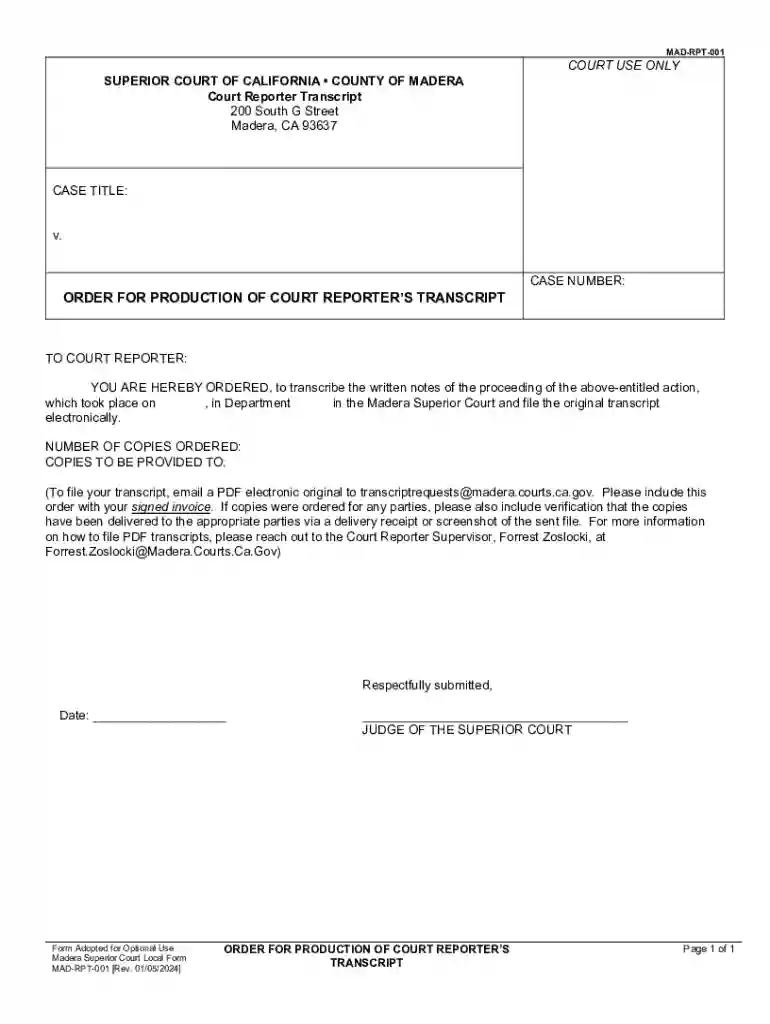
The form Mad-rpt-001 is an official document mandated by the Superior Court of California in the County of Madera. It is primarily intended for court reporters who are required to transcribe notes from specific court proceedings. This process ensures that a comprehensive and legally recognized record of the hearing is created, allowing all involved parties, including judges, attorneys, and litigants, to reference the transcript as needed. Understanding the scope and purpose of Mad-rpt-001 is crucial for legal professionals who frequently interact with the judicial system in California.
To effectively utilize the Mad-rpt-001 form, court reporters must accurately follow guidelines ensuring the transcription process adheres to legal standards. These transcripts serve as a vital resource in appeals and other post-trial proceedings. The submission encompasses digitally transcribing the notes and filing them according to predetermined court submission protocols. It's crucial to be familiar with all procedural details, including electronic submission requirements and format specifics, to maintain the integrity and legality of the transcription process.
The Mad-rpt-001 comprises several critical components to ensure comprehensive coverage of the court proceedings. Key elements include:
Familiarity with specific terminology enhances the completeness and accuracy of the Mad-rpt-001 form. Essential terms include:
Primary users of the Mad-rpt-001 include court reporters tasked with managing and transcribing courtroom proceedings. Legal professionals such as attorneys and judges also rely on this form to access accurate records for appeals or legal arguments. Students and researchers analyzing legal procedures may find transcripts derived from this form invaluable for educational and analytical purposes.


Failure to comply with the Mad-rpt-001's submission guidelines can lead to several consequences:
The modern landscape requires formats of the Mad-rpt-001 to be compatible with prevailing software systems. Compatible document formats may include:
Exploring these elements ensures a deeper understanding of the Mad-rpt-001 form, its application, and the strict requirements for its use in legal settings in California.
At DocHub, your data security is our priority. We follow HIPAA, SOC2, GDPR, and other standards, so you can work on your documents with confidence.

Atlantis Document Control was originally managed and executed by. Technip. Less efficient system in comparison with Thunder Horse DC.
Dec 2, 2015 If used, Deenergizing the MAINT CALL RPT Input (observe input on I/O view). Restore MAINT CALL RPT input and MC lights. If power-off relay
Page 1. MAD-RPT-001. Form Adopted for Optional Use. Madera Superior Court Local Form. MAD-RPT-001 [Rev. 01/05/2024]. ORDER FOR PRODUCTION OF COURT


