



01. Edit your form online
Type text, add images, blackout confidential details, add comments, highlights and more.

Type text, add images, blackout confidential details, add comments, highlights and more.

Draw your signature, type it, upload its image, or use your mobile device as a signature pad.

Send it via email, link, or fax. You can also download it, export it or print it out.
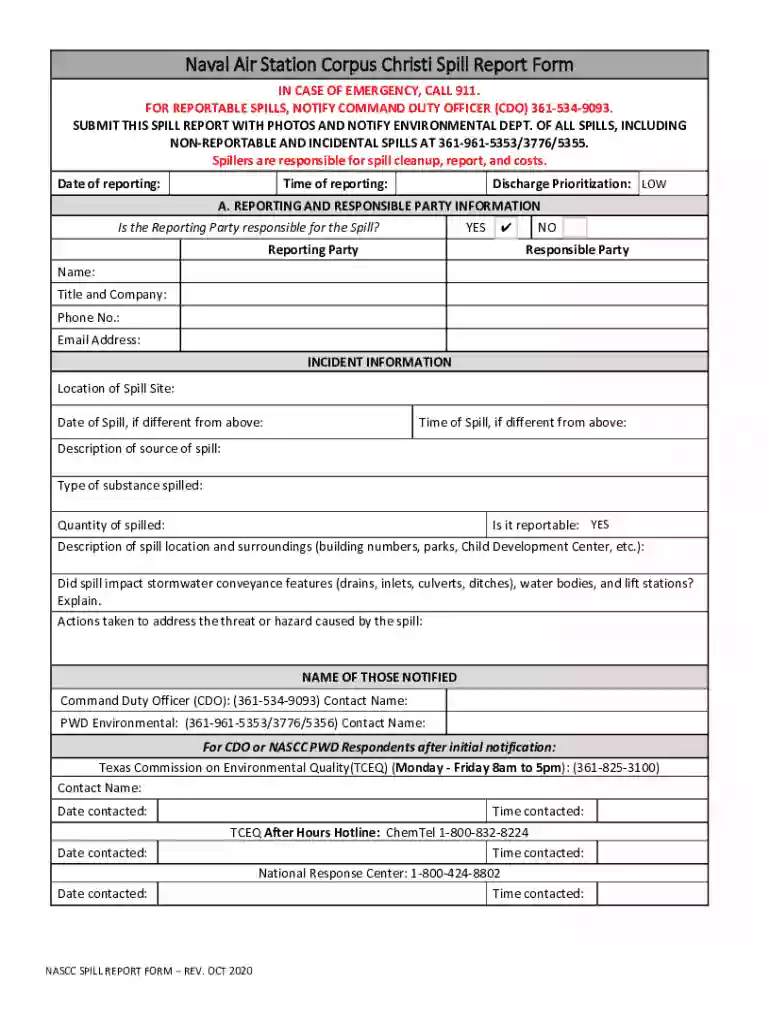
The Spill Reporting Information Form - Template - Gov bc ca is a vital tool for documenting and reporting environmental spills. This form is designed to ensure that all necessary details regarding a spill incident are captured accurately and completely. The form facilitates communication between the spiller and authorities, ensuring timely reactions to mitigate the environmental impact. Typically, the form will capture information such as the type and volume of the substance spilled, the precise location of the incident, and immediate actions taken to contain or remediate the spill. This ensures that all stakeholders have the correct, standardized data to reduce adverse environmental effects.
To effectively use the Spill Reporting Information Form, begin by gathering all pertinent details concerning the spill. Users should ensure they have clear information about when and where the spill occurred, what was spilled, and the surrounding conditions that could affect the spill's impact. Complete the form by inputting detailed descriptions in each section, ensuring clarity and accuracy. Submit the form to the appropriate governmental body or environmental agency, such as the Ministry of Environment in British Columbia, as soon as possible after the spill is discovered. Follow any subsequent instructions provided by the authorities to address the spill. Timely submission helps in coordinating rapid responses and conducting further investigations if necessary.
The Spill Reporting Information Form can be accessed through government websites, specifically those associated with environmental departments in British Columbia. Users can download digital versions directly from these sites, ensuring they have the latest official template. For those who prefer paper forms, local government offices often provide physical copies. It is crucial to verify that the form is the most recent version before completing it, as using outdated versions might result in incomplete record submission.
The Spill Reporting Information Form is utilized by various entities and individuals, including environmental agencies, companies handling hazardous materials, and site managers of facilities at risk for spills. It is also critical for emergency responders who attend spill incidents to ensure that the authority's mandated response protocols are followed. Since accurate documentation is vital for both regulatory compliance and environmental protection, the form is an indispensable tool for environmental professionals.


The form encompasses several critical sections that comprehensively document spills:
British Columbia mandates specific rules governing environmental spill reporting, emphasizing rapid notification and detailed documentation. The province requires prompt reporting upon discovery of a spill, often within 24 hours. Familiarity with both federal and provincial regulations is necessary to ensure full compliance. Regulatory bodies may impose different requirements for spills occurring in various environments, such as urban areas compared to natural reserves, making it essential to understand these variations when completing the form.
There are multiple channels for submitting the Spill Reporting Information Form, accommodating varying preferences and circumstances:
Accurate following of submission guidelines ensures that all forms are processed correctly and responses to spills are orchestrated promptly.
At DocHub, your data security is our priority. We follow HIPAA, SOC2, GDPR, and other standards, so you can work on your documents with confidence.


ITRC documents and training are products designed to help regulators and others develop a consistent approach to their evaluation, regulatory approval, and
- This report provides a list of all vessels, both tank and non-tank, whose COFRs are currently valid in the State of California, having met the application,
The information provided on the contact information form will help establish the lead federal agency; this is determined based on the program intent


