




01. Edit your form online
Type text, add images, blackout confidential details, add comments, highlights and more.

Type text, add images, blackout confidential details, add comments, highlights and more.

Draw your signature, type it, upload its image, or use your mobile device as a signature pad.

Send it via email, link, or fax. You can also download it, export it or print it out.
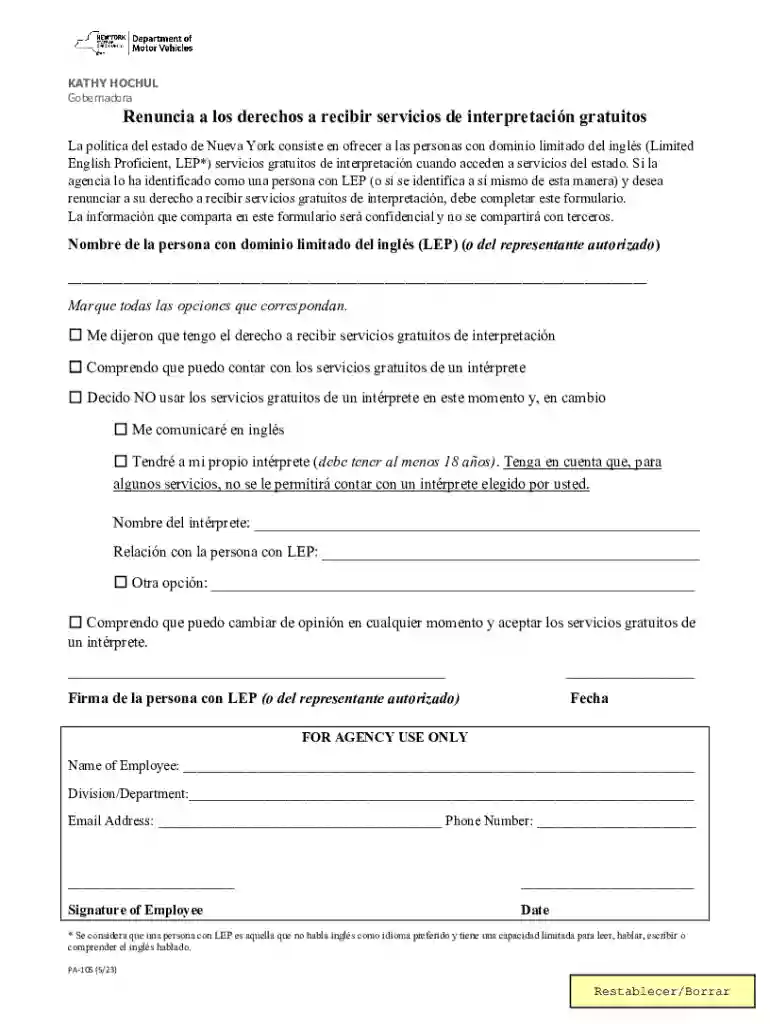
The "Renuncia a los derechos a recibir servicios de interpretación gratuitos Renuncia a los Derechos de Re" is a formal document that allows individuals with limited English proficiency (LEP) to voluntarily waive their right to receive free interpretation services. This form is significant for those who wish to decline such services for personal, legal, or convenience reasons. By signing this document, individuals acknowledge that they understand the implications of not using the provided interpretation assistance during official interactions, particularly in legal or governmental settings.
When using the "Renuncia a los derechos a recibir servicios de interpretación gratuitos Renuncia a los Derechos de Re," individuals should ensure that they fully understand the content and consequences of waiving their rights to interpreter services. The form typically includes sections that must be filled out with the individual's personal information, including full name, identification details, and a declaration of understanding regarding the waiver. It's crucial to follow all instructions carefully and to use this form only if one genuinely intends to waive interpretation services.
The "Renuncia a los derechos a recibir servicios de interpretación gratuitos Renuncia a los Derechos de Re" is commonly used by individuals who are fluent in English and feel confident communicating without the aid of interpretation services. This might include naturalized citizens, permanent residents, or legal immigrants who are proficient in English or who have a trusted person to assist them in communication during official matters.


Legally, the form acts as a binding agreement indicating that the individual acknowledges and accepts the risks of waiving their right to free interpretation services. It is often used in scenarios involving legal proceedings, governmental communication, or other official contexts where clear and accurate communication is essential. It's crucial to ensure that the waiver does not violate any legal rights outside the scope of the interpretation services.
Though the general purpose of this form is consistent, some states may have specific regulations governing the use of the "Renuncia a los derechos a recibir servicios de interpretación gratuitos Renuncia a los Derechos de Re." This could include additional requirements such as notarization, language translation requirements, or specific submission procedures. It is essential to check the local regulations in the state where the form will be used.
An example could be a resident in New York State who is attending a hearing. If this individual speaks proficient English and chooses not to use the free interpretation services offered, they would complete and submit the "Renuncia a los derechos a recibir servicios de interpretación gratuitos Renuncia a los Derechos de Re." They must understand that this decision means they will not receive language assistance during their official interactions.
When submitting the "Renuncia a los derechos a recibir servicios de interpretación gratuitos Renuncia a los Derechos de Re," certain documents may be required to accompany it. These often include identification documents to verify the individual’s identity and possibly proof of proficiency in English. The specific requirements can vary, so it is important to check with the issuing authority.
The form can usually be submitted in several ways, providing flexibility for the applicant. Common methods include:
These various options ensure that users can choose the most convenient method for their situation while still adhering to the official requirements.
At DocHub, your data security is our priority. We follow HIPAA, SOC2, GDPR, and other standards, so you can work on your documents with confidence.



Estudio de los lmites del derecho a intrprete y a la traduccin de los documentos esenciales en los procesos penales en la UE.
Feb 18, 2019 Renuncia a mi Derecho Recibir los Servicios Gratuitos de un Interprete. Los servicios gratuiitos de interpretes estan disponibles en las
renuncia a cualquier inters sobre la propiedad de Para obtener instrucciones sobre cmo utilizar el servicio de asistencia tcnica, consulte Servicio.


