Small Cell Application Instructions 2026

Get Form
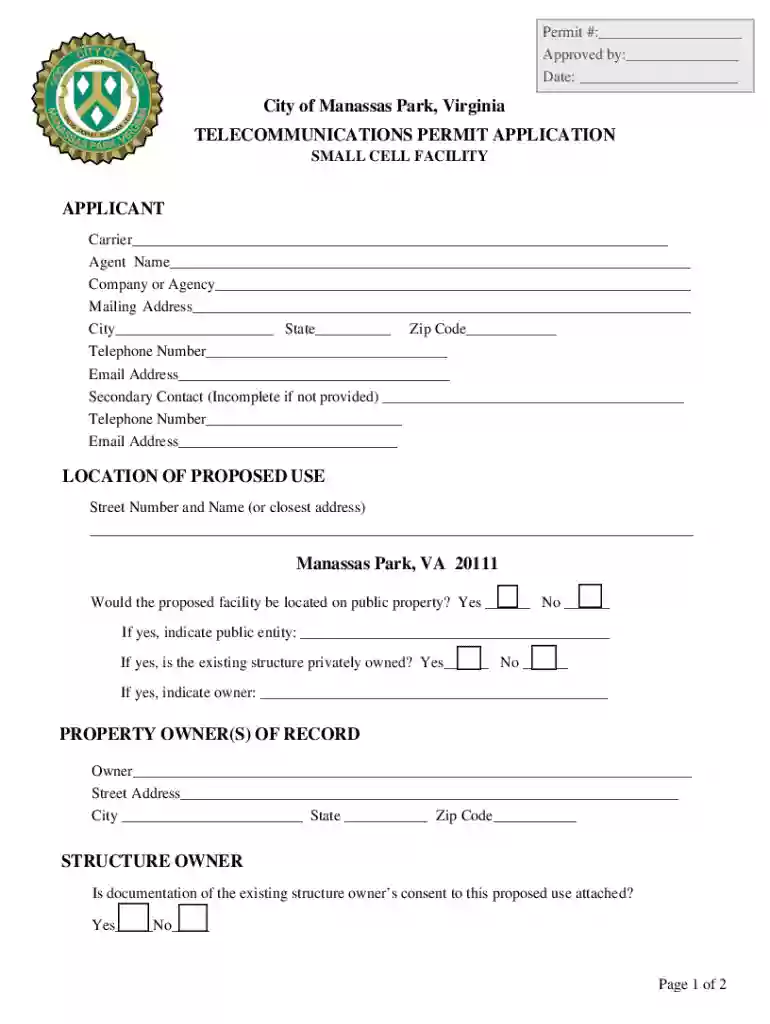
Small Cell Application Instructions Preview on Page 1

Here's how it works

01. Edit your form online
Type text, add images, blackout confidential details, add comments, highlights and more.

02. Sign it in a few clicks
Draw your signature, type it, upload its image, or use your mobile device as a signature pad.

03. Share your form with others
Send it via email, link, or fax. You can also download it, export it or print it out.

Definition & Meaning

The "Small Cell Application Instructions" serve as a detailed guide to navigate the process of applying for permits for small cell facilities, particularly within urban areas like Manassas Park. These small cells are low-powered cellular radio access nodes that improve network coverage and capacity, which is crucial for supporting fast and reliable wireless communication in densely populated areas. The instructions are tailored to ensure applicants understand the comprehensive requirements and standards for constructing these facilities.

How to Use the Small Cell Application Instructions

To effectively utilize the "Small Cell Application Instructions," applicants should first familiarize themselves with each step of the application process. This involves carefully reviewing the guidelines to ensure compliance with submission requirements, such as providing detailed site plans and obtaining necessary certifications. The instructions are intended to streamline the application process by outlining what is needed for successful submission and review.

  1. Initial Review: Begin by reading through the full set of instructions to understand the overall requirements.
  2. Preparing Documentation: Gather the necessary documents, including site plans and ownership consent, as stipulated in the guidelines.
  3. Submission Process: Follow the detailed steps provided for submitting applications, either online or in physical form.

Steps to Complete the Small Cell Application Instructions

Completing the application requires adherence to a sequence of well-defined steps:

  1. Compile Required Materials: Gather all necessary documents, such as detailed site plans and safety certifications.
  2. Form Completion: Carefully fill out the application form, ensuring that all fields are completed accurately.
  3. Submission: Submit the application through the stated methods, whether online, by mail, or in-person, according to the preference stated in the instructions.
  4. Approval Follow-Up: Keep track of the application status and be prepared to make any necessary modifications if additional information or adjustments are requested by the review committee.

Important Terms Related to Small Cell Application Instructions

A few critical terms must be understood to navigate the application process efficiently:

  • Permit: An official document giving someone authorization to do or use something.
  • Small Cell Facility: A low-powered cellular radio access node that enhances existing network infrastructure.
  • Certification: A document serving as proof or confirmation of certain facts, such as compliance with safety standards.

Legal Use of the Small Cell Application Instructions

The "Small Cell Application Instructions" are legally binding documents. They outline the obligations and standards required by municipal governments for the installation and operation of small cell facilities. Following these instructions ensures legal compliance, which helps avoid penalties or application rejection. Misuse or failure to comply with these instructions can lead to legal disputes or operational delays.

State-Specific Rules for the Small Cell Application Instructions

The guidelines laid out in the instructions may vary by state, reflecting local regulations and zoning laws. For example, timelines and fees involved in the application process can differ based on state requirements or municipal ordinances. Applicants should always check local regulations to ensure their applications are aligned with state-specific mandates.

Examples of Using the Small Cell Application Instructions

Consider a telecommunications company aiming to expand its 5G network in an urban area. The company must refer to the Small Cell Application Instructions to secure necessary permits and ensure its infrastructure complies with city regulations. By following the instructions, the company can efficiently manage the logistics of site selection, construction, and network integration.

Application Process & Approval Time

The application process involves several steps, including compiling required documents, form completion, and submission through specified channels. According to the instructions, applications are typically reviewed and a decision is made within 60 days. However, extensions may be granted depending on the complexity of the application or the need for additional information.

Key Elements of the Small Cell Application Instructions

The instructions consist of several essential components:

  • Submission Requirements: Detailed descriptions of required documentation, such as site plans and certifications.
  • Fees and Payment Methods: Information about applicable fees and available payment options.
  • Review Timelines: Standard timelines for the application review process, highlighting potential delays or extensions.
  • Certification: Required safety and technical certifications confirming that the proposed facility meets predetermined standards.

Penalties for Non-Compliance

Non-compliance with the instructions can lead to various penalties, including application denial or delayed approval. Fines or further regulatory scrutiny may be imposed if the constructed facilities are found to violate safety or zoning regulations. Therefore, adherence to these guidelines is critical to ensure timely and successful project execution.

Required Documents

Essential documents typically include:

  • Detailed Site Plans: Architectural plans depicting the proposed facility's layout and design.
  • Safety Certifications: Documents confirming adherence to safety standards.
  • Ownership Consent: Proof of consent from the property owner if the facility is to be installed on privately owned land.

Compliance with these documentation requirements is critical to ensure a smooth review process and reduce the risk of application rejection.

be ready to get more

Complete this form in 5 minutes or less

Get form

Got questions?

We have answers to the most popular questions from our customers. If you can't find an answer to your question, please contact us.
Contact us
Small cells go by other names including micro-cells. They are small, low-power, integrated radios and antennas intended for small geographic areas. They typically operate in the frequency range of 700MHz to 2.6GHz with power outputs from
By offloading traffic from macro cells, small cells increase the overall network capacity and improve data speeds for users. Dense Urban Areas: In densely populated urban areas, small cells are used to handle the high demand for wireless connectivity.
The overall outlook of SCLC remains poor despite improvements in treatment in recent years. Doctors often use a doubling rate to measure how quickly cancer grows. The doubling rate of SCLC has been reported anywhere from 25217 days . The most common type of lung cancer, called NSCLC, tends to grow much slower.
Macro cells provide fast and reliable connectivity to large groups of users across large areas. Small cell networks are frequently deployed to boost wireless coverage and capacities in regions experiencing high user demand, such as urban areas, stadiums, and arenas.
Similar to a tower, small cells communicate wirelessly over radio waves, and connect signals to the internet or phone system. Because theyre connected with fiber they are able to handle massive amounts of data at fast speeds.

Security and compliance

At DocHub, your data security is our priority. We follow HIPAA, SOC2, GDPR, and other standards, so you can work on your documents with confidence.
Learn more
ccpa2
pci-dss
gdpr-compliance
hipaa
soc-compliance

People also ask

Cons Of Small Cell Deployment Due to resource constraints, the number of users per cell is restricted. For many deployments, a substantial expenditure is required. Compared to traditional BSs, they have a smaller coverage area. They manage fewer simultaneous internet surfing and voice/data call sessions.
Small cell installation consists of small radio equipment and antennas about the size of a pizza box or backpack that can be placed on structures such as streetlights, the sides of buildings or poles.

Related links