






Definition and Meaning
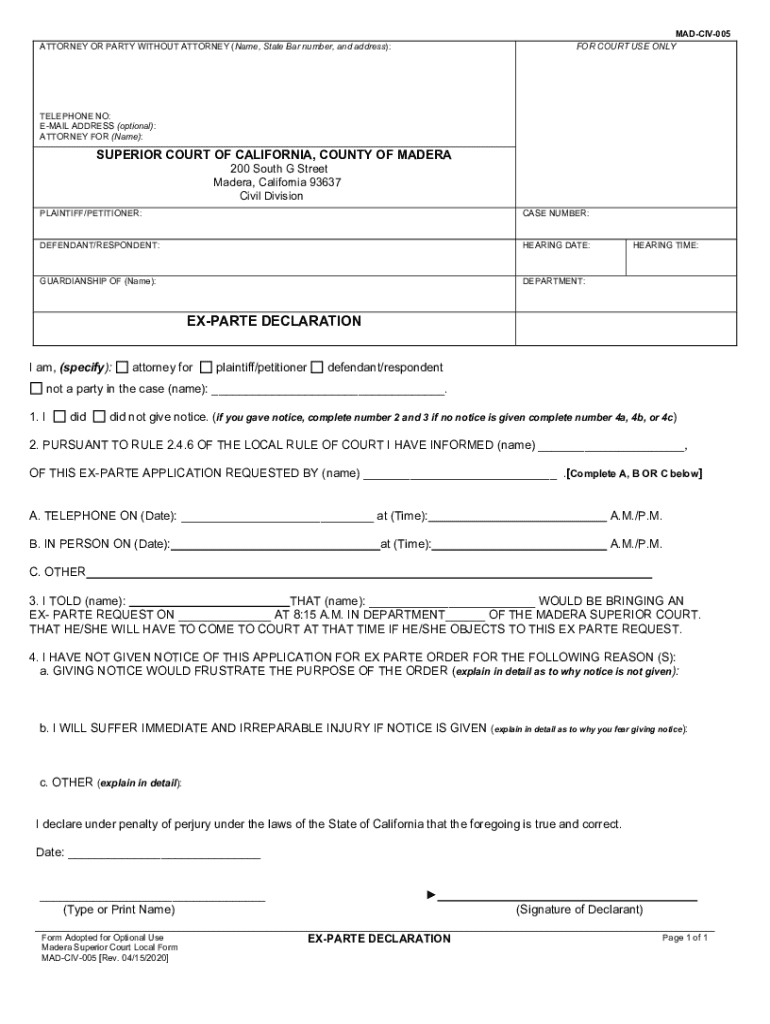
The MAD-CIV-005 form, officially an Ex-Parte Declaration, is utilized within the Superior Court of California, County of Madera. It serves a crucial legal function by allowing one party to request an ex-parte order without needing to provide prior notice to the opposing party. This form is intended for situations where immediate court intervention is necessary due to urgent circumstances. It includes sections that require the applicant to provide a thorough justification for the request, detailing the requirements and reasoning for bypassing standard notification procedures.
Steps to Complete the MAD-CIV-005
-
Identify Parties Involved: Begin by clearly specifying the individuals or entities involved in the legal proceedings. This typically includes the petitioner and respondent.
-
Case Details: Provide comprehensive information about the case, such as the case number and relevant court details. Accurate case identification ensures that the request is matched with the correct legal proceedings.
-
Declaration Section: In this section, applicants must detail their reasons for seeking an ex-parte order. This involves explaining the urgency and potential consequences if the order is not granted.
-
Sign Under Penalty of Perjury: Conclude the form with a signature, certifying all information is truthful under penalty of perjury, adding a layer of legal accountability.
Legal Use of the MAD-CIV-005
The MAD-CIV-005 form is legally significant due to its role in facilitating urgent judicial action. It allows a requesting party to obtain temporary court orders swiftly, typically under circumstances where waiting for a standard notice period could result in irreparable harm or injustice. This ex-parte mechanism is an integral part of managing time-sensitive legal matters within the California legal system.
Important Terms Related to MAD-CIV-005
-
Ex-Parte: Legal proceedings conducted for the benefit of one party without the presence of the opposing party, usually in urgent cases.
-
Declaration: A formal statement provided under oath, outlining the facts or reasons supporting the legal request.
-
Penalty of Perjury: Legal assurance that the information provided is accurate and truthful, subjecting the signer to potential penalties for falsehoods.
Who Typically Uses the MAD-CIV-005
The MAD-CIV-005 form is most often utilized by individuals or legal representatives involved in urgent civil cases. Common users include petitioners in family law disputes, such as custody or restraining orders, where immediate action is necessary to protect rights or maintain status quo. Legal professionals often assist in accurately completing and submitting the form, ensuring compliance with procedural requirements.


How to Obtain the MAD-CIV-005
To acquire the MAD-CIV-005 form, one can typically visit the official website of the Superior Court of California, County of Madera. Alternatively, physical copies may be available at local court offices. It is essential to use the most current version of the form to meet any updated legal or procedural requirements.
Key Elements of the MAD-CIV-005
-
Urgency Justification: A core element requiring detailed explanation of the need for immediate court action without standard notice.
-
Notification Waiver Explanation: Documentation of attempts or reasons for not notifying the opposing party, reinforcing the necessity of ex-parte proceedings.
Filing Deadlines and Important Dates
Given the urgent nature of the form, filing should occur as soon as the need for an ex-parte order arises. Specific deadlines can vary based on the case type and court schedules, emphasizing the importance of timely submission to prevent delays. Consulting the court’s calendar and procedural guidelines is critical for compliance.
Examples of Using the MAD-CIV-005
In practical terms, the MAD-CIV-005 form might be used in a scenario where a parent urgently seeks a modification to child custody arrangements to protect a child’s welfare. Similarly, it may apply in business contexts, such as seeking a temporary restraining order to stop the transfer of company assets without shareholder consent. These examples demonstrate the form’s versatility in addressing diverse, pressing legal issues.