




01. Edit your form online
Type text, add images, blackout confidential details, add comments, highlights and more.

Type text, add images, blackout confidential details, add comments, highlights and more.

Draw your signature, type it, upload its image, or use your mobile device as a signature pad.

Send it via email, link, or fax. You can also download it, export it or print it out.
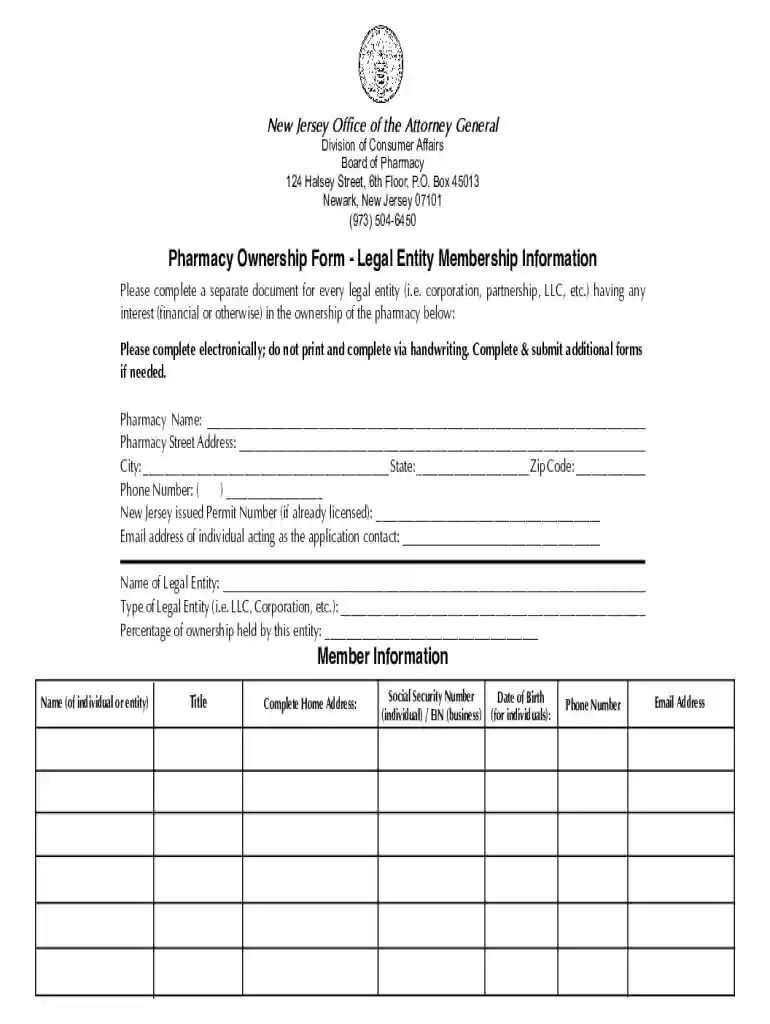
The Pharmacy Ownership Form - Legal Entity Membership Information is an essential document typically required by the Office of the Attorney General's Division of Consumer Affairs, particularly the Board of Pharmacy in New Jersey. This form is integral for detailing the ownership structures of pharmacies. It focuses on gathering specific information about legal entities involved in pharmacy ownership, ensuring compliance with regulatory standards.
The form demands specific data including names, types of legal entities, ownership percentages, and contact details. By collecting this information, the form aims to create a transparent record of all entities involved in the management and control of a pharmacy.
Filling out the Pharmacy Ownership Form involves providing several crucial pieces of information about each legal entity involved:
These elements ensure that all necessary regulatory information is captured to uphold compliance and maintain transparency in pharmacy operations.
The Pharmacy Ownership Form is primarily used by:
These stakeholders depend on the form to provide an accurate and up-to-date account of ownership, critical for both legal and operational purposes.


Completing the Pharmacy Ownership Form involves a series of steps typically followed to ensure full compliance and accuracy:
By following these steps, pharmacy owners can ensure they meet all necessary requirements for regulatory compliance.
The legal significance of the Pharmacy Ownership Form is to ensure regulatory compliance with state laws governing pharmacy operations. It supports transparency in ownership, allowing regulatory authorities to maintain an accurate registry of entities involved.
Proper use of the form helps in avoiding penalties and legal challenges that could arise from non-compliance or incomplete documentation.
While the form is standardized for use across the board, specific state rules may apply, particularly for the Board of Pharmacy in New Jersey:
Understanding these nuances can help form filers in correctly adapting their submission to align with specific state mandates.
Understanding the language and terms associated with the Pharmacy Ownership Form is critical for accuracy:
Familiarity with such terms ensures that those involved in filling out the form can do so with precision, reducing the chance for misinterpretation or errors.
Failure to submit the Pharmacy Ownership Form accurately and timely can result in several penalties:
Awareness of these implications emphasizes the importance of correctly completing the form and avoiding any regulatory misconduct.
At DocHub, your data security is our priority. We follow HIPAA, SOC2, GDPR, and other standards, so you can work on your documents with confidence.

KRS 315.035(5) requires that if there is a change of ownership of a pharmacy notice is to be provided by a buyer at least five (5) days prior to the date of
Pharmacy Ownership Form - Legal Entity Membership Information. Name (of individual or entity). Title. Complete Home Address: Social Security Number. (individual)
Aug 6, 2014 (Exact name of registrant as specified in its charter). Delaware. 47-1758322. (State or Other Jurisdiction of Incorporation or Organization).


