







Definition and Purpose of the Motors and Generators Worksheet
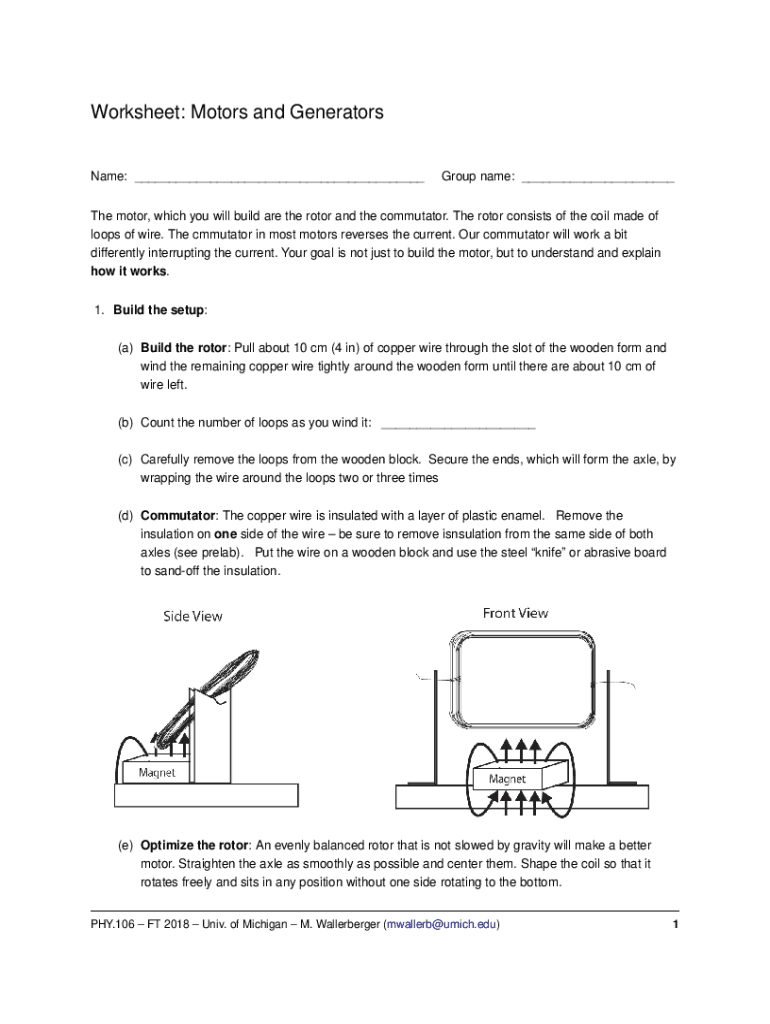
The "Motors and Generators - Worksheet" is a structured educational tool designed to facilitate hands-on learning about the principles of motors and generators. It provides a comprehensive guide for constructing, optimizing, and experimenting with motor and generator setups. Through step-by-step instructions, users can build a motor using a rotor and commutator, learn to reverse its direction, and explore the generation of electricity through a generator configuration. This worksheet is an invaluable resource for enhancing understanding and practical skills in electrical engineering concepts.
How to Use the Motors and Generators Worksheet
The worksheet is organized into a series of instructions that guide users through the process of assembling and experimenting with motors and generators. To use it effectively:
- Gather Materials: Collect necessary components such as rotors, commutators, and other electrical elements.
- Follow Instructions: Adhere strictly to the step-by-step guidelines provided in the worksheet to accurately construct the motor or generator.
- Experiment and Optimize: Use the worksheet's suggestions for experimenting with different setups to improve performance.
- Document Findings: Record observations and results in the designated sections to facilitate analysis and learning.
This systematic approach ensures that learners can confidently apply theoretical knowledge in practical scenarios.
Key Elements of the Motors and Generators Worksheet
Several critical components are outlined in the worksheet to aid in building motors and generators:
- Construction Steps: Detailed blueprint for assembling motors using essential parts like a rotor and commutator.
- Performance Optimization: Tips and strategies for enhancing efficiency and functionality through various adjustments.
- Directional Reversal: Instructions to reverse the motor's direction, expanding learners' understanding of electric circuits.
- Electricity Generation: Guidelines on setting up generators and principles underpinning their operation.
Each element is accompanied by explanations to support users in comprehending and executing the tasks effectively.
Who Typically Uses the Motors and Generators Worksheet
The worksheet is primarily designed for:
- Students: Engaged in courses related to physics, engineering, or electrical technology.
- Educators: Utilizing it as a teaching aid to provide interactive learning experiences.
- Hobbyists: Enthusiasts with an interest in electromechanical projects seeking to deepen their understanding.
- Professionals: Engineers and technical experts aiming to refine practical skills or introduce new learning methods.
The worksheet serves a diverse audience, each benefitting from its instructional and experimental elements.


Steps to Complete the Motors and Generators Worksheet
To fully complete the worksheet, follow these structured steps:
- Review Objectives: Begin by understanding the learning goals outlined in the introduction.
- Prepare Tools and Materials: Assemble all necessary components to begin building the motor or generator.
- Construct Following Guideline: Carefully follow each construction step, ensuring accuracy and safety.
- Secure all connections properly to avoid malfunctions.
- Test and Observe: Conduct experiments proposed in the worksheet and note variations in performance.
- Analyze and Reflect: Use provided sections to analyze results and consider improvements or further investigations.
This sequence is intended to maximize educational outcomes and practical skill acquisition.
Examples of Using the Motors and Generators Worksheet
Practical examples illustrate the worksheet's application:
- Classroom Projects: A high school physics class uses the worksheet to build basic motors and observe their operation, fostering collaborative learning.
- College Assignments: An engineering course assigns students to construct a generator, requiring documentation and analysis of electricity production methods.
- Workshops: In hobbyist workshops, groups employ worksheets to build and modify small-scale motors, facilitating communal knowledge exchange.
These examples highlight the worksheet's adaptability across different educational environments.
Important Terms Related to the Motors and Generators Worksheet
To understand and apply the worksheet fully, familiarity with key terms is necessary:
- Rotor: A rotating part of the motor or generator.
- Commutator: Device that reverses the direction of current flow within the rotor.
- Electromagnetism: Underlying principle of motor function, relating to the interaction between electricity and magnetic fields.
- Current Reversal: Process affecting the motor's rotation direction, governed by the commutator's function.
Understanding these terms facilitates more effective use of the worksheet and enhances comprehension of its scientific principles.
Digital vs. Paper Version
The worksheet is available in both digital and paper formats, each with distinct advantages:
- Digital Version: Allows for easy distribution, integration of multimedia resources like video tutorials, and interactive features for dynamic learning.
- Paper Version: Offers a tangible tool for note-taking, sketches, and physically engaging learners during the construction phase.
Choosing between formats depends on user preference, classroom resources, and specific teaching strategies.
Software Compatibility with Motors and Generators Worksheet
For those using digital versions, compatibility with various software systems is crucial:
- Adobe Acrobat: Enables annotation and highlighting of PDF-format worksheets.
- Google Workspace: Facilitates collaborative editing and sharing through Google Drive, allowing multiple students or educators to interact with the content.
- Design Software (e.g., AutoCAD): Useful for detailed motor or generator design simulations linked to worksheet tasks.
Selecting appropriate software enhances functionality and enriches the learning process.




