




01. Edit your form online
Type text, add images, blackout confidential details, add comments, highlights and more.

Type text, add images, blackout confidential details, add comments, highlights and more.

Draw your signature, type it, upload its image, or use your mobile device as a signature pad.

Send it via email, link, or fax. You can also download it, export it or print it out.
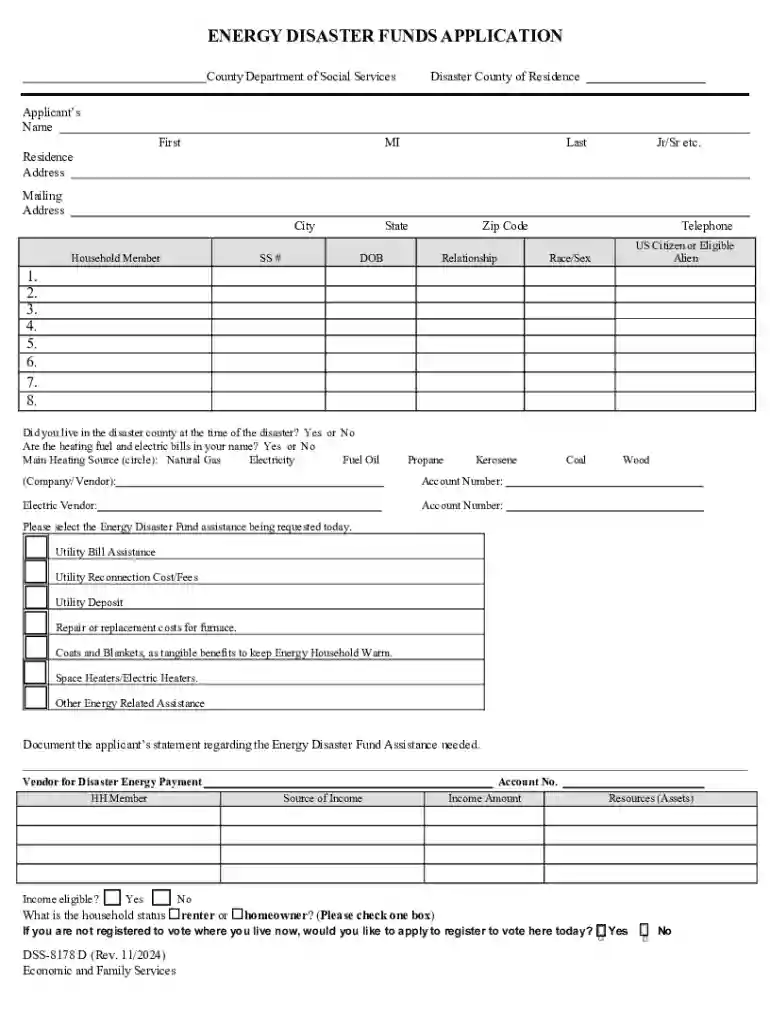
The Energy Disaster Funds Application is a critical document for individuals affected by disasters who seek financial assistance for their energy-related needs. Managed by the County Department of Social Services, this application primarily assists with utility bills, reconnection fees, deposits, and other energy necessities caused by a disaster. Understanding the purpose and structure of this application is essential for those requiring help to recover from challenging circumstances.
Before applying, applicants need to confirm their eligibility. Key criteria include:
These eligibility requirements ensure that funds are allocated to those most in need.


Completing the Energy Disaster Funds Application involves several steps:
Gather Necessary Documents:
Fill Out Personal Information:
Detail Energy Needs:
Certify Information Accuracy:
Submission:
To facilitate the approval process, applicants need to prepare and submit comprehensive documentation:
Proper documentation increases the likelihood of a swift application approval.
The application not only serves as an aid request but also acts as a legal document requiring truthful information:
Misrepresentation in the application can lead to penalties or revocation of aid.
This form is typically used by:
Understanding the target users helps in tailoring communication and processing efforts to assist those most likely to benefit from the funds.

Certain states may impose additional rules or modifications to the application process. For instance:
Applicants should check with their local social services departments for state-specific requirements.
Upon submission, the application undergoes a review process:
Initial Review:
Approval Process:
Notification:
Appeal Process:
Understanding this process ensures applicants have realistic expectations on timing and results.
At DocHub, your data security is our priority. We follow HIPAA, SOC2, GDPR, and other standards, so you can work on your documents with confidence.

by WR Young Jr The funds will be used to purchase renewable energy hardware PV is a viable source of electrical power for certain disaster relief applications such.
Did you live in the disaster county at the time of the disaster? Yes or No. Are the heating fuel and electric bills in your name? Yes or No.


