






Definition and Purpose of the Renewal Application
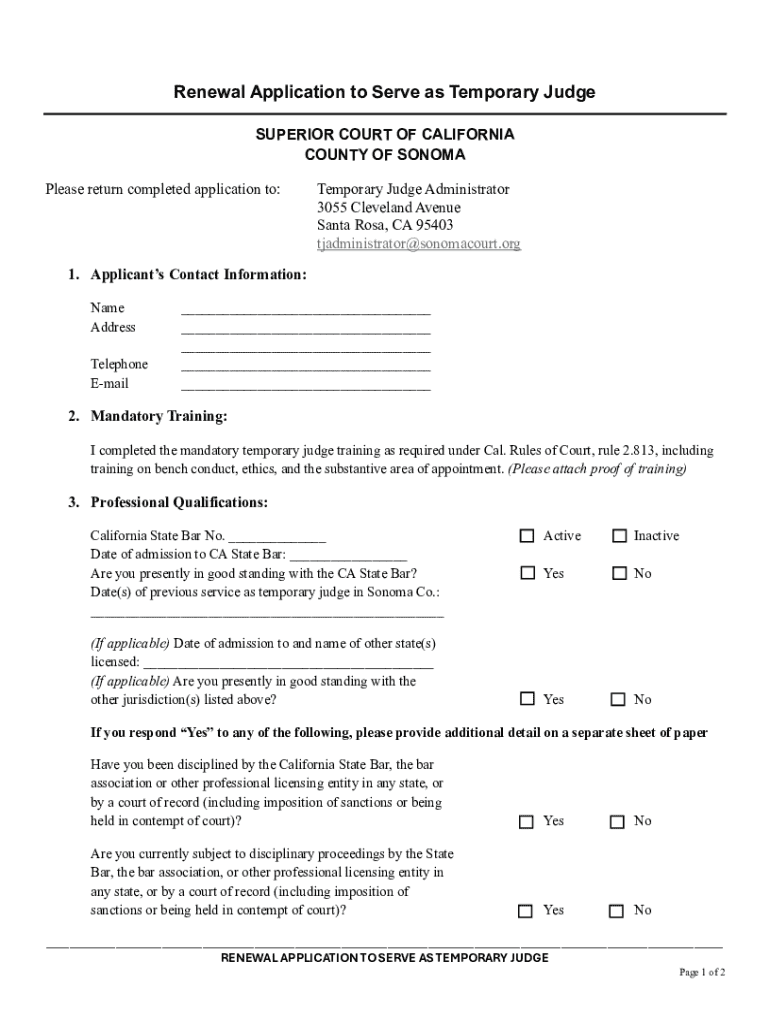
The "Renewal Application to Serve as Temporary Judge" is an essential document used within the Superior Court of California, specifically in the County of Sonoma. This form is designed for individuals who are seeking to renew their appointment as temporary judges. Its primary purpose is to ensure that applicants continue to meet the required qualifications and standards necessary to serve in this judicial capacity, reflecting their current professional standing and adherence to legal criteria.
Key Components of the Form
- Personal Contact Information: The form requires detailed personal information to maintain up-to-date records for applicants.
- Proof of Mandatory Training: Applicants must show evidence of completing any obligatory training programs needed for temporary judges.
- Professional Qualifications and Bar Standing: This includes verification of standing with the California State Bar and any professional credentials relevant to the role.
- Disciplinary Actions or Legal Issues: Applicants must disclose any past or pending disciplinary actions or legal matters that may influence their eligibility.
Steps to Complete the Renewal Application
Completing the "Renewal Application to Serve as Temporary Judge" involves a methodical process to ensure accuracy and compliance.
- Gather Necessary Documents: Start by collecting all required documents, including proof of training and professional qualifications.
- Fill Out Personal Information: Carefully complete all sections regarding personal and contact information.
- Attach Proof of Training: Provide documentation that confirms completion of any required training sessions for temporary judges.
- Verify Bar Standing: Include statements or certifications that confirm your current standing with the California State Bar.
- Disclose Relevant Legal Issues: Answer all questions pertaining to disciplinary actions or any legal issues candidly and thoroughly.
- Review and Submit: Double-check all information for accuracy and completeness before submission.
Submitting the Form
- Online: Electronic submission may be available, allowing for a faster review process.
- Mail or In-Person: Submissions can also be completed via traditional mail or delivered in person, depending on specific court requirements.
Eligibility Criteria
Applicants must meet several eligibility criteria to successfully renew their position as a temporary judge in the Superior Court of California.
- Current Membership with the California State Bar: Active membership and a clean record are mandatory for all applicants.
- Completion of Required Training: Any required judicial education courses must be completed before applying for renewal.
- Disclosure of Disciplinary Actions: Transparency regarding any disciplinary actions is crucial, as withholding information could result in disqualification.


Legal Considerations
- The application includes a waiver for the release of information related to the applicant's legal standing, allowing the court to verify the applicant's history comprehensively.
- Understanding the discretionary nature of appointments is vital, as meeting all criteria does not automatically ensure renewal.
Form Submission Methods
Applicants have several options for submitting their renewal application, each with its own processes and timelines.
- Online Portal: If available, the online submission process tends to be more efficient, facilitating quicker processing times.
- Mailing the Application: Ensure that all components of the application are included and send via certified mail to confirm receipt.
- In-Person Submission: Dropping off the form directly at the designated court office provides an opportunity for immediate feedback on any additional requirements.
Penalties for Non-Compliance
Failing to comply with the form's requirements or deadlines can result in significant consequences.
- Denial of Application: Non-compliance with submission guidelines or incomplete applications can lead to denial.
- Ineligibility for Future Positions: Persistent non-compliance could affect the applicant’s eligibility for future appointments as a temporary judge.
- Implications for Legal Standing: Failing to disclose disciplinary actions or legal issues could impact professional standing with the California State Bar.
Important Terms and Legal Use
Understanding the terms and legal implications within the form is crucial for proper completion and compliance.
- Discretionary Appointment: The appointment as a temporary judge is not guaranteed and is subject to approval based on the court's discretion.
- Waiver of Information Release: Applicants must agree to this waiver, allowing the court to access information relevant to their candidacy.
Contextual Insights
- This renewal process reflects broader principles of accountability and transparency required of those serving in temporary judicial capacities.
- The emphasis on training and ethical standing aligns with the judiciary's commitment to uphold integrity and competence in the court system.
Quick Facts
The "Renewal Application to Serve as Temporary Judge" has several notable aspects:
- It is a critical document for maintaining standards and ensuring the quality of temporary judges.
- The Superior Court of California holds the authority to review and decide on applications, reflecting state-specific judicial requirements.
- Detailed attention to the form’s instructions is essential for successful application submission and approval.
By thoroughly understanding the form's components, eligibility requirements, and submission methods, applicants can effectively navigate the process of renewing their appointment as temporary judges within the Superior Court of California.