
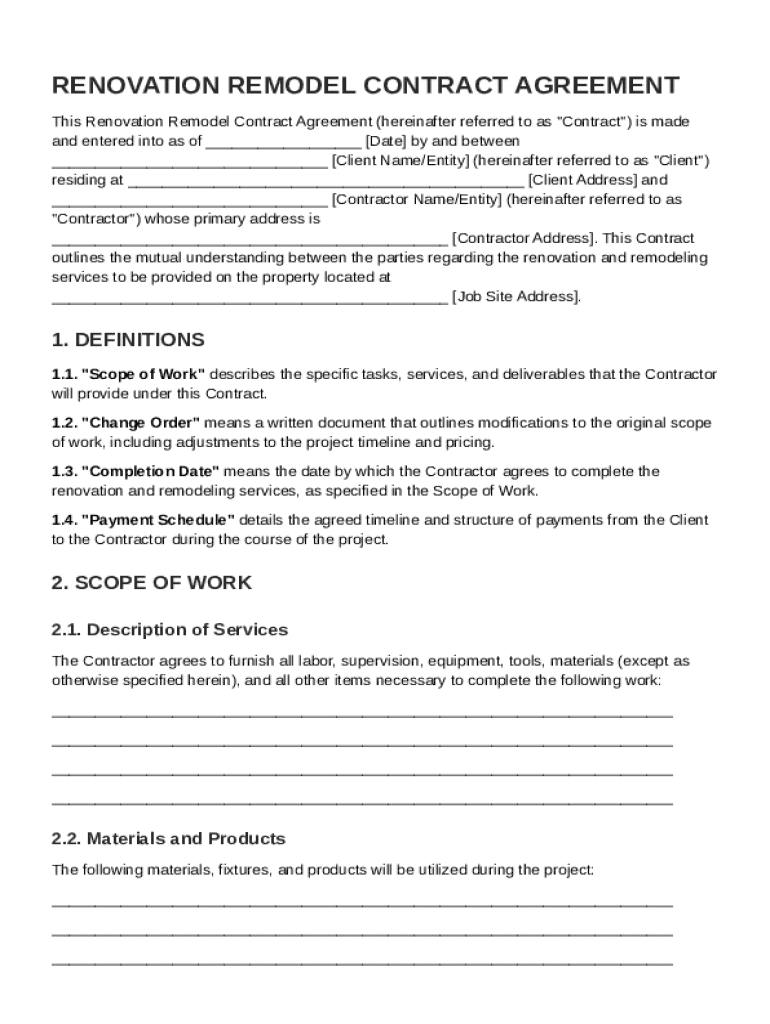







Definition & Meaning
The "Renovation Remodel Contract Template" is a comprehensive document designed to formalize agreements between a client and a contractor engaged in renovation and remodeling projects. This template serves as a binding contract, outlining essential terms and conditions that govern the working relationship. It includes definitions of key terms to ensure all parties have mutual understanding without ambiguities. Such terms might encompass renovation scope, change orders, and completion timelines.
Understanding and defining these terms explicitly helps prevent disputes and ensures that both parties are clear about their obligations, responsibilities, and rights. Practitioners use this contract to cover both standard and unique project-specific aspects, further integrating detailed statements that reflect the personalized nature of renovation work.
How to Use the Renovation Remodel Contract Template
To effectively utilize the "Renovation Remodel Contract Template," begin by tailoring it to address the specific needs of your project. Here’s a step-by-step guide to adopting it:
- Customize the Template: Input specific project details such as the scope of work, timelines, and cost estimates.
- Review Key Sections: Pay careful attention to sections related to payment terms, dispute resolution, and responsibilities of both client and contractor.
- Obtain Legal Review: If possible, have the contract reviewed by a legal professional specialized in construction law to ensure compliance with local regulations.
- Agreement by All Parties: Before work commences, ensure both parties review and agree to the terms, which should be verified by signatures.
- Implementation: Once signed, implement the terms as specified within the template, adhering to the protocols for any amendments.
Key Elements of the Renovation Remodel Contract Template
The template encompasses several critical elements necessary for a detailed agreement:
- Scope of Work: Describes the specific work to be done, detailing tasks and services provided.
- Payment Schedule: Outlines the agreed-upon payment terms, including amount, method, frequency, and penalties for late payments.
- Change Orders: Establishes procedures for making amendments to the project, including additional costs and time modifications.
- Insurance Requirements: Specifies the types of insurance needed to protect both parties from potential risks.
- Termination Clause: Describes conditions under which the contract may be terminated by either party.
These elements are crucial for maintaining transparency and setting clear expectations.
Steps to Complete the Renovation Remodel Contract Template
Completing the "Renovation Remodel Contract Template" requires careful attention to each component, aligning it with the project's specifics:
- Collect Project Information: Gather all necessary project data before filling out the contract.
- Complete Basic Information: Fill in names, addresses, and contact details of both the client and contractor.
- Detail the Project Scope: Clearly outline intended work and project specifications.
- Establish Financial Arrangements: Set forth payment terms, pricing, and financial responsibilities.
- Define Execution Timeline: Include start and completion dates, along with benchmarks for project phases.
- Legal Verification: Have the contract reviewed for legal validity.
- Confirm with Signatures: Secure signatures from all necessary parties to enforce the contract.
Legal Use of the Renovation Remodel Contract Template
The template adheres to U.S. construction law and contracting principles, providing a structured yet flexible approach to legal agreements for remodeling projects. It serves as an enforceable document in disputes when duly signed, highlighting compliance with statutes such as the Electronic Signatures in Global and National Commerce Act (ESIGN).
- Compliant Signatures: Sign electronically using validated electronic signature tools.
- Binding Agreement: Once executed, becomes a legally binding contract that holds in court.
- Dispute Resolution: Detailed clauses for mediation or arbitration to manage disagreements.
Who Typically Uses the Renovation Remodel Contract Template
This template is primarily used by:
- Homeowners and Property Owners: Seeking professional renovation services.
- Contractors and Subcontractors: Offering construction and remodeling expertise.
- Real Estate Developers: Managing large-scale residential projects.
- Legal & Compliance Teams: Ensuring contract management adheres to relevant laws and policies.
Regardless of the user, the template is adapted for projects within various scopes, ensuring flexibility and adaptability to meet individual needs.


Examples of Using the Renovation Remodel Contract Template
Real-world scenarios illustrate the practicality of the template:
- Residential Renovations: Home upgrades and expansions are structured using this contract to establish clear communication between homeowners and contractors.
- Commercial Projects: Office or retail space remodels require precise scheduling and resource management, achievable through the predefined sections of the template.
- Safety Upgrades: For projects focused on safety enhancements, specific clauses adapt to include compliance with safety standards.
These examples highlight the template's adaptability across diverse types of renovation projects.
State-Specific Rules for the Renovation Remodel Contract Template
In the U.S., different states may impose unique rules affecting renovation contracts. It’s crucial to adjust the template according to the following state-specific aspects:
- Licensing Requirements: Contractors in states like California need specific licenses before legally engaging in work.
- Consumer Protection Laws: States implement varying protections, such as needed cancellation windows for consumers in Louisiana.
- Building Codes: Adherence to regional guidelines for safety and environmental sustainability might necessitate alterations to the template.
Understanding and incorporating these variables ensure compliance with state regulations, enhancing the contract's enforceability in local jurisdictions.
Penalties for Non-Compliance
Non-compliance with the terms stipulated in the "Renovation Remodel Contract Template" can lead to a spectrum of consequences:
- Financial Penalties: For delay sanctions or unfulfilled contract terms.
- Legal Action: Possibilities of lawsuits for breach of contract.
- License Suspension: Contractors risk revocation of operating licenses.
- Damage to Reputation: Impacts client relationships and future opportunities.
To avoid these repercussions, it is critical to adhere to all laid-out agreements and maintain open communication with contractual counterparts throughout the project lifespan.




