Definition & Meaning
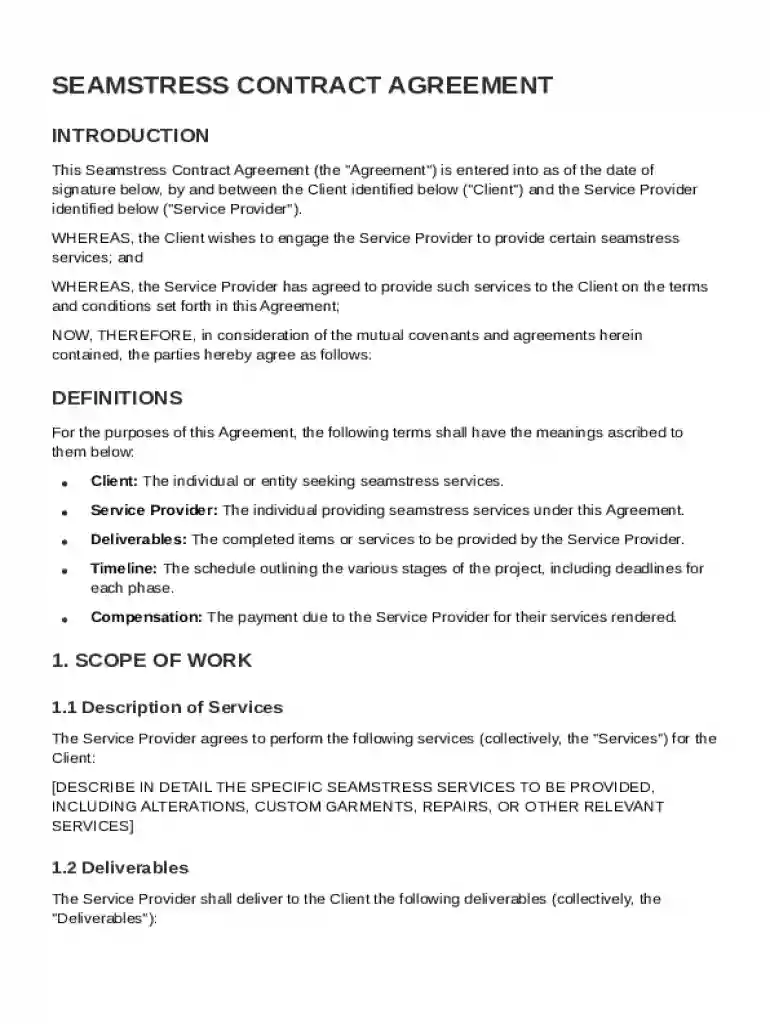
A Seamstress Contract Template is a formal document used to outline the agreement between a client and a service provider for professional seamstress services. This contract serves as a legal framework detailing the expectations and obligations of both parties involved in the transaction. The template typically outlines the scope of work, payment terms, timelines, and other essential elements that define the professional relationship. This helps in avoiding potential disputes by clearly stating the responsibilities and rights of each party before services commence.
Key Elements of the Seamstress Contract Template
The Seamstress Contract Template comprises several critical elements designed to provide a comprehensive understanding of the agreement's terms. Key components include:
- Scope of Work: Detailed description of the services to be provided, including any specific tailoring or design requirements.
- Payment Terms: Information about how and when payments will be made, including the total project cost and any deposit requirements.
- Timelines: A project timeline that includes essential milestones, delivery dates, and completion deadlines.
- Responsibilities of Both Parties: Clear delineation of what the client and the seamstress are expected to do throughout the project lifespan.
- Confidentiality Clauses: Rules regarding the nondisclosure of any proprietary or personal information exchanged during the project.
- Dispute Resolution Procedures: Steps to be followed if a dispute arises, which might include mediation or arbitration processes.
- General Provisions: Additional terms that may cover amendments to the contract, force majeure, and termination conditions.
How to Use the Seamstress Contract Template
Utilizing a Seamstress Contract Template involves several steps to ensure the document meets the specific needs of the project:
- Review the Template: Begin by thoroughly reading the template to understand its structure and sections.
- Customize the Contract: Modify any necessary sections, ensuring they reflect the agreement's specific details such as names, dates, and service descriptions.
- Discuss with the Client: Present the drafted contract to the client for review and make any necessary revisions based on feedback.
- Finalize Details: Ensure all essential information, such as payment and timelines, is clearly stated and agreed upon by both parties.
- Sign the Contract: Both parties need to sign the contract to formalize the agreement. Electronic signatures can be utilized for convenience.
- Maintain a Copy: Each party should retain a signed copy for future reference.
Who Typically Uses the Seamstress Contract Template
The Seamstress Contract Template is particularly beneficial for:

- Professional Seamstresses: Individuals offering tailoring and sewing services who need to formalize their engagements with clients.
- Fashion Designers: Those who outsource specific aspects of garment production to freelance seamstresses and need to outline deliverables.
- Boutique Owners: Businesses that require periodic tailoring services for their inventory or customers.
- Event Planners: Professionals coordinating events like weddings or fashion shows that necessitate tailored garments.
- Clients Seeking Custom Work: Customers engaging seamstresses for personal projects, such as wedding dresses or bespoke outfits.
Legal Use of the Seamstress Contract Template
The Seamstress Contract Template serves as a binding legal document under U.S. contract law, meaning it must comply with standard legal requirements to be considered enforceable:
- Mutual Consent: Both parties must agree to the terms voluntarily.
- Capacity: Parties involved must have the legal ability to enter into the contract, usually meaning they are of legal age and sound mind.
- Consideration: There must be an exchange of value, such as services for payment.
- Legal Purpose: The contract's objectives must be lawful and not against public policy.
- Written and Signed: Although oral agreements can be valid, the written and signed contract serves as stronger evidence in legal proceedings.
State-specific Rules for the Seamstress Contract Template
Certain states may have specific requirements or considerations that affect how you use a Seamstress Contract Template, including:
- State-Specific Clauses: Some states mandate the inclusion of particular laws or disclosures, such as consumer protection clauses.
- Sales Tax Implications: Depending on the state, services rendered might be subject to sales tax, affecting payment terms.
- License Requirements: In some states, seamstresses might need a professional license to offer certain services, which should be mentioned in the contract.
- Cancellation Terms: Some jurisdictions may have statutes governing cancellation policies, requiring specific time frames or penalty clauses.
Examples of Using the Seamstress Contract Template
Using the Seamstress Contract Template can offer several practical benefits in real-world scenarios like:
- Custom Wedding Gowns: Ensuring both the bride and seamstress are clear on design specifications and deadlines, helping prevent stressful last-minute changes.
- Theatrical Costumes: Coordinating multiple costume creations for a play, with detailed timelines and fitting schedules to avoid production delays.
- Corporate Uniforms: Describing bulk garment orders for businesses, outlining specifications for standard sizes, and including penalty clauses for late deliveries.
- Repair and Alteration Services: Specifying individual garment adjustments for clients, with particular attention to turnaround times and fitting appointments.
Digital vs. Paper Version
When it comes to utilizing the Seamstress Contract Template, deciding between digital and paper versions can significantly impact workflow:
- Digital Version:
- Offers flexibility for editing and customization with document editing tools.
- Allows for electronic signatures, reducing need for in-person meetings.
- Facilitates easy sharing, storage, and retrieval via cloud-based services.
- Paper Version:
- Provides a tactile, traditional form for clients more comfortable with physical documents.
- Is essential in environments where digital access is limited or for clients who prefer physical records.
- Integration:
- Platforms like DocHub can bridge the gap by permitting easy conversion between digital and physical forms, enabling electronic handling while maintaining the option for hard copies when necessary.