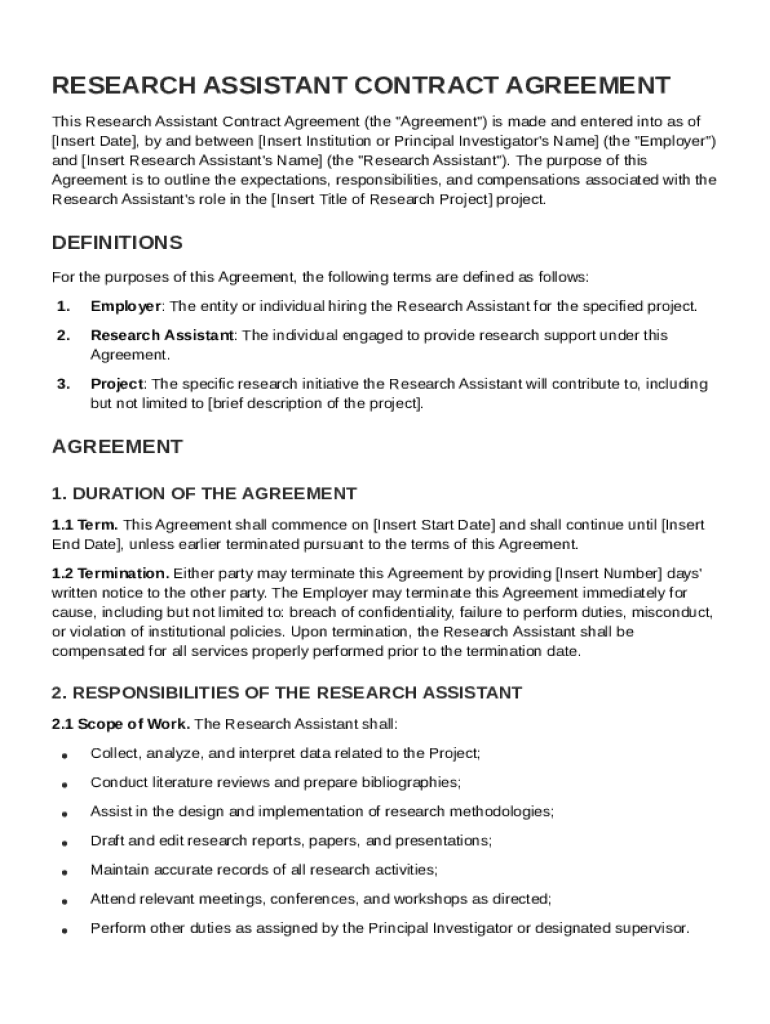







Definition and Purpose of the Research Assistant Contract Template
The Research Assistant Contract Template serves as a structured framework for defining the terms and conditions of employment for a Research Assistant engaged in a specific research project. This document lays out crucial components such as employment duration, roles and responsibilities, and compensation details, ensuring clear communication between the employer and the research assistant. It acts as a legally binding agreement that not only outlines the expectations from both parties but also safeguards the interests of the employer by assigning ownership of any intellectual property developed during the project.
Components of the Template
- Duration of Employment: Specifies the start and end dates of the employment contract, providing a clear timeline for the engagement.
- Roles and Responsibilities: Details the specific duties and tasks expected of the research assistant, tailored to the needs of the project they are working on.
- Compensation and Benefits: Outlines the financial remuneration for the research assistant, including salary, benefits, and any potential bonuses.
- Confidentiality Obligations: Establishes the confidentiality requirements and the importance of maintaining discretion regarding sensitive project information.
How to Use the Research Assistant Contract Template
Utilizing the Research Assistant Contract Template involves several critical steps to ensure that it aligns with the specific needs of both the employer and the research assistant. It must be customized to reflect the unique characteristics of the research project and the specific agreements made between the involved parties.
Steps to Customize the Template
- Review and Understand: Begin by thoroughly reading the template to understand its structure and the standard provisions included.
- Customize Sections: Edit the template to incorporate project-specific details such as unique responsibilities, specific timeline constraints, and customized benefits.
- Consultation with Legal Advisors: Engage with legal experts to verify that the template adheres to relevant employment laws and regulations.
- Final Review and Consent: Both parties should review the finalized contract to confirm mutual agreement on all terms highlighted.
Steps to Complete the Research Assistant Contract Template
Completing the Research Assistant Contract Template requires systematic attention to detail to ensure all necessary information is accurately captured. This process involves filling out specific sections and obtaining required endorsements.
Procedural Steps
- Input Basic Information: Start by entering the employer and research assistant’s details, including names and contact information.
- Define Project Specifics: Clearly articulate the project’s scope, objectives, and expected outcomes.
- Assign Deliverables: List any reports, data analysis, or other deliverables expected from the research assistant.
- Finalization and Signatures: Both parties must sign the document to formalize the agreement.
Key Elements of the Research Assistant Contract Template
The Research Assistant Contract Template is built upon several foundational elements essential for effective and clear communication. These core components ensure all critical aspects of the employment relationship are outlined.
Core Sections
- Employment Terms: Includes specifics on working hours, job flexibility, and expected attendance.
- Professional Development: Details opportunities for skill development and enhancement related to the project.
- Behavioral Expectations: Defines acceptable work conduct and performance metrics.
Legal Use of the Research Assistant Contract Template
Ensuring legal compliance with the Research Assistant Contract Template involves adhering to relevant employment laws and regulations within the United States. This provides a legally sound framework for both parties.
Legal Considerations
- Compliance with State Laws: The contract must meet the stipulations of state-specific labor laws and intellectual property rights.
- Anti-Discrimination Clauses: Incorporation of clauses that disallow discrimination based on race, gender, and other protected categories.
- Dispute Resolution: Establishes mechanisms for resolving any potential disputes that may arise.
Who Typically Uses the Research Assistant Contract Template
This template is employed by a diverse range of organizations and individuals involved in research activities. It is particularly vital for establishing clear agreements in academic, governmental, and corporate research contexts.


Common Users
- Academic Institutions: Universities and colleges employ these contracts to formalize employment with graduate or undergraduate research assistants.
- Research Firms: Private companies operating in scientific, social, or market research.
- Non-Profit Organizations: Entities focused on research initiatives for social good.

Important Terms in the Research Assistant Contract Template
Terminology used within the Research Assistant Contract Template can significantly impact the interpretation and enforcement of its terms. Understanding these terms ensures clear expectations and legal integrity.
Glossary of Key Terms
- Intellectual Property: Ownership rights over findings, innovations, or materials developed during the project.
- Confidential Information: Data or insights that must be kept secure to protect the project’s integrity.
- Termination Clause: Conditions under which the contract may be prematurely ended by either party.
Examples of Using the Research Assistant Contract Template
Learning from practical examples aids in leveraging the template’s full potential. These scenarios illustrate how the contract template can be adapted to various research settings.
Practical Scenarios
- Academic Project: A professor employing a graduate student for a specific research study over one semester.
- Corporate Research: A tech company hiring a research assistant to assist with a product development initiative.
- Non-Profit Research: Utilizing the contract in a project aimed at studying environmental impacts within a community initiative.
Each scenario reflects nuanced variations in template application and customization, demonstrating its flexibility and utility for different research environments.