
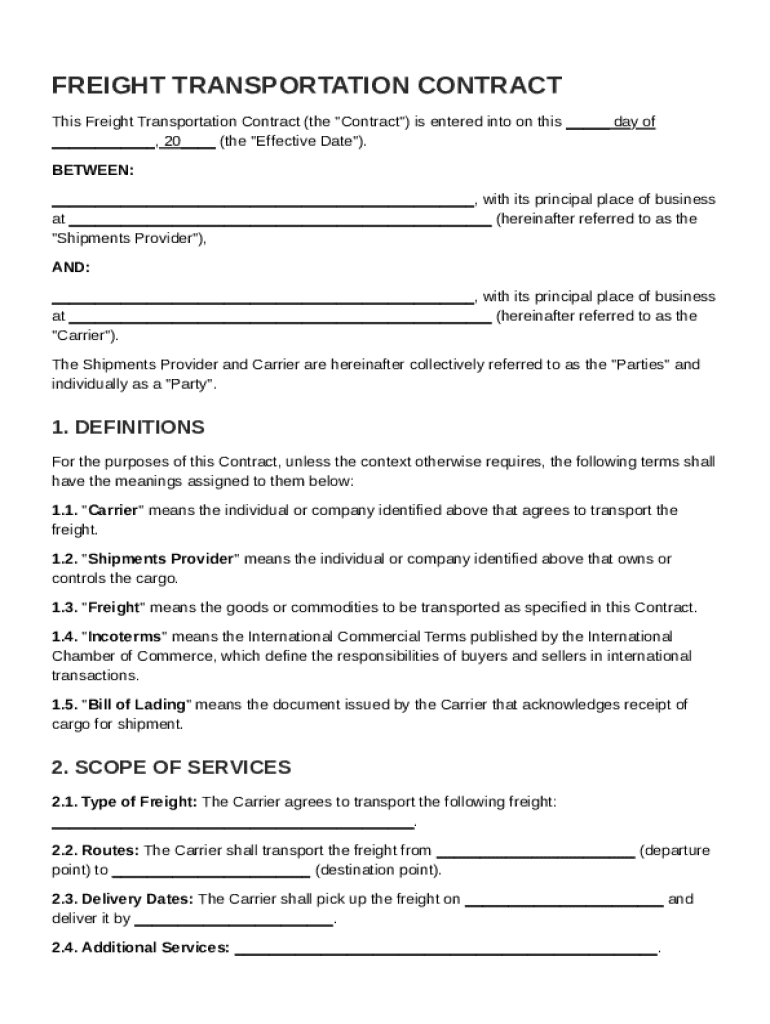







Definition and Purpose of a Freight Contract Template
A freight contract template is a structured document used to formalize the agreement between a shipments provider and a carrier for the transportation of goods. This important legal document serves as a blueprint for specifying the terms and conditions under which freight transportation will occur. It outlines responsibilities, payment terms, liabilities, insurance coverages, termination clauses, and dispute resolution mechanisms. By doing so, it fosters clear communication and accountability, helping parties avoid misunderstandings and potential conflicts during the transportation process. Most businesses, especially those involved in logistics and distribution, rely heavily on such templates to ensure their freight operations are conducted smoothly and according to agreed-upon standards.
How to Use the Freight Contract Template
Using a freight contract template involves several key steps. Here’s a comprehensive guide:
- Download or open the template: Access the freight contract template through a document management platform like DocHub.
- Input specific details: Fill out the template with details like the names and contact information of both parties, description of goods, and shipping dates.
- Define terms and conditions: Clearly specify the payment terms, responsibilities, and liabilities for each party involved.
- Include legal stipulations: Add clauses related to insurance requirements, termination conditions, and dispute resolution processes.
- Review and revise: Before finalizing the document, review all sections to ensure accuracy and completeness.
- Sign the document: Use DocHub’s electronic signature feature to sign the contract. You can draw, type, or upload a signature.
- Share with all parties: Once signed, distribute the completed contract to all involved parties for their records.
Using modern platforms like DocHub enhances efficiency by allowing seamless editing, signing, and sharing of the contract with involved parties.
Key Elements of the Freight Contract Template
The freight contract template is built upon several critical elements that ensure a comprehensive and legally sound agreement:
- Parties Involved: Identifies the shipments provider and carrier, including company names and contact information.
- Scope of Work: Details the nature of goods to be transported, including specifications and any special handling instructions.
- Payment Terms: Specifies payment amounts, due dates, and any penalties for late payment.
- Liabilities and Insurance: Outlines responsibilities of each party for freight losses, damages, or delays, and specifies necessary insurance coverages.
- Termination Clauses: Includes provisions under which the contract may be terminated, either by mutual agreement or due to breach.
- Dispute Resolution: Sets forth methods for resolving disagreements, such as negotiation, mediation, or arbitration.
- Miscellaneous Provisions: Captures other essential terms, such as confidentiality agreements and force majeure conditions.
These elements help ensure that the contract is comprehensive and protects the interests of all parties involved.
Who Typically Uses the Freight Contract Template
Freight contract templates are utilized by a wide range of business entities within the logistics and supply chain sectors. Key users include:
- Logistics companies: To manage transportation agreements with carriers.
- Manufacturers: Ensuring their products are shipped securely to retailers and consumers.
- Retailers: For coordinating deliveries from suppliers and distribution centers.
- Individual shippers: When transporting personal goods through a third-party carrier.
These templates provide a standardized way to handle shipments, making them ideal for businesses that regularly engage in the shipping of goods.


Steps to Complete the Freight Contract Template
Completing a freight contract template involves a series of specific actions. Here’s how to do it effectively:
- Collect Necessary Information: Gather all details related to the shipment, such as weight, type of goods, addresses, and parties involved.
- Fill Out the Template: Enter the collected information into the corresponding fields in the template.
- Add Legal Terms: Define payment obligations, liability limits, and include standard legal clauses necessary for freight transportation contracts.
- Review All Entries: Ensure all information is correct and complete, making adjustments as necessary.
- Seek Legal Review: If needed, have the document reviewed by a legal professional to ensure compliance with relevant laws.
- Sign Electronically: Both parties should sign the contract using an electronic signature tool, ensuring it is binding and enforceable.
- Distribute Copies: After signing, each party should receive a copy of the agreement for their records.
This step-by-step process ensures clarity and mutual understanding between parties, supporting efficient and smooth freight operations.
Digital vs. Paper Version of the Freight Contract Template
In today’s digital age, both digital and paper versions of the freight contract template have their place. Here’s how they differ:
-
Digital Version:
- Offers ease of access and editing through platforms like DocHub.
- Supports real-time collaboration and immediate sharing.
- Ensures security with encryption and digital signatures.
- Facilitates eco-friendly and cost-effective operations by reducing paper use.
-
Paper Version:
- Provides a tangible document for those who prefer physical copies.
- May be necessary for regulatory compliance in certain industries or jurisdictions.
- Useful in scenarios where digital access is limited or non-existent.
The choice between digital and paper largely depends on operational needs and stakeholder preferences, though digital offers numerous efficiency and security benefits.
Software Compatibility and Integration
DocHub and other similar platforms offer seamless compatibility with many popular productivity and document management applications. Here’s how it integrates:
- Google Workspace Integration: Import, edit, and export documents seamlessly with Google Drive and Gmail.
- Cloud Storage Compatibility: Works smoothly with Dropbox, OneDrive, and other major cloud services.
- Cross-Platform Accessibility: Accessible from any web browser without the need for dedicated software installations, supporting both desktop and mobile use.
- File Type Support: Besides PDFs, supports editing of DOC, PPT, XLS, and TXT files, ensuring compatibility with various document formats.
Employing such software ensures that businesses can create, manage, and finalize freight contracts with ease, supporting flexible operational needs.
Legal Use of the Freight Contract Template in the U.S.
In the context of the United States, the legal use of a freight contract template must adhere to federal and state-specific regulations. Consideration should be given to:
- Compliance with U.S. Commerce Laws: Ensuring that contracts meet requirements under the Uniform Commercial Code (UCC) for the sale and transport of goods.
- ESIGN Act Compliance: Electronic signatures must meet criteria set by the Electronic Signatures in Global and National Commerce Act.
- State Regulations: Different states may have additional regulations regarding freight and transportation contracts, which should be reviewed and incorporated as needed.
Ensuring compliance with these legal frameworks prevents potential disputes and contributes to enforceable and reliable freight agreements.




