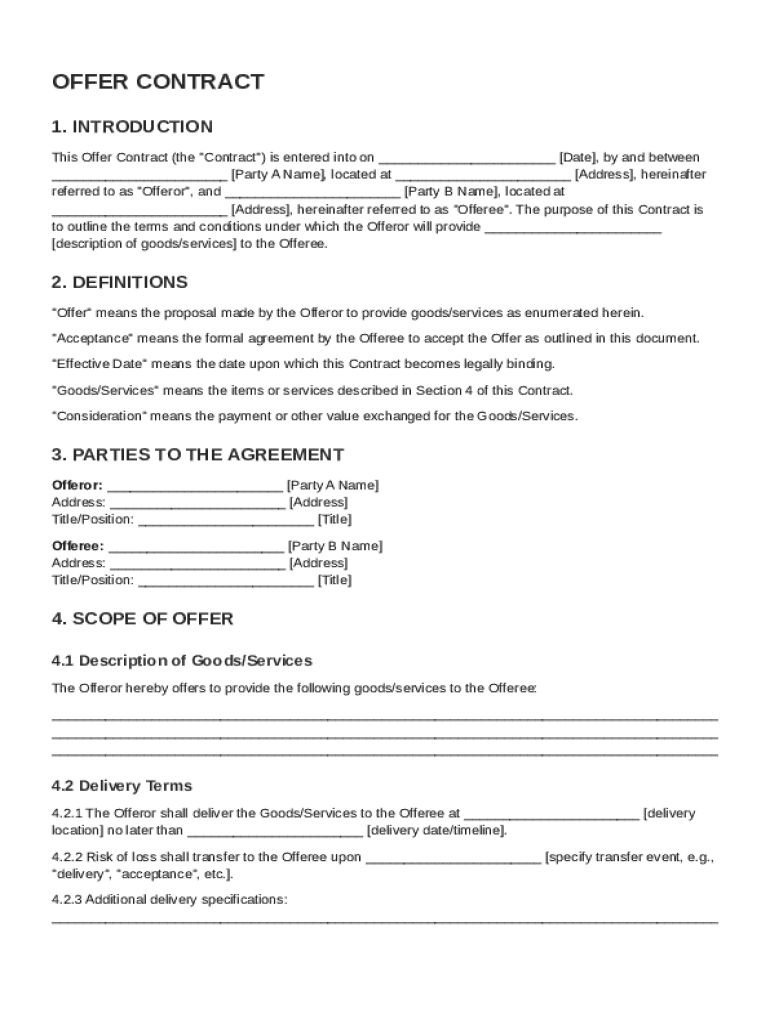







Definition and Meaning of an Offer Contract Template
An Offer Contract Template is a standardized document used to formalize an offer for goods or services between two parties, known commonly as the Offeror and the Offeree. It delineates the terms, conditions, and expectations agreed upon, laying the groundwork for a mutual understanding and legal commitment. This document is pivotal in establishing critical components such as the scope of the offer, payment structures, and both parties' obligations. Ensuring that all terms are clearly defined helps prevent misunderstandings and disputes, fostering a smooth transaction process.
- Scope of Offer: The template clearly outlines the specific goods or services being provided, including detailed descriptions to avoid ambiguity.
- Payment Details: This section specifies the payment terms, including the total amount, schedule, and method of payment. Clear payment instructions ensure timely and accurate financial exchanges.
- Liability Limitations: Defining who is responsible for what in case of unforeseen circumstances is crucial in managing risks and setting expectations.
The Offer Contract Template serves as a legally binding document once both parties have accepted and signed, making it a vital tool in business transactions.
Steps to Complete the Offer Contract Template
Completing the Offer Contract Template involves several critical steps to ensure accuracy and compliance with legal standards. Follow a systematic approach to fill out the document thoroughly:
- Gather Required Information: Collect all necessary details from both parties, including names, addresses, and contact information.
- Define the Scope and Terms: Clearly articulate the goods or services being offered, ensuring all aspects are fully described.
- Outline Payment Details: Specify the payment structure, including any deposits, due dates, and preferred methods of payment.
- Include Confidentiality and Liability Clauses: These sections protect sensitive information and limit risks, detailing the responsibilities and potential liabilities of each party.
- Review Legal Compliance: Make sure all sections comply with applicable laws and regulations, potentially consulting legal counsel for added protection.
- Signatures and Dates: Both parties must sign and date the document to signify acceptance of all terms, thereby making the contract legally binding.
Each of these steps necessitates careful attention to detail to avoid potential issues and ensure the document's enforceability.
Key Elements of the Offer Contract Template
The Offer Contract Template comprises several crucial elements, each serving a distinct purpose to construct a reliable agreement:
- Definitions Section: Essential terms used throughout the contract are clearly defined for mutual understanding.
- Acceptance Procedures: Explains how and when the Offeree can accept the offer, including any deadlines or conditions for acceptance.
- Termination Conditions: Details the circumstances under which the contract can be dissolved by either party and any repercussions thereof.
- Amendment Procedures: Establishes how changes to the contract terms can be made and agreed upon after initial signing.
- Governing Law: Indicates which jurisdiction's laws will apply to the contract, critical for resolving disputes.
These foundational components ensure that the contract is comprehensive, clear, and enforceable.
Legal Use of the Offer Contract Template
The Offer Contract Template is a legally binding instrument governed by contract law principles. Its use ensures that all agreed-upon terms between the Offeror and Offeree are enforceable in court:
- Binding Agreement: Once signed, both parties are legally obliged to fulfill their contractual obligations.
- Contractual Remedies: In case of breach, parties may seek enforcement or damages through court proceedings.
- Evidence of Agreement: Serves as legal proof of the mutually agreed terms and conditions, providing security for both parties.
Understanding the legal weight and implications of the Offer Contract Template is essential to utilizing it effectively and protecting one's interests.
Examples of Using the Offer Contract Template
Real-world application of the Offer Contract Template spans various scenarios and industries:
- Service Agreements: Used by service providers offering maintenance, consulting, or professional services to outline deliverables and compensation.
- Sales Contracts: Deployed in the sale of goods such as electronics or commodities, specifying product details and payment terms.
- Partnership Agreements: Facilitates terms of collaboration between business partners, delineating roles, contributions, and profit sharing.
These examples illustrate the versatility and necessity of the Offer Contract Template in different business contexts.
Important Terms Related to the Offer Contract Template
Understanding specific terminology related to the Offer Contract Template aids in its effective use and comprehension:
- Offeror and Offeree: The Offeror makes the offer, while the Offeree is the party to whom the offer is extended.
- Consideration: Refers to the value exchanged between parties, often monetary, to validate the contract.
- Breach of Contract: Occurs when one party fails to uphold their contractual obligations, allowing for possible legal recourse by the other party.
Familiarity with these terms ensures accurate interpretation and implementation of the contract.
State-Specific Rules for the Offer Contract Template
While the Offer Contract Template provides a foundation for agreement, state-specific laws can influence its execution and enforceability:
- Contract Enforcement: Variance in laws across states can affect how contracts are interpreted and enforced.
- Regulatory Compliance: Certain industries adhere to state-specific regulations which must be accommodated within the contract terms.
- Dispute Resolution: Procedures for dispute resolution may differ based on location, necessitating inclusion of a governing law clause.
Awareness of these nuances is vital for aligning the contract with jurisdictional requirements.
Who Typically Uses the Offer Contract Template
The Offer Contract Template is utilized by a diverse range of individuals and entities in different transactional contexts:
- Businesses: Companies use it to formalize agreements with clients, vendors, and partners.
- Freelancers and Consultants: Professionals leverage it to detail the scope of services and compensation in client contracts.
- Individuals: When engaging in significant personal transactions, such as purchasing a vehicle or property, an offer contract provides a clear, structured format for agreement.
Its flexibility makes it an essential tool across many professional and personal dealings.