
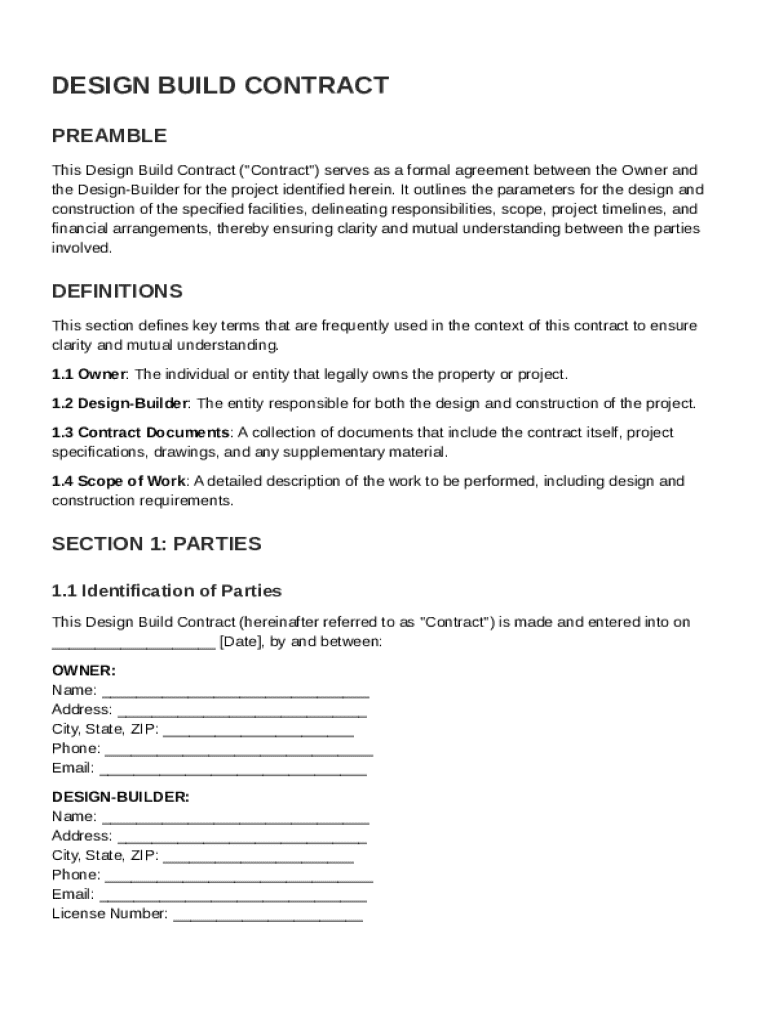




Definition of Design Build Contract Template
The "Design Build Contract Template" is a structured agreement used primarily in the construction industry, outlining the responsibilities and expectations between an Owner and a Design-Builder. This template seeks to streamline project management by consolidating the design and construction phases under one contract, thus ensuring that both roles are managed by a single entity. This approach contrasts with the traditional design-bid-build method and aims to enhance efficiency and communication. The template includes crucial elements such as project scope, timelines, financial arrangements, and dispute resolution processes, ensuring all parties have a clear understanding of their obligations and expectations.
How to Use the Design Build Contract Template
Utilizing the Design Build Contract Template involves several steps to ensure that all relevant details are meticulously documented:
-
Review the Template Structure: Familiarize yourself with the sections of the template, including project description, responsibilities of each party, timelines, and financial terms.
-
Customize Project Details: Input specific information related to the project, such as the scope of work, deliverables, and any unique requirements or constraints.
-
Define Payment Terms: Clearly outline the payment schedule, including milestones or deliverables tied to specific payments, to prevent disputes and ensure transparent financial management.
-
Establish Communication Protocols: Determine how parties will communicate throughout the project duration, specifying methods and frequency of updates, meetings, and reports.
-
Incorporate Legal and Compliance Requirements: Ensure the contract meets all relevant legal standards and includes clauses on insurance, warranties, and dispute resolution to protect all involved parties.
-
Review and Sign: Before finalizing, both the Owner and Design-Builder should thoroughly review the document, addressing any ambiguities or concerns. Once agreed upon, signatures from all parties involved should be added, making the contract legally binding.
Key Elements of the Design Build Contract Template
The Design Build Contract Template typically consists of several critical components that provide a comprehensive framework for construction projects:
-
Project Description and Scope of Work: Clearly defines the objectives, deliverables, and specifications of the project to ensure mutual understanding.
-
Roles and Responsibilities: Outlines the duties of both the Owner and the Design-Builder, specifying who is responsible for design, permits, construction, and other project phases.
-
Timeline and Milestones: Establishes a detailed schedule with key milestones, ensuring the project progresses on time and any potential delays are managed efficiently.
-
Financial Arrangements: Includes detailed payment terms, budget allocations, cost estimations, and contingencies to manage project finances effectively.
-
Change Order Process: Describes procedures for modifications to the project scope or schedule, ensuring changes are documented and agreed upon by all parties.
-
Dispute Resolution: Provides mechanisms for resolving conflicts, which may include mediation, arbitration, or litigation.
-
Insurance and Warranties: Specifies the types of insurance coverage required and any warranties offered by the Design-Builder upon project completion.
Steps to Complete the Design Build Contract Template
Achieving a comprehensive and effective Design Build Contract involves a series of methodical steps:
-
Gather Necessary Information: Collect details about the project, including scope, budget, schedule, and key stakeholders.
-
Review Legal Requirements: Ensure compliance with local, state, and federal regulations that may impact the contract’s validity.
-
Draft Initial Contract: Populate the template with the gathered information, ensuring all sections are complete and accurate.
-
Seek Professional Review: Have legal and construction professionals review the draft to confirm thoroughness and legal compliance.
-
Negotiate Terms: Facilitate a discussion between the Owner and Design-Builder to address any concerns and finalize contract terms.
-
Finalize and Sign: Once all parties agree, execute the contract with signatures, making it legally binding.
Legal Use of the Design Build Contract Template
Using a Design Build Contract Template legally requires adherence to regulatory requirements specific to construction contracts. The contract should reflect all mandates imposed by the American Institute of Architects (AIA) or other relevant authoritative bodies. Additionally, all parties must verify that the contract fulfills state-specific statutory requirements related to construction, licensing, and safety standards. This legal rigor ensures the contract’s enforceability and protects both the Owner’s and the Design-Builder’s interests throughout the project lifecycle.
State-Specific Rules for the Design Build Contract Template
Each U.S. state may impose different rules impacting the formation and execution of a Design Build Contract. Variations typically include licensing requirements, bonding and insurance provisions, dispute resolution mechanisms, and prevailing wage laws. It is critically important for the contracting parties to consult local legal advisors or state construction boards to tailor the contract template to state-specific rules and regulations. Ensuring that the contract is compliant with these rules will help to mitigate potential legal issues and maintain the project’s alignment with state mandates.
Important Terms Related to the Design Build Contract Template
Understanding the terminology used in design build contracts is essential for clear communication and effective contract management:
- Design-Builder: The entity responsible for both the design and construction phases of the project.
- Owner: The individual or organization commissioning the project, responsible for providing the project site and funding.
- Change Order: A formal document amending the original contract terms, often related to scope or timeline adjustments.
- Substantial Completion: A stage when the project is sufficiently complete, allowing for its intended use.
- Retainage: A portion of the contract sum withheld from payment until project completion, ensuring satisfactory work completion.
Examples of Using the Design Build Contract Template
Real-world application of a Design Build Contract Template often involves various industries where construction and design are integral. For instance, in commercial construction, a retail chain might use the template to quickly establish new store locations by working with a single entity overseeing both design and construction. Similarly, in infrastructure projects like bridge construction, the contract allows for concurrent progression of design and build phases, reducing project timelines and costs. These examples highlight the versatility and efficiency offered by the Design Build Contract approach.
Versions or Alternatives to the Design Build Contract Template
While the Design Build Contract Template is comprehensive, some projects might benefit from alternative forms such as the Design-Bid-Build or Construction Management at Risk contracts. These alternatives offer different levels of control, risk management, and financial arrangements. For smaller projects, a simplified agreement might suffice, while extensive projects may require bespoke adaptations of the template to accommodate unique circumstances. Understanding these variations can help decision-makers select the most suitable contract format to match their specific project needs.