




Definition & Meaning
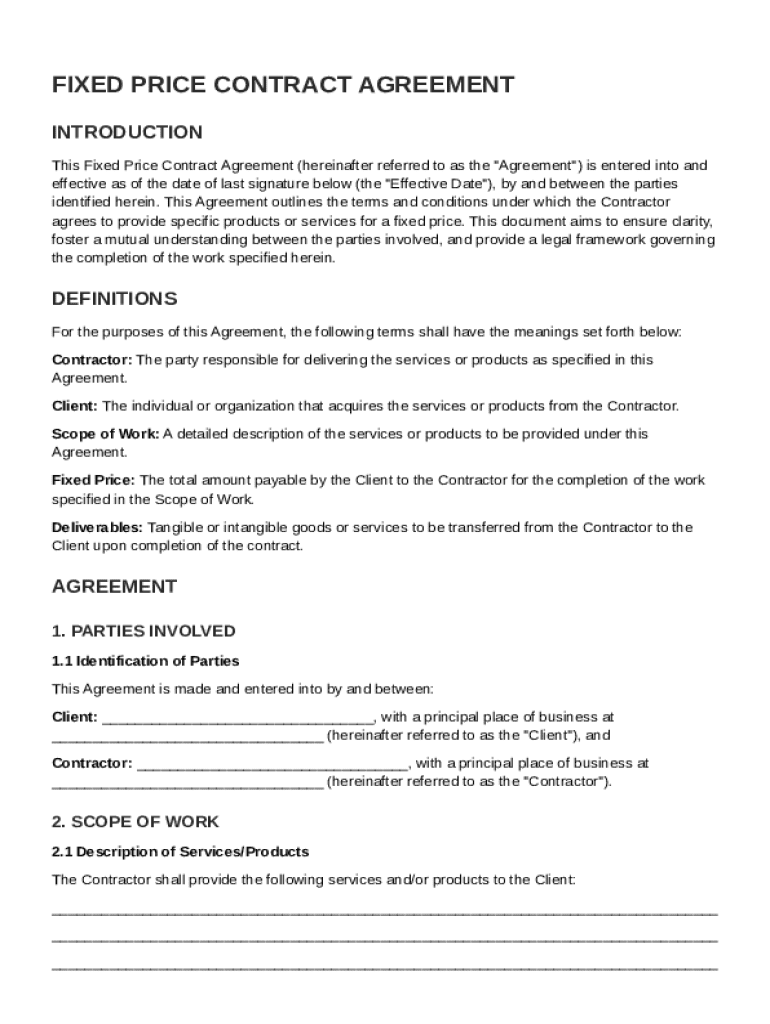
A Fixed Price Contract Template is an essential document that establishes a clear agreement between a client and a contractor regarding the provision of specified products or services at an agreed-upon fixed price. This template is used to lay out the contractual terms that detail each party's obligations and ensures that there is mutual understanding about the scope of work, payment terms, and performance standards. It is a legally binding document that mitigates the risk of misunderstandings or disputes by providing a definitive framework for the project.
How to Use the Fixed Price Contract Template
Using a Fixed Price Contract Template involves customizing it to reflect the specific details of the agreement between the contractor and the client. Begin by inserting the names of both parties and detailed descriptions of the work to be performed. It is crucial to specify deadlines and milestones to ensure clarity on timing expectations. Payment details, including the total amount, payment schedule, and terms of payment, must also be clearly outlined. Finally, review the template for any clauses that need adjustment, such as confidentiality, dispute resolution, and termination procedures, to fit the unique requirements of the contract.
Customizing Key Sections
- Scope of Work: Clearly define the tasks or services to be performed, including any deliverables.
- Payment Terms: Detail the total fixed price, installment schedule, and any penalties for late payment.
- Performance Standards: Specify the quality or performance metrics the contractor is expected to meet.
Key Elements of the Fixed Price Contract Template
The Fixed Price Contract Template typically includes several critical elements to ensure comprehensive coverage of the agreement terms. These include:
- Definitions: Clarify key terms used throughout the contract to prevent ambiguity.
- Scope of Work: Provides a detailed description of the services or products provided.
- Payment Schedule: Outlines the total price and the timeline for payments.
- Performance Standards: Sets expectations for the quality and standards of work.
- Confidentiality Clauses: Explains the obligations to protect sensitive information.
- Dispute Resolution: Describes the process for resolving any disagreements that arise.
- Governing Law: Indicates the legal jurisdiction applicable to the contract.
Important Terms Related to Fixed Price Contract Template
Understanding the terminology associated with fixed price contracts is crucial for effectively using the template. Key terms include:
- Milestone Payments: Payments made upon reaching specific project phases.
- Change Order: A document outlining modifications to the original scope, cost, or schedule.
- Retention: A portion of the payment withheld pending satisfactory project completion.
Examples of Usage
- Milestone Payment Example: "A payment of $5,000 will be made upon completion of the project design phase."
- Change Order Scenario: "A change order must be agreed upon if additional tasks are required outside the initial scope."
Legal Use of the Fixed Price Contract Template
The Fixed Price Contract Template serves as a legally enforceable agreement when both parties sign it. Compliance with applicable laws and regulations is critical, requiring careful consideration of any specific legal requirements based on the project's location or nature. It's advisable to consult with a legal professional to ensure the contract adheres to applicable laws, particularly those involving labor standards, safety regulations, and any industry-specific legalities.
Legal Considerations
- Enforceability: Ensure the contract includes all required elements for it to be enforceable in court.
- Compliance: Review relevant state and federal laws applying to the contract's subject matter.
State-Specific Rules for the Fixed Price Contract Template
Contracts might need to be adjusted based on state-specific regulations. Each state can have unique laws regarding contract enforcement, permissible clauses, and dispute resolution. For example, certain states require specific disclosures in construction contracts concerning timelines and consumer rights. Understanding these variances is critical for ensuring the legality and enforceability of the contract.
State Variations Example
- California: Contracts might require additional environmental compliance clauses.
- New York: Specialty trade contracts may require bonds or additional licensing information.
Examples of Using the Fixed Price Contract Template
The template is versatile and can be applied across diverse industries. Here are a few scenarios:
- Construction Projects: Contractors use the template to outline the work, timing, and fees for building a residential property.
- IT Services: A tech firm employs the template to agree on software development tasks and deliverables for a fixed fee.
- Consultancy Agreements: A management consultant and a business use the template to detail strategic advice services for a set price.
Steps to Complete the Fixed Price Contract Template
A step-by-step approach is beneficial when filling out a Fixed Price Contract Template to ensure nothing is overlooked:
- Identify Parties: Clearly state the names and contact information of both parties.
- Define Scope of Work: Detail the tasks, services, and deliverables expected from the contractor.
- Establish Payment Terms: Specify the total fixed price and the schedule for payments.
- Set Performance Standards: Describe the quality criteria or standards expected.
- Include Legal Clauses: Add necessary legal terms, such as confidentiality and dispute resolution.
- Review and Sign: Thoroughly review the contract and obtain signatures from both parties to make it legally binding.
Additional Tips
- Review Regularly: Review and update the template for each new contract to ensure relevance.
- Seek Legal Advice: Consult legal professionals when unsure about any contractual section.