




01. Edit your form online
Type text, add images, blackout confidential details, add comments, highlights and more.

Type text, add images, blackout confidential details, add comments, highlights and more.

Draw your signature, type it, upload its image, or use your mobile device as a signature pad.

Send it via email, link, or fax. You can also download it, export it or print it out.
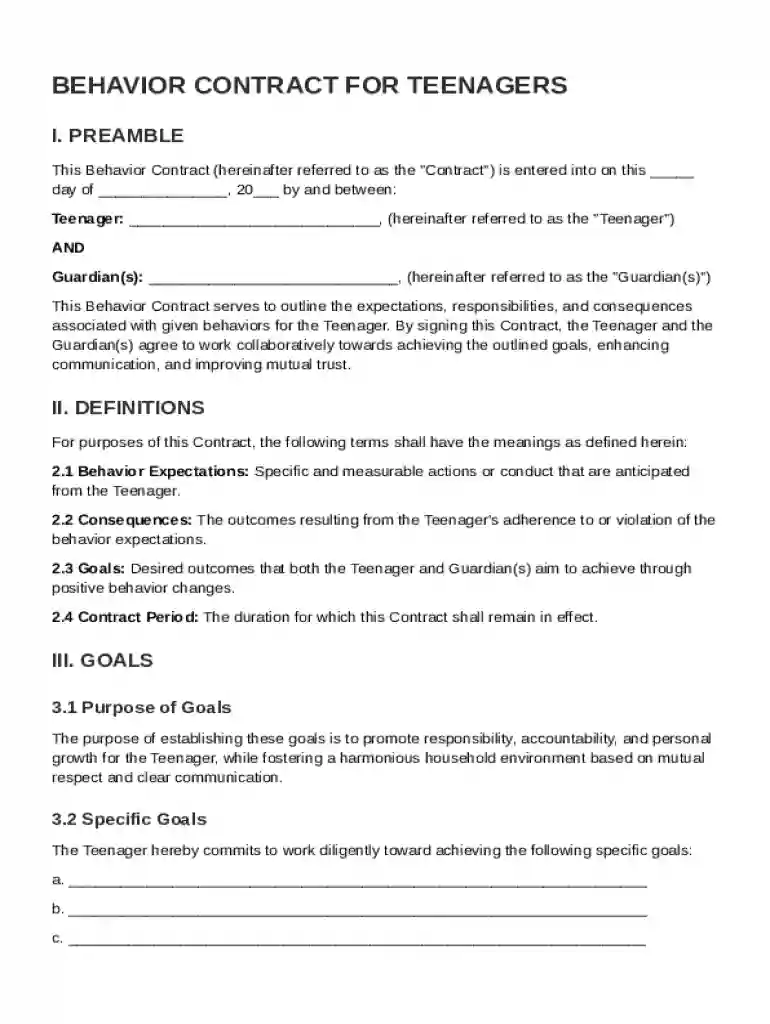
A Behavior For Teenager Contract Template is a structured agreement designed to establish clear expectations and responsibilities between a teenager and their guardians. This document is used to guide behavior, encourage accountability, and enhance communication within the family context. By defining specific behavioral goals, responsibilities, and consequences, it serves as a tool to promote personal growth and mutual trust. The contract typically outlines the expected behavior, the rewards for compliance, and the repercussions of violations, making it a crucial component for fostering a cooperative and supportive home environment.
The template is intended to be used as a customizable framework where guardians and teenagers can outline behavior expectations tailored to their specific situation. This process involves filling in sections such as behavioral goals, responsibilities, and agreed-upon rewards and consequences.
The contract template consists of several crucial components that help guide its effective execution:
Completing the contract involves several straightforward steps that help ensure clarity and mutual agreement:
While this contract is not legally binding in the way a formal legal document might be, it holds considerable weight as a mutual agreement within a family setting. It is crucial for both parties to understand the contract is more of a personal accountability tool rather than a legal enforcement document. By fostering open communication, it builds a foundation of trust and respect, integral to private family dealings in the United States.
The application of behavioral contracts can vary based on state guidelines concerning parental authority and juvenile rights. While most behavior contracts function similarly nationwide, specific state laws might influence how a contract is perceived in terms of enforceability and parental rights. It's essential to consider state regulations if the contract extends into areas that require legal compliance, particularly around issues of child welfare.
Numerous household scenarios serve to illustrate the practicality and success of behavior contracts:
Understanding some key terms enhances the use and creation of the behavior contract:
Each element of the Behavior For Teenager Contract Template is designed to provide a comprehensive framework for improving behavior, enhancing communication, and fostering a conducive environment for personal development.
At DocHub, your data security is our priority. We follow HIPAA, SOC2, GDPR, and other standards, so you can work on your documents with confidence.




Rule #1: Treat family members respectfully. No fighting. This means no kicking, pushing, shoving, hitting, throwing things, or spitting at someone.
Cell phone contract for younger kids. We agree that the following behaviors are deal-breakers and will cause my phone to be taken away until we work out a
Behavior contracts are negotiated agreements between teacher and student to increase positive behaviors, with both parties benefiting from the agreement.


