01. Edit your form online
Type text, add images, blackout confidential details, add comments, highlights and more.

Type text, add images, blackout confidential details, add comments, highlights and more.

Draw your signature, type it, upload its image, or use your mobile device as a signature pad.

Send it via email, link, or fax. You can also download it, export it or print it out.
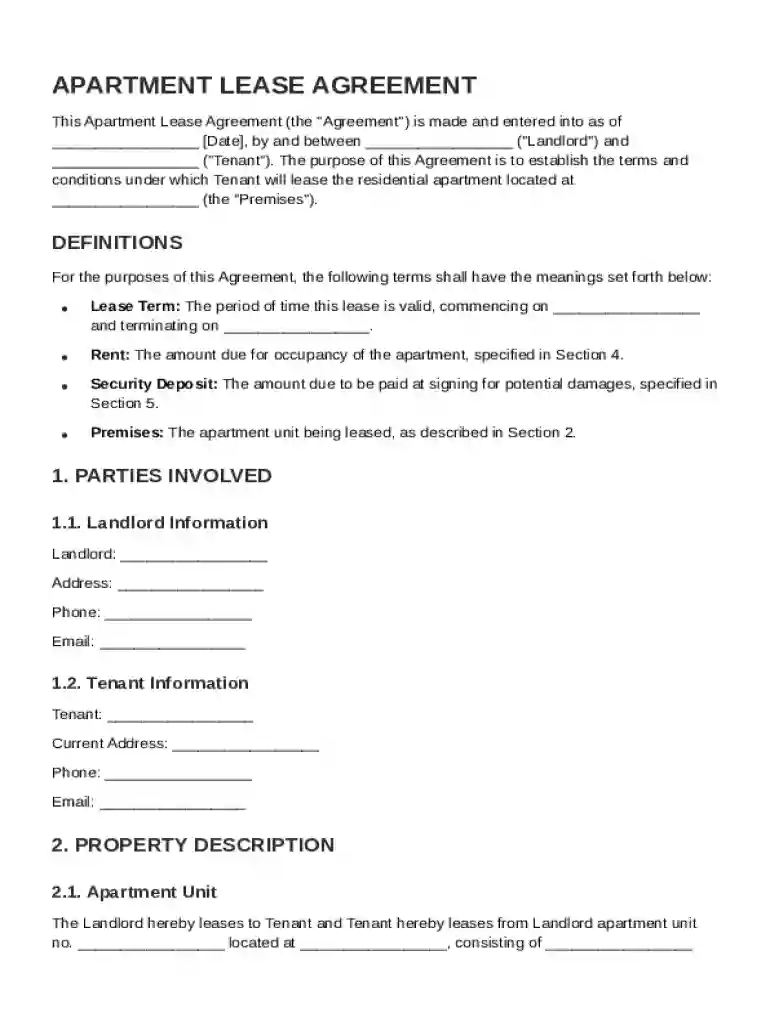
An Apartment Contract Template serves as a foundational document specifically designed to facilitate residential leasing agreements between the landlord and tenant. This template contains standardized sections that ensure clarity and comprehensiveness in outlining the responsibilities and rights of both parties. Essential in providing a structured framework, the template typically includes sections such as property description, tenant obligations, and landlord duties. By using a uniform layout, the template minimizes legal ambiguities and promotes transparent communication. In legal terms, this template functions to formalize rental arrangements, offering a safeguard for all involved parties by documenting mutual agreements.
Utilizing an Apartment Contract Template involves multiple steps to tailor it to specific rental situations. Initially, import the template into a document editing platform like DocHub to ensure it's editable. Next, input the details of the leasing agreement, starting with basic information such as the names of the landlord and tenant, and the location of the property. Customize sections like rent amount, payment due dates, and security deposit details to reflect the agreed terms. Add clauses that specify tenant responsibilities, such as maintenance duties or restrictions on alterations. Before finalizing, ensure both parties review and agree upon the terms to prevent misinterpretation. The document can be electronically signed through platforms supporting legally binding e-signatures.
Several pivotal elements are consistently found in an Apartment Contract Template:
These components ensure a comprehensive agreement, covering all typical landlord-tenant interaction facets.
Legally, an Apartment Contract Template serves as a binding agreement between parties. Its enforceability roots from compliance with federal, state, and local rental laws. The lease agreement acts as evidence of terms in legal proceedings and guides conflict resolution. It must adhere to housing regulations such as the Fair Housing Act and state-specific landlord-tenant statutes. The template should also consider rent control laws where applicable. Parties should always ensure legal clauses are reviewed by a legal professional or knowledgeable party to avoid unenforceable or unfair terms.
This template is primarily utilized by landlords, property management companies, and real estate professionals seeking an efficient method to draft leases. It benefits landlords with multiple properties by standardizing agreements for ease of management. Real estate agents may use it to swiftly finalize tenant agreements. Tenants also engage with the template to understand their rights and obligations, often negotiating specific terms. The template is adaptable for various residential leasing contexts, including single apartments, multi-unit buildings, or subdivided housing units.

Completing the Apartment Contract Template involves a series of detailed actions:
This step-by-step process ensures the agreement is thorough, legally sound, and tailored to specific rental conditions.
Understanding certain terms can enhance the use of an Apartment Contract Template:
These terms form the legal language that governs the relationship between the landlord and tenant, ensuring clarity in rental agreements.
Different states may impose unique conditions or requirements for leases, affecting an Apartment Contract Template.
To ensure compliance, landlords and tenants should research state-specific laws or consult a local attorney to align the template correctly with regional regulations. These variations emphasize the importance of adapting templates to fit legal prerequisites within different jurisdictions.
At DocHub, your data security is our priority. We follow HIPAA, SOC2, GDPR, and other standards, so you can work on your documents with confidence.