
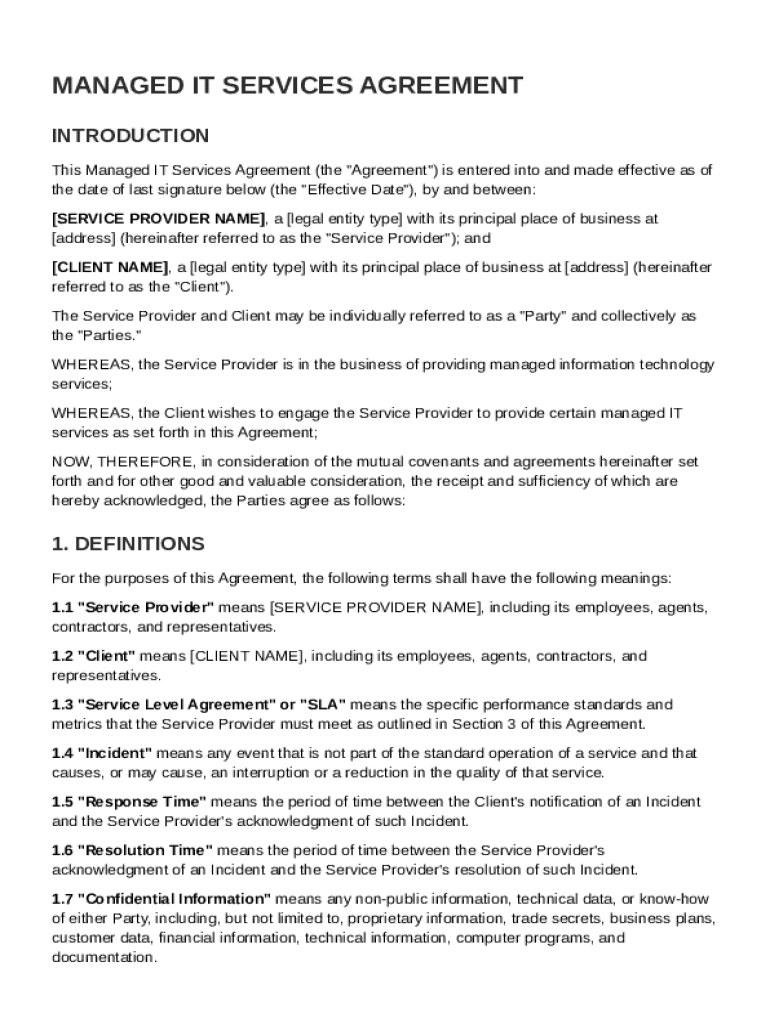







Definition and Importance of the Managed IT Contract Template
The Managed IT Contract Template is a comprehensive document that outlines the terms and conditions under which managed IT services are provided from a Service Provider to a Client. This template includes definitions of critical terms, a detailed scope of services, and performance expectations. These agreements are crucial in establishing a clear understanding between parties to minimize disputes and ensure smooth service delivery. In this template, definitions and explanations of service level agreements (SLAs), responsibilities, confidentiality obligations, and termination rights are clearly detailed, setting the standard for the relationship.
Key Components of the Managed IT Contract Template
- Scope of Services: This section outlines the specific IT services offered, such as network security, software management, and technical support.
- Service Level Agreements (SLAs): SLAs define performance metrics and expectations, ensuring that the service meets agreed-upon standards.
- Payment Terms: Details regarding payment schedules, invoicing, and any late fees or penalties.
- Confidentiality Obligations: Terms that protect sensitive information, ensuring that both parties adhere to strict privacy guidelines.
How to Use the Managed IT Contract Template
Using the Managed IT Contract Template involves several key steps to ensure its proper implementation and effectiveness. Firstly, both the service provider and client should review the template to ensure that the outlined terms align with their expectations and needs. Revisions might be necessary to adapt the template to specific requirements. Once agreed upon, the template serves as an authoritative reference for managing workflows and resolving potential misunderstandings.
Instructions for Adaptation and Customization
- Identify Key Requirements: Determine the IT services needed and confirm that they are included in the agreement's scope.
- Modify SLAs: Ensure that SLAs accurately reflect performance targets and penalties for non-compliance.
- Review Payment Terms: Tailor payment structures to align with the services rendered and client's billing preferences.
- Integrate Confidentiality Clauses: Customize confidentiality terms to address unique data protection needs.
Steps to Complete the Managed IT Contract Template
Correctly completing the Managed IT Contract Template is critical for the contract’s validity and enforceability. The following steps provide a logical sequence for accurately filling out the template.
- Review Each Section Thoroughly: Start by understanding responsibilities and rights outlined in the template.
- Insert Parties' Information: Clearly state the names and contact details of both the service provider and the client.
- Detail Out Services Provided: Specify all services included under the contract to avoid ambiguity.
- Agree on SLAs: Ensure mutual agreement on performance metrics and responsibilities.
- Finalize Payment Terms: Confirm the accuracy of terms related to payments, including methods, schedules, and penalties.
- Sign and Date: Both parties must sign and date the document to formalize the agreement.
Why Use a Managed IT Contract Template
Using a Managed IT Contract Template is crucial for businesses seeking consistency and legal protection in their service agreements. This template offers a standardized approach to managing service relationships, reducing the need for repeated legal consultations. By clearly defining the scope of services, it provides a shared understanding, enhancing trust and reducing potential conflicts.
Benefits of Using the Template
- Efficiency: Saves time by providing a ready-made framework adaptable to different IT services.
- Cost-effective: Reduces legal expenses by decreasing the need for custom contracts.
- Clarity: Minimizes misunderstandings through detailed and clear documentation of terms.
- Protection: Provides legal safeguards for both parties in the event of a breach or dispute.
Key Elements of the Managed IT Contract Template
A well-structured Managed IT Contract Template contains essential components that form the backbone of service agreements. These include detailed descriptions of services, outlined performance standards, and specific terms governing the relationship.
Major Sections and Their Roles
- Responsibilities of Parties: Clearly delineates duties to prevent overlap and ensure accountability.
- Indemnification Clauses: Protects both parties from specific legal liabilities that might arise from the service.
- Dispute Resolution Procedures: Provides a structured process for addressing contract disagreements.
- Termination Rights: Specifies conditions under which either party can terminate the agreement.
Legal Use and Compliance with the Managed IT Contract Template
Adhering to legal standards is critical when using a Managed IT Contract Template. The template complies with national and state laws to maintain legality and enforceability. It also aligns with industry standards to provide additional security to both parties.
Legal Considerations and Best Practices
- Ensure Compliance: Verify that all terms comply with current laws and regulations at the federal and state levels.
- Review Periodically: Regular updates may be necessary to reflect changes in technology laws or business operations.
- Legal Counsel Consultation: Engage legal experts to review the document, ensuring that all clauses meet legal standards.
Who Typically Uses the Managed IT Contract Template
The Managed IT Contract Template is primarily used by businesses and IT service providers looking to formalize service-related agreements. The template is particularly beneficial for small to medium-sized enterprises (SMEs) that outsource IT services and require a comprehensive agreement to cover various service aspects.


User Profiles and Scenarios
- IT Service Providers: Use the template to clearly communicate service offerings and obligations to clients.
- Business Owners: Employ the template to ensure clarity in what IT services are being procured and the expected outcomes.
- Legal Advisors: Reference the template to guide clients in drafting legally sound service contracts.
State-Specific Rules for the Managed IT Contract Template
While the Managed IT Contract Template provides a robust framework applicable across different jurisdictions, slight modifications may be necessary to adhere to state-specific rules. Each state in the U.S. may have distinct regulations affecting contract law, impacting aspects such as service delivery standards or termination rights.
Adapting to Local Regulations
- Research State Laws: Understand specific state laws that influence managed IT service contracts.
- Customize Accordingly: Modify template clauses to align with regional legal requirements.
- State Variations: Identify unique legal considerations, such as licensing requirements or consumer protection laws, that vary state by state.
Important Terms Related to Managed IT Contract Template
A clear understanding of the terminology used within the Managed IT Contract Template is imperative for all parties involved. Terms such as 'service level agreements,' 'indemnification,' and 'confidentiality obligations' have specific meanings that impact the execution and legal efficacy of the contract.
Glossary of Essential Terms
- Service Level Agreement (SLA): A contractual commitment specifying service expectations and remedies for service shortcomings.
- Indemnification: A clause assuring protection against certain legal responsibilities.
- Confidentiality: Obligations to maintain privacy and security of shared information.
- Termination Clause: Provisions detailing conditions under which a contract can be ended by either party.
Each of these elements serves to guide the parties in their rights, responsibilities, and expectations as outlined within the Managed IT Contract Template, supporting clear communication and efficient service delivery.




