
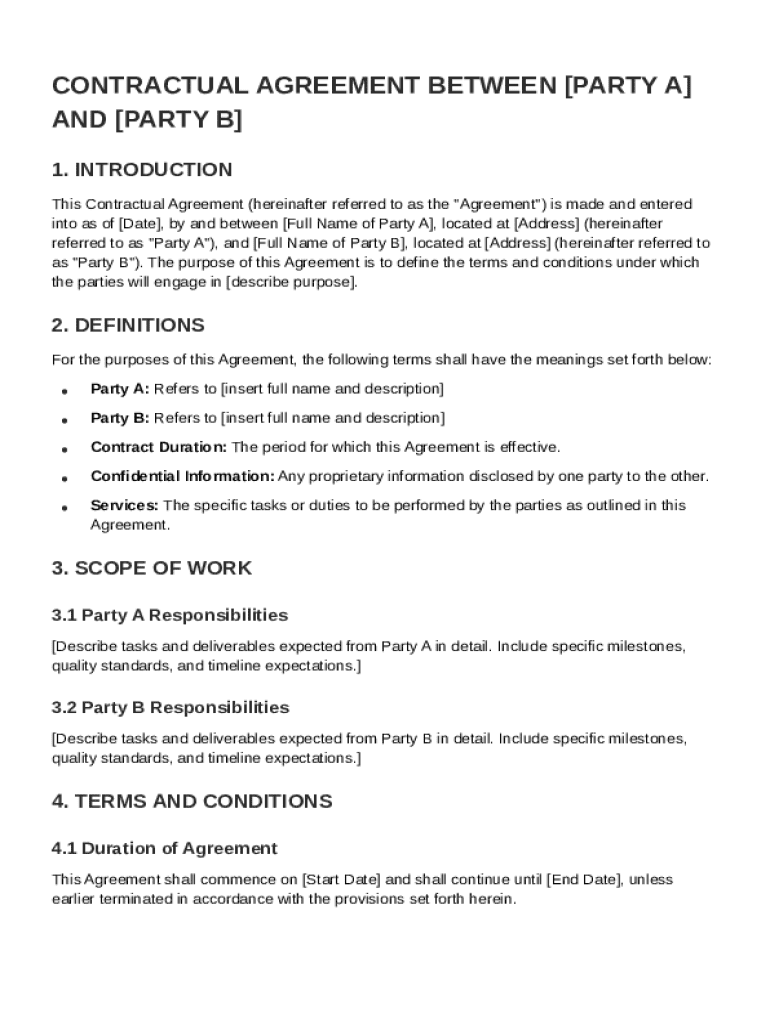







Definition & Meaning
A "Contractual Between Two Parties Agreement Template" is a structured document that serves as a foundation for outlining the terms and conditions of a legal agreement between two parties. This template usually includes key elements such as responsibilities, payment terms, confidentiality obligations, dispute resolution, liability limitations, and governing law. The template is designed to be comprehensive and flexible to accommodate the specifics of a variety of engagements, offering the parties a clear understanding of their obligations and rights.
Key Elements
- Definitions: Clarifies terms used throughout the agreement to avoid misunderstandings.
- Responsibilities: Outlines the duties and obligations of each party involved.
- Payment Terms: Details the financial aspects, including payment schedules, amounts, and methods.
- Confidentiality Obligations: Ensures sensitive information is protected and not disclosed improperly.
- Dispute Resolution: Provides mechanisms for resolving any disagreements that may arise.
- Liability Limitations: Sets boundaries on the extent of liabilities each party may bear.
- Governing Law: States which jurisdiction's laws will be used to interpret the agreement.
How to Use the Contractual Between Two Parties Agreement Template
Using the template effectively involves understanding its structure and customizing it to fit the specific needs of the involved parties. This template is an excellent starting point for drafting a legally binding agreement.
Customization Process
- Identify Parties: Clearly identify each party with full legal names and contact details.
- Detail the Engagement: Specify the nature of the services or goods being exchanged.
- Modify Clauses: Adjust terms to match specific legal requirements or personal agreements.
- Review and Revise: Consult with a legal professional to review the draft for compliance and clarity.
- Finalize and Execute: Upon mutual agreement, both parties sign the document to formalize it.
Practical Scenarios
- Business Partnerships: Useful in defining roles and profit-sharing arrangements.
- Supplier Contracts: Helps in outlining delivery schedules and payment obligations.
- Service Agreements: Clarifies service deliverables and milestones.
Steps to Complete the Contractual Between Two Parties Agreement Template
Completing the template requires attention to detail to ensure that all relevant sections are adequately addressed and tailored to the specific contract.
Step-by-Step Instructions
- Input Party Information: Begin by filling in the names and details of the contracting parties.
- Define Scope: Clearly describe the scope of work, services, or goods to be provided.
- Set Payment Terms: Specify how and when payments will be made, including any conditions for payment.
- Outline Responsibilities: List each party’s obligations in detail.
- Include Confidentiality Clauses: If applicable, state any confidentiality requirements.
- Add Dispute Resolution Methods: Detail how disputes will be handled, including arbitration or mediation options.
- Review Legal Terms: Ensure the legal language aligns with the jurisdiction and is understandable.
- Sign and Date: Both parties must sign and date the document to make it binding.
Legal Use of the Contractual Between Two Parties Agreement Template
The template can be used in a variety of legal contexts, providing a standardized format that ensures essential legal elements are covered. By formalizing agreements, it mitigates potential legal disputes.
Compliance Considerations
- Jurisdiction: Ensure the template complies with local laws pertinent to the type of agreement.
- Legal Advisor Consultation: Engaging a legal professional for review enhances validity.
- Legal Validity: Must be signed by both parties to hold legal power.
Edge Cases
- In cases involving minors, additional legal considerations and parental consents might be required.
- For international agreements, translation and understanding of local laws may be necessary.
Key Elements of the Contractual Between Two Parties Agreement Template
This section elaborates on the features integral to the template, ensuring all critical legal aspects are included.
Core Components
- Agreement Purpose: Clarifies the main intention of the contract.
- Duties and Rights: Clearly delineates who will do what and the rights each party retains.
- Termination Clauses: Specifies conditions under which the contract may be terminated.
- Amendment Procedures: Describes how changes to the agreement can be made and approved.
Practical Examples
- Service Provision: Clearly outlining deliverables, deadlines, and quality standards.
- Sales Agreements: Detailing product descriptions, delivery timelines, and return policies.
Who Typically Uses the Contractual Between Two Parties Agreement Template
This template is versatile and widely used across various industries and sectors for formalizing agreements.

Common Users
- Businesses: Companies of all sizes use it to establish clear partnerships and supplier agreements.
- Freelancers: Independent service providers use it to protect their work terms.
- Non-Profits: Engage volunteers and partners in a structured and formalized manner.

Benefits for Different Users
- Clarity and Understanding: Promotes mutual understanding and reduces miscommunication.
- Protection of Interests: Safeguards against breach of agreement and protects rights.
Digital vs. Paper Version
In today's digital age, understanding the advantages of using a digital format of the template over a traditional paper version is essential.
Advantages of Digital
- Accessibility: Easily accessible and editable via multiple devices without geographical restrictions.
- Efficiency: Fast to distribute and update, reducing time spent on manual mailing or scanning.
- Storage: Electronic storage saves physical space and allows for easy retrieval.
Scenarios for Paper Use
- Court Requirement: Paper versions may be required in certain legal jurisdictions for official filings.
- Lack of Digital Literacy: In some cases, parties might prefer traditional methods due to lack of comfort with digital tools.
Software Compatibility
When utilizing a digital version of the contractual agreement template, understanding its compatibility with various software platforms enhances usability.
Compatible Platforms
- DocHub: Supports editing, signing, and sharing of documents directly within the platform.
- Google Workspace: Allows for seamless integration with Google Drive for document editing and management.
- Microsoft Office: Format compatibility ensures documents can be easily imported and edited in Word.
Integration Examples
- Collaborative Edits: Use DocHub to have multiple parties comment and make real-time edits.
- Cloud Storage: Secure documents in Google Drive or OneDrive directly from DocHub.
State-Specific Rules for the Contractual Between Two Parties Agreement Template
While the template provides a general framework, it is crucial to adapt certain terms based on state-specific regulations to remain compliant with local laws.
Consideration for Variations
- Governing Law: Clearly state which state's laws will apply.
- Specific Clauses: Add clauses that reflect state-specific legal requirements such as employment law or business statutes.
Example States
- California: May require specific disclosures on business practices or liability limitations.
- New York: Contract terms might need to reflect unique state tax implications or arbitration procedures.




