



Definition & Meaning
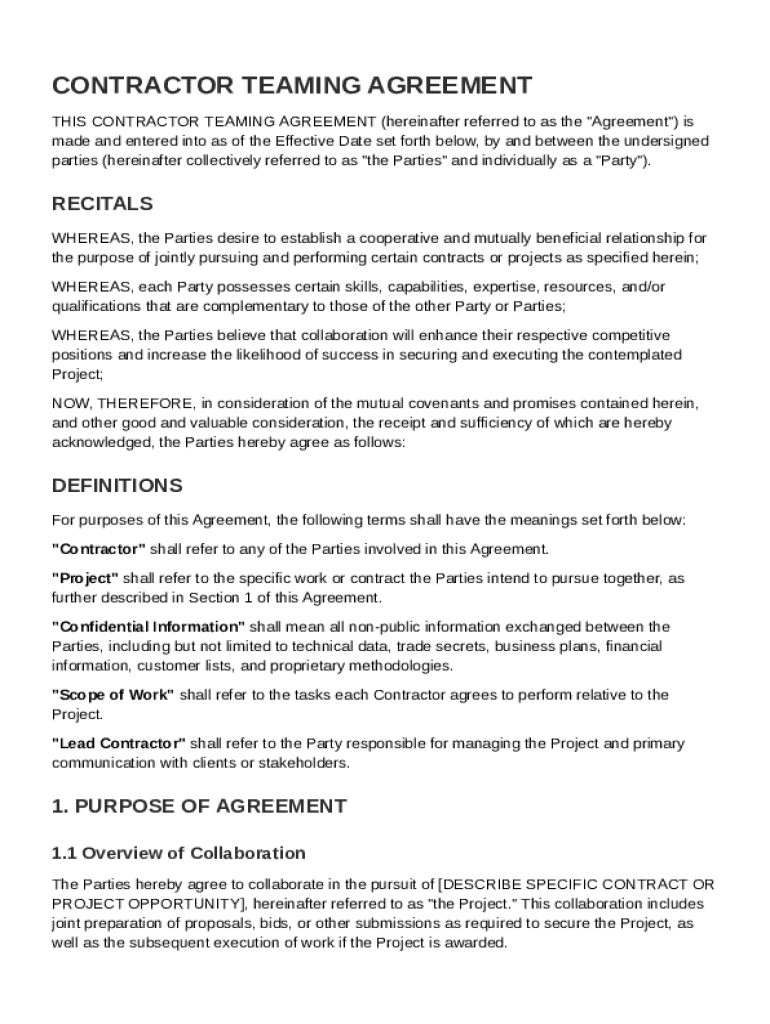
A Contractor Teaming Agreement Template is a formal document that outlines the terms under which two or more parties collaborate on a specific project. It serves as an essential framework for defining roles, responsibilities, and the financial arrangements between contractors who aim to jointly perform contractual duties. The document is designed to ensure that all parties understand their obligations, the scope of work, cost-sharing practices, and how profits or losses will be distributed. It also sets out the terms for confidentiality, management of intellectual properties, and how disputes will be resolved. This agreement is vital in providing a structured approach to managing and executing a collaborative business endeavor, fostering mutual trust and cooperation among the involved parties.
Key Elements of the Contractor Teaming Agreement Template
Roles and Responsibilities
- Definition of each party's role: Clearly outline who does what within the project scope.
- Resource allocation: Specify what each party will contribute in terms of materials, labor, or expertise.
- Decision-making authority: Detail who has the final say on different aspects of the project.
Financial Arrangements
- Cost-sharing: Explain how costs will be divided among parties.
- Profit distribution: Outline the method for profit allocation once the project is completed.
- Payment schedules: Establish timelines for payments to be made to all parties.
Confidentiality and Intellectual Property
- Sensitive data protection: Specify how confidential information will be handled.
- Ownership of innovations: Define who owns any intellectual property created throughout the project.
- Rights to existing IP: Clarify the rights associated with pre-existing intellectual property brought into the project.
Steps to Complete the Contractor Teaming Agreement Template
-
Collect Party Information: Gather details about the parties involved, such as company names, addresses, and contact information.
-
Define Project Scope: Clearly describe the project objectives, deliverables, and timelines.
-
Specify Financial Terms: Agree on cost-sharing proportions and profit distribution methods.
-
Assign Roles: Determine and document the specific roles and responsibilities for each party.
-
Draft Confidentiality Clauses: Include terms that protect sensitive information and intellectual property rights.
-
Review and Edit: Go through the drafted agreement with all participating parties to ensure accuracy and completeness.
-
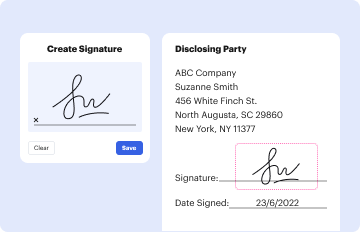
Finalize and Sign: Obtain signatures from authorized representatives of each party to validate the agreement.
Legal Use of the Contractor Teaming Agreement Template
The Contractor Teaming Agreement Template is utilized to legally bind parties into a collaborative arrangement for shared projects. Its legal use includes establishing the terms of collaboration, which can be enforced by law if one or more parties fail to comply with the agreed-upon terms. The agreement mitigates potential risks by delineating the responsibilities and liabilities of each party involved, thereby providing a legal recourse in disputes. It also serves as a proof of intent, showing that all parties have willingly agreed to engage with each other under defined terms, bolstered by legal backing in case misunderstandings arise.
State-Specific Rules for the Contractor Teaming Agreement Template
Variations by Jurisdiction
- California: May require more stringent clauses on intellectual property, especially in tech-based projects.
- New York: Might need additional elements for financial regulations and contractor status verification.
- Texas: Often necessitates specific statements of liability due to its unique legal environment for business partnerships.
Legal Compliance
- Ensure that the agreement terms align with state laws where the project will be executed.
- Consider state-specific occupational licenses required for particular project types.
- Acknowledge state taxation implications based on profit distribution agreements.
Important Terms Related to Contractor Teaming Agreement Template
- Prime Contractor: The primary party responsible for the execution of the contract.
- Subcontractor: Parties hired by the prime contractor to perform parts of the contracted work.
- Joint Venture: A collaborative entity formed by two or more parties for a single project.
- Licensing Agreements: Terms under which one party allows another to use its assets or properties.
Examples of Using the Contractor Teaming Agreement Template
Real-World Scenarios
- Construction Projects: A contractor teams with a plumbing company to complete the plumbing work in a new building.
- IT Services: A software firm partners with a cybersecurity company to enhance security aspects of a software development project.
- Marketing Campaigns: An advertising agency collaborates with a freelance videographer to produce promotional content for a client.
Case Studies
- Scenario 1: Two consulting firms enter an agreement to adapt a successful project model for a new client, ensuring clear terms to prevent intellectual property disputes.
- Scenario 2: A small business teams up with a larger corporation to deliver a comprehensive solution, defining profit-sharing mechanisms to reflect each party's contribution and risk.
Who Typically Uses the Contractor Teaming Agreement Template
The Contractor Teaming Agreement Template is commonly used by small and large businesses that desire to combine their resources and expertise for significant projects. This includes industries such as construction, IT, marketing, and consulting. Typically, the agreement involves parties like prime contractors, subcontractors, and joint venture partners, all seeking to define clear working relationships and share risks or benefits equitably. This template serves as a strategic tool for businesses aiming to scale operations without absorbing all the risks singlehandedly and looking to leverage specialized skills that they do not possess in-house.