




01. Edit your form online
Type text, add images, blackout confidential details, add comments, highlights and more.

Type text, add images, blackout confidential details, add comments, highlights and more.

Draw your signature, type it, upload its image, or use your mobile device as a signature pad.

Send it via email, link, or fax. You can also download it, export it or print it out.
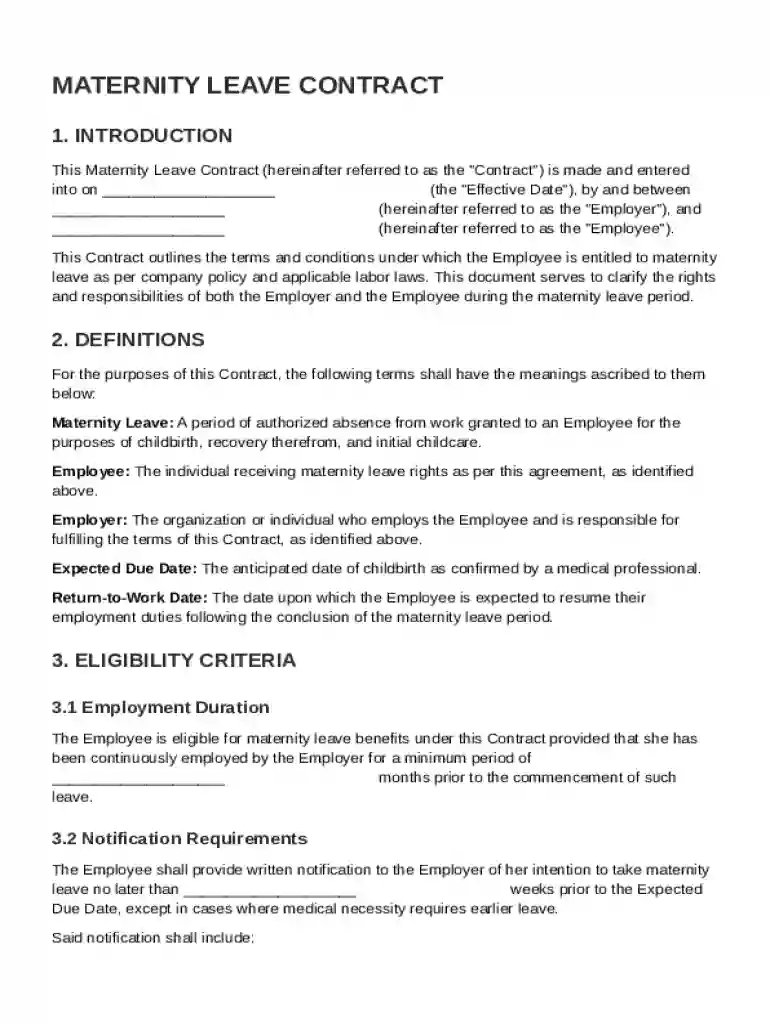
A Maternity Leave Contract Template is a formal document outlining the terms and conditions associated with maternity leave between an employer and an employee. It stipulates the rights and responsibilities of both parties, ensuring clarity on several critical factors. These factors often include eligibility criteria, the duration of leave, and compensation details during the leave period. The template serves as a standardized framework for addressing communication protocols and job protection measures, thereby minimizing misunderstandings and disputes. By having a clear contract in place, both employers and employees can navigate the maternity leave process effectively, ensuring compliance with legal standards and organizational policies.
Understanding the components of a Maternity Leave Contract Template is crucial for effective utilization:
Eligibility Criteria: Defines who qualifies for maternity leave within the organization. Criteria might include length of service, type of employment contract, or specific conditions related to work performance.
Duration of Leave: Details the allowed length of maternity leave. This might be influenced by federal or state laws, such as the Family and Medical Leave Act (FMLA), which grants up to 12 weeks of unpaid leave for eligible employees.
Compensation Details: Provides specifics on pay during leave. This section explains whether the leave is paid or unpaid and the method of compensation if applicable, such as partial salary or state-provided benefits.
Job Protection: Assures the employee that their position or an equivalent role will be available upon their return, safeguarding against unfair job loss.
Health Insurance Maintenance: Clarifies how health benefits will be maintained during the leave. This often involves coordination with HR to ensure continuous coverage.
Completing the Maternity Leave Contract Template involves a detailed understanding of the terms and verification of the information provided:
Review Employment Policies: Begin by reviewing company policies on maternity leave to ensure alignment with organizational guidelines and any applicable legal requirements.
Gather Necessary Information: Collect essential details about both the employee and employer, such as names, roles, the expected due date, and any preliminary leave start and end dates.
Fill in Eligibility and Duration Sections: Verify and document eligibility for the leave and specify the approved duration according to company policy and applicable state or federal laws.
Define Compensation Terms: Detail the agreed compensation structure or confirm if the leave will be unpaid. Include specifics about any benefits or insurance continuations.
Outline Job Protection Terms: Clearly state the terms of job retention and conditions of return, ensuring these are in compliance with employment law.
Submit for Approval: Once completed, submit the contract for review and approval by the HR department and obtain signatures from both the employer and employee to formalize the agreement.
Ensuring legal compliance is vital when using Maternity Leave Contract Templates:
Federal and State Laws: The template must comply with laws like the FMLA, which mandates certain leave privileges for eligible employees. It's crucial to understand both federal and state-specific legislation that might affect leave policies.
Governing Law Clause: Includes a section clarifying the jurisdiction under which the contract's terms will be interpreted and enforced, typically in line with the employer's primary location.
Regular Updates: Templates should be regularly reviewed and updated to reflect changes in the law or company policy, ensuring ongoing legal compliance.
Utilizing practical examples can illustrate the flexibility and adaptability of the Maternity Leave Contract Template across different scenarios:
Large Corporations: In a multinational corporation, the template can be adapted to respect varied international laws, providing a unified format that ensures legal adherence in multiple jurisdictions.
Small Businesses: A small business might use the contract to establish clear expectations and reassurance for employees, reducing the potential for disputes and fostering a supportive work environment.
Government Entities: Public sector organizations might use the template to ensure compliance with federal mandates, such as the FMLA, ensuring employees' rights are protected uniformly across branches.
Eligibility is a key aspect of the Maternity Leave Contract Template, affecting how and when employees can avail of this benefit:
Employment Duration: Often, a minimum period of employment is required, such as having worked for 12 months in a company before qualifying for leave.
Full-Time vs. Part-Time: Eligibility may vary based on employment status, with full-time employees typically receiving more comprehensive benefits than part-time counterparts.
Medical Certification: Some contracts may require a medical certificate to verify the pregnancy and expected delivery date as part of the eligibility criteria.


Considering the need for flexibility, the Maternity Leave Contract Template might have variations to suit specific organizational or regional requirements:
Extended Leave Options: Certain templates offer extended leave options beyond standard policies, accommodating those who might need additional time for recovery or childcare.
Paternity and Parental Leave Incorporation: Templates might include options for paternity or broader parental leave, supporting diverse family structures and needs.
State laws can significantly impact the terms of maternity leave, necessitating awareness of regional differences:
California: Offers up to four months of job-protected pregnancy disability leave (PDL) for eligible employees, separate from FMLA allowances.
New York: Requires paid family leave, providing benefits for up to 12 weeks to care for a newborn, funded through employee payroll contributions.
Understanding these variables helps frame the maternity leave agreement in a manner that respects both employer capabilities and employee rights across different locations.
At DocHub, your data security is our priority. We follow HIPAA, SOC2, GDPR, and other standards, so you can work on your documents with confidence.



ARTICLE 1. AGREEMENT / PURPOSE 1. ARTICLE 2. UNION RECOGNITION 1. ARTICLE 3. DUES DEDUCTION AND UNION
Sep 5, 2015 For example: will pregnancy leave be paid or unpaid, and for how long; will study leave be fully funded, partially etc. Agree content and
Sep 1, 2018 Maternity (Childbirth) and Parental Leave Fact Sheet. Maternity (Childbirth) and Parental Leave Examples. Guide to Time Off Options for


