
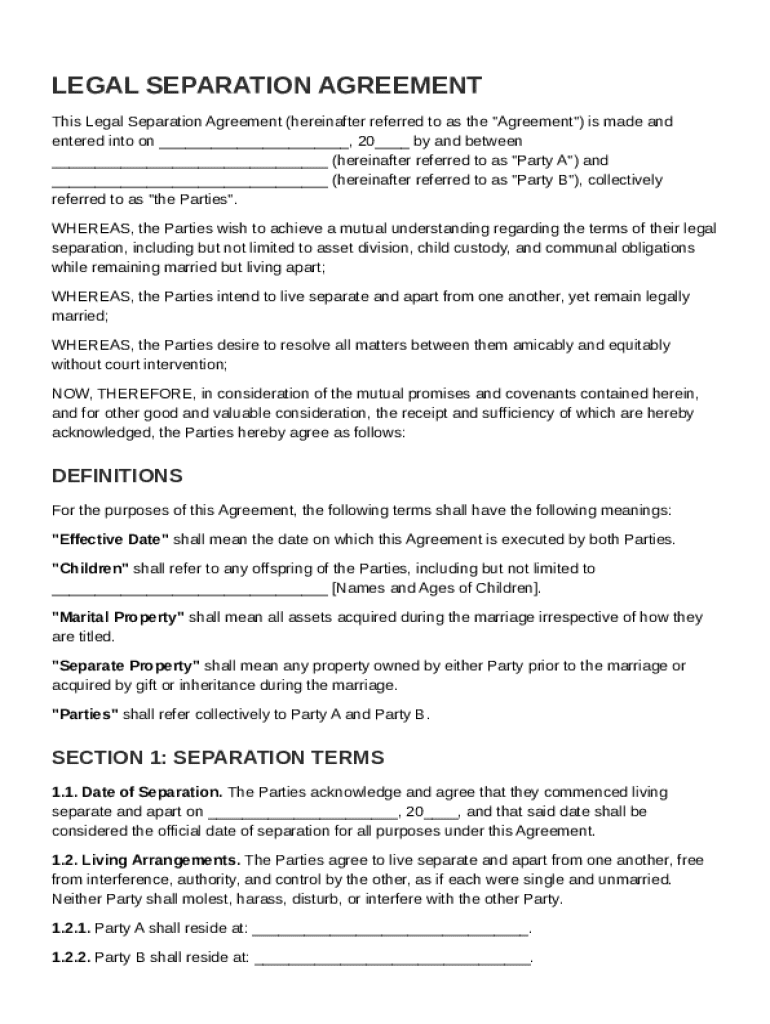







Definition and Meaning
A Legal Separation Contract Template serves as a structured framework for couples who wish to live separately while legally remaining married. It outlines the terms under which two parties, typically referred to as Party A and Party B, agree to live independently. This agreement aims to facilitate a mutual and clear understanding of each party's responsibilities and rights without pursuing a formal divorce. The template includes details about asset division, child custody, and financial arrangements, all crafted to help avoid court interventions.
Key Elements of the Legal Separation Contract Template
A comprehensive Legal Separation Contract Template will include essential components that both parties need to address. These elements typically encompass:
-
Asset Division: Clearly outlines how joint properties, debts, and financial resources will be divided or managed.
-
Child Custody and Support: Specifies custody arrangements and financial responsibilities for any children involved, including visitation rights and child support.
-
Spousal Support: Details any agreed-upon spousal maintenance or alimony, specifying amounts and duration.
-
Healthcare Responsibilities: Assigns responsibilities for health insurance and medical expenses.
-
Dispute Resolution: Provides mechanisms for resolving potential disputes through mediation or arbitration to prevent litigation.
This coverage is designed to offer clarity and prevent conflicts, ensuring both parties know their rights and obligations.
How to Use the Legal Separation Contract Template
To effectively utilize the Legal Separation Contract Template, consider the following practical steps:
-
Review the Template: Familiarize yourself with all sections to understand the information required.
-
Gather Information: Collect relevant documents such as financial records, property deeds, and any current agreements related to custody or support.
-
Complete Required Fields: Fill in personal details and specific agreements for each section, ensuring accuracy and mutual consent.
-
Consult Legal Counsel: To ensure the template aligns with your legal needs and state's requirements, consult a family law attorney.
-
Finalize and Sign: Once all parties have reviewed and agreed upon the terms, both should sign the document to make it binding.
This step-by-step approach ensures the template is filled out thoroughly and legally sound.
Important Terms Related to Legal Separation Contract Template
Understanding key terms is crucial for drafting a valid Legal Separation Contract. Some important terms include:
-
Custody Arrangement: The legal decision on who will have the authority to make decisions regarding the children.
-
Alimony/Spousal Support: Financial support paid to a partner post-separation.
-
Equitable Distribution: A legal principle used to divide property and assets fairly, though not necessarily equally.
-
Jurisdiction: The legal authority that a court has to make decisions regarding the separation agreement.
Grasping these terms helps in navigating the complexities involved in legal separations.
Steps to Complete the Legal Separation Contract Template
Completing the template requires a careful and organized approach:
-
Initiate Discussion: Both parties should discuss and agree on the major points before drafting.
-
Draft Preliminary Agreement: Use the template to draft a preliminary version based on initial discussions.
-
Legal Review: Submit the draft to an attorney for review to ensure compliance with local laws.
-
Negotiate Adjustments: If necessary, negotiate any terms before reaching a final agreement.
-
Final Approval and Signature: Have both parties sign the template once all terms are agreed upon and legally vetted.
Following these steps can help streamline the process and reduce the risk of future disputes.
Who Typically Uses the Legal Separation Contract Template
The template is used by various individuals and entities for different purposes:
-
Married Couples: Who wish to live separately while keeping their legal marital status.
-
Attorneys: Who assist clients in drafting mutually agreeable terms of separation.
-
Mediators: Who facilitate discussions between parties to reach an amicable agreement.
Understanding the typical users helps in recognizing the broad applicability of the template across different scenarios.


Examples of Using the Legal Separation Contract Template
Examples provide clarity on how the template can be employed:
-
Couple with Children: A couple may use the template to outline custody and visitation schedules while living separately.
-
Division of Business Assets: A couple can specify how jointly owned business assets will be handled during the separation period.
-
Primary Residence Management: One party might continue living in the shared home, with agreed-upon responsibilities for mortgage and maintenance.
These scenarios illustrate the template's adaptability in addressing varied separation circumstances.
State-Specific Rules for the Legal Separation Contract Template
Legal separation rules may vary significantly by state, impacting how the template should be completed:
-
Community Property States: Such as California, require equal division of marital property, influencing terms on asset division.
-
Income Considerations: States may have guidelines concerning alimony, especially concerning the length of the marriage and income disparity.
-
Child Support Calculations: State-specific formulas dictate how child support should be calculated, affecting terms listed in the template.
Awareness of state laws ensures the separation agreement is enforceable and tailored to meet legal requirements.
Legal Use of the Legal Separation Contract Template
When effectively utilized, the Legal Separation Contract Template acts as a legally binding document ensuring both parties adhere to the agreed terms. For its legal enforceability:
-
Voluntary Agreement: Both parties must willingly enter into the agreement without duress.
-
Full Disclosure of Assets: Each party must provide a full and honest disclosure of their assets and liabilities.
-
Legal Formalities: Following the state-specific legal requirements related to acknowledgment and witness signatures is crucial.
These legal use aspects ensure the contract remains valid and can be upheld in a court of law if necessary.




