






Definition and Meaning of Sale Addendum Contract Template
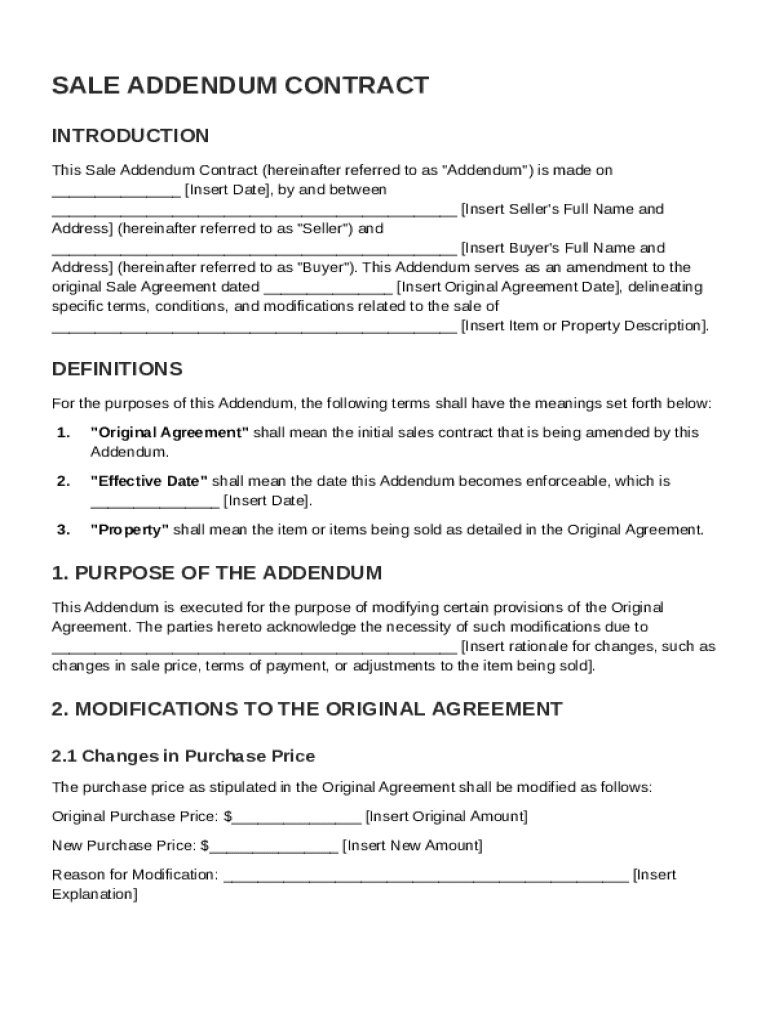
The Sale Addendum Contract Template is a legally binding document that alters specific terms of an original sale agreement between a seller and a buyer. It serves to adjust, expand, or limit certain aspects of the contract without voiding the original document. The addendum is designed to address variables such as changes in purchase price, amendments to the payment terms, or the introduction of new contingencies. By utilizing a sale addendum, both parties can consensually agree to the stipulated modifications while affirming the validity of the remaining original terms.
Key Components of a Sale Addendum
- Purchase Price Adjustments: Changes to the agreed-upon price based on new valuations or conditions.
- Payment Terms Alterations: Modifications in the schedule or method of payment.
- Delivery Changes: New timelines or methods for transferring goods or property.
- Contingency Inclusions: Addition of conditions that must be fulfilled for the sale to proceed.
- Governing Law: Specification of the jurisdiction under which legal issues will be resolved.
- Severability: Clauses ensuring unaffected parts of the contract remain in effect if one section is invalidated.
Steps to Complete the Sale Addendum Contract Template
Completing a Sale Addendum Contract Template involves several precise steps to ensure legality and mutual understanding. Here is a step-by-step guide:
- Identify Modifications: Clearly outline the specific terms being amended or added to the original contract.
- Draft the Addendum: Include detailed language that explains each modification, ensuring clarity and precision.
- Review Existing Contract Terms: Verify how the proposed changes interact with existing terms.
- Obtain Agreement: Both parties must review the draft and agree to the stipulated changes.
- Sign and Date: Each party must sign and date the document, indicating their consent.
- Attach to Original Contract: The addendum should be attached to the original contract for reference and validity.
- Keep a Copy: Both parties should retain a copy for their records to ensure each has a complete contract including the addendum.
Common Considerations
- Legal Review: Consider consulting legal counsel to ensure compliance.
- Detailed Descriptions: Use explicit language to avoid ambiguity.
- Mutual Consent: Ensure both parties have verbally understood the modifications before signing.
Important Terms Related to Sale Addendum Contract Template
Familiarity with key terms ensures all parties fully understand the contract modifications. Important terms include:
- Original Agreement: The initial contract that the addendum is modifying.
- Amendment: The process of officially altering parts of the contract.
- Contingency: Conditions that must be met for the contract terms to be executed.
- Mutual Assent: Agreement by both parties to all terms and conditions.
- Consideration: The benefit or compensation exchanged for accepting the amendment.
Real-World Scenarios
- Price Fluctuations: Adjusting the price in response to market conditions.
- Inspection Results: Adding contingencies based on property inspections.
- Negotiation Outcomes: Incorporating results of mutual negotiations.
Legal Use of the Sale Addendum Contract Template
A Sale Addendum is legally binding when executed correctly, meaning it will hold up in a court of law if drafted and adhered to properly. Its legal strength comes from both parties' consent to the terms.
Compliance Requirements
- Signature Legality: Both parties must legally sign the document.
- Age and Capacity: Signers must be of legal age and mentally competent.
- Adherence to Laws: The addendum must not contravene any applicable laws or regulations.
Potential Pitfalls
- Ambiguity: Unclear terms can lead to legal disputes.
- Unjust Modifications: Alterations perceived as one-sided may be contestable in court.
Who Typically Uses the Sale Addendum Contract Template
The Sale Addendum is primarily utilized by parties involved in sales transactions requiring flexibility or changes over time. This includes:
- Real Estate Agents: Adjusting terms based on property appraisals or inspections.
- Automobile Dealers: Amending terms for payment structures in car sales.
- Business Contract Negotiators: Updating terms for ongoing supply contracts.
- Private Sellers and Buyers: Modifying personal property sale agreements.

Applicability Across Industries
- Real Estate: A common setting for using addendums to cater for dynamic market conditions.
- Automotive: Ideal for adjusting financing terms or delivery schedules.
- Corporate Transactions: Useful in international deals subject to regulatory changes.
State-Specific Rules for the Sale Addendum Contract Template
Despite a universal framework, some aspects of a Sale Addendum may be state-specific in the United States, impacting its application and enforcement.
Variations by State
- Governing Law: Each state may have unique laws affecting contract terms and enforcement.
- Filing Requirements: Some states may require filing of modifications in certain public registries.
- Specific Clauses: States may mandate the inclusion of specific clauses, like a mediation clause, as part of local consumer protection laws.
State Examples
- California: Requires strict compliance with consumer protection laws.
- Texas: Common law jurisdiction with a focus on the freedom of contract principles.
- New York: May require disclosures linked to property sales addendums.
Key Elements of the Sale Addendum Contract Template
Key elements of a Sale Addendum involve the specific details and conditions that differentiate it from the original agreement.
Core Components
- Title and Introduction: Ensures parties understand the document's purpose.
- Clear Listing of Changes: Detailed articulation of what modifications are being made.
- Signatures and Dates: Legitimizes the document's legality and timeline of agreement.
- Attachment Provision: Confirms the addendum's attachment and incorporation into the main document.
Best Practices
- Clarity and Precision: Avoid vague language to prevent misunderstandings.
- Proper Format: Follow a consistent format to ensure its acceptance and enforceability.
- Forward-looking Provisions: Include clauses to handle potential future changes or disputes.
Examples of Using the Sale Addendum Contract Template
Practical examples illustrate how Sale Addendums are used across different scenarios.
Example Scenarios
- Real Estate Transaction: An addendum might alter closing dates or adjust conditions after a property inspection reveals hidden damage.
- Purchase of Goods: Modifying payment terms due to changes in MOQ (minimum order quantity) for a manufacturing contract.
- Service Agreements: Adding deliverables based on additional client requests outside of the initial scope.
Case Study
- John's Auto Sale: After an initial agreement on a used car, John discovers a needed repair not foreseen initially. Both parties agree to an addendum that reduces the sale price, reflecting repair costs, and adjust the payment deadline based on parts availability.
Software Compatibility
For seamless integration and workflow efficiency, it is important that the Sale Addendum Contract Template works well with existing software.
Compatible Software Platforms
- DocHub: Supports editing, signing, and sharing of the Sale Addendum without needing conversions.
- PDF Editors: Essential for viewing and modifying non-editable contracts.
- Cloud Storage Services: Google Drive and OneDrive support easy saving and sharing of updated contracts.
Integration Insights
- Google Workspace: Offers fluid integration for importing, editing, and exporting documents directly within Docs and Drive.
- Collaboration Tools: Platforms like DocHub facilitate multi-user collaboration on the addendum, with real-time updates visible to all parties.
State-by-State Differences
Since legal requirements can vary, understanding state-by-state differences is imperative when applying the Sale Addendum Contract Template.
Notable State Comparisons
- Financial Disclosure Requirements: States like Florida may demand that any financial changes made to a sales contract via an addendum be explicitly disclosed to all involved parties.
- Environmental Regulations: An addendum in states like California may need to cover compliance with specific local environmental regulations affecting property transactions.
Practical Approach
- Legal Consultation: It's prudent to consult with legal professionals familiar with state laws, especially when transactions span across multiple jurisdictions.
- Custom Templates: For multi-state operations, consider using custom addendums designed to comply with varying state regulations, thus ensuring legality and reducing risk.