
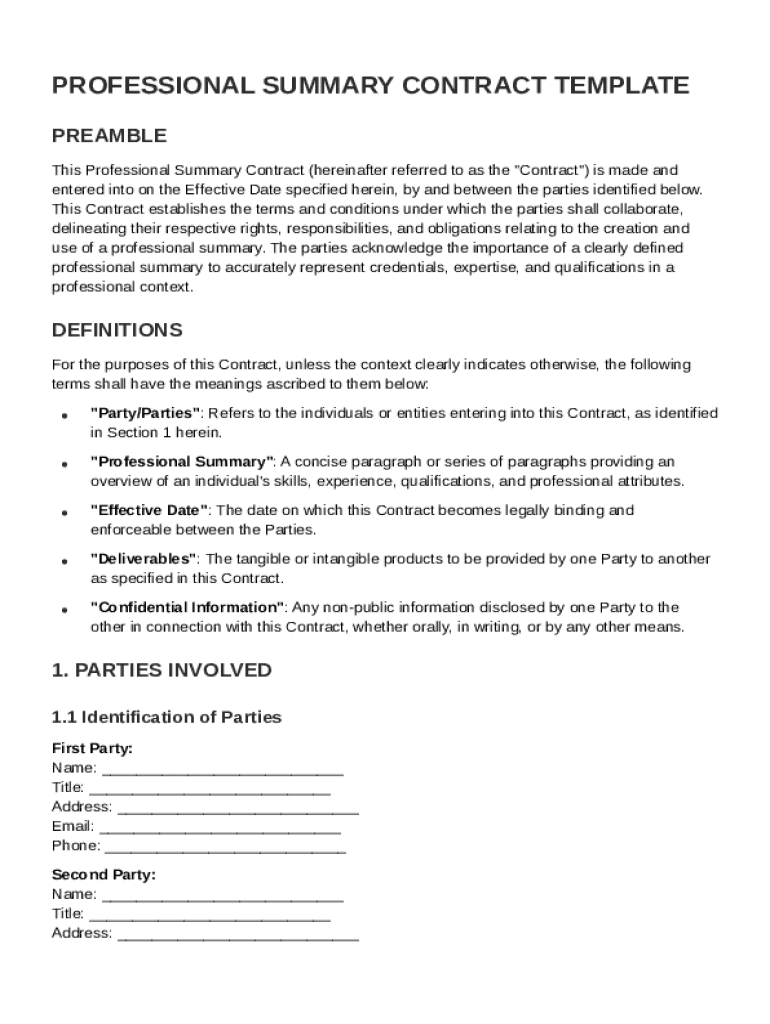







Definition and Meaning of Professional Summary Contract Template
A Professional Summary Contract Template is a standardized document used to outline the terms of collaboration between two parties for creating a professional summary. It serves as a formal agreement that details key components such as the scope of work, responsibilities, payment arrangements, and confidentiality obligations. By defining these elements, the template ensures clarity and sets precise expectations for both parties involved, preventing any misunderstandings throughout the process.
Key Components
- Scope of Work: Clearly delineates the tasks and deliverables expected from each party.
- Responsibilities: Assigns specific duties to each party to streamline the workflow.
- Payment Terms: Outlines compensation, payment schedules, and any financial contingencies.
- Confidentiality Obligations: Protects sensitive information shared between parties.
- Termination Conditions: Specifies situations under which the contract may be dissolved.
- Amendment Processes: Details how any changes to the contract can be made.
How to Use the Professional Summary Contract Template
Using the Professional Summary Contract Template effectively requires understanding its structure and components. This template is designed to be adaptable, allowing parties to tailor its sections to their specific needs.
Steps to Utilize
- Review All Sections: Understand each section of the template and how it applies to your collaboration.
- Customize for Relevance: Modify sections such as scope of work and responsibilities to suit the project requirements.
- Discuss Terms: Collaborate with the other party to agree on key terms such as payment and confidentiality.
- Finalize the Contract: Once both parties agree on the terms, sign and retain copies for reference.
Practical Example
Consider a situation where a freelancer is hired by a company to create executive summaries for reports. The company would outline the tasks in the 'Scope of Work' section, and both parties would agree on a reasonable deadline under the 'Payment Terms' section.
Key Elements of the Professional Summary Contract Template
The Professional Summary Contract Template incorporates several crucial elements that provide a structured framework for discussions and agreements between parties.
Core Elements
- Purpose of the Contract: Clearly states the intent and objectives of the professional summary.
- Clear Terms Definition: Eliminates ambiguity through precise definitions of all relevant terms.
- Delivery Deadlines: Sets timelines for deliverables to ensure timely completion.
- Performance Metrics: Identifies benchmarks for quality and completion to measure performance.
Examples
A document could specify that the first draft of a summary is due within ten days, with required revisions to be completed within five days of each feedback cycle. Performance metrics could also be set based on client satisfaction ratings after each project phase.
Steps to Complete the Professional Summary Contract Template
Completing a Professional Summary Contract Template requires attention to detail and clear communication between all parties involved.
Completion Process
- Gather Information: Collect all necessary data, including project goals and requirements.
- Fill in Template Sections: Accurately input data into each section of the template.
- Review and Revise: Ensure all information is correct and relevant, making revisions where necessary.
- Obtain Approvals: Get approval from all involved parties, ensuring consensus on all terms.
Detailed Example
Suppose a writer is completing a contract to provide summaries for academic research papers. They would begin by defining the reporting periods and terms of compensation. Following the completion of each section, both parties review the terms to confirm they align with expectations, revising sections where disagreements occur.
Legal Use of the Professional Summary Contract Template
Understanding the legal implications of using a Professional Summary Contract Template is crucial to ensure all parties are legally protected.
Compliance with Legal Standards
- Legal Binding: The contract becomes legally binding upon signing, holding each party accountable to its terms.
- Adherence to the ESIGN Act: For electronic signatures, ensuring compliance with the ESIGN Act is paramount for enforceability.
- Enforceability in the U.S.: Contracts should be drafted to meet state-specific legal requirements for enforceability across different jurisdictions.
Practical Example
A U.S.-based consulting firm utilizes a contract template that adheres to state laws regarding confidentiality terms and compensation to protect its interests and those of its clients.
Who Typically Uses the Professional Summary Contract Template
The Professional Summary Contract Template is a versatile tool used by various individuals and organizations across industries.

Primary Users
- Freelancers and Consultants: Use the template to formalize agreements with clients for creating summaries or reports.
- Corporate Teams: Healthcare or tech companies employing writers for internal documentations.
- Educational Institutions: For collaborations with external parties on research or publication projects.
Case Study
A university partners with an external researcher to create a summary of complex scientific findings. Utilizing the contract template, they clearly define the collaboration process, ensuring precise communication and clarifying the deliverables expected by both parties.
Variations or Alternatives to the Professional Summary Contract Template
While the Professional Summary Contract Template serves various purposes, there are alternatives depending on specific needs and contexts.
Form Variants
- Freelance Work Agreement Templates: Tailored specifically for freelancers, focusing on work scope and deliverables.
- Non-Disclosure Agreement (NDA): Used when confidentiality of shared information is the primary concern.
- Memorandum of Understanding (MOU): Utilized when parties need an agreement that's less formal but outlines basic terms of cooperation.
Scenario-Based Usage
A freelance graphic designer might find a freelance work agreement template more appropriate for a short-term project, while an NDA would be essential for a software developer handling proprietary information.




